Honeywell 2MLQ-TR4B Industrial Network Interface for Micro PLC Systems: Precision Data Links for Smart Factory Connectivity
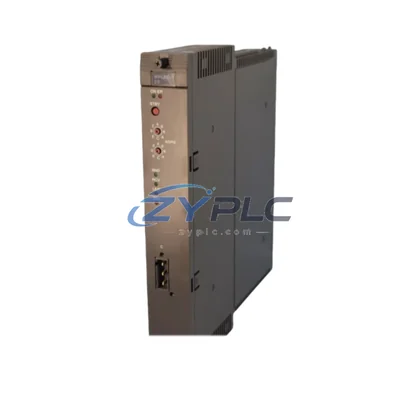
The Honeywell 2MLQ-TR4B is a 4-channel NPN transistor output module engineered for the Honeywell Micro PLC Series, delivering reliable digital signal output at the heart of modern industrial automation architectures. Designed to bridge field-level devices and upper-layer control systems, the 2MLQ-TR4B plays a critical role in the data flow chain — from signal acquisition at sensors and actuators, through PLC logic execution, to real-time monitoring on SCADA and HMI platforms. Whether deployed in discrete manufacturing, process control, or smart factory environments, this module ensures deterministic output switching, low-latency response, and seamless integration across multi-vendor industrial networks.
In today’s connected factory, every output module is a node in a larger communication architecture. The 2MLQ-TR4B interfaces directly with the Honeywell Micro PLC CPU unit, receiving processed commands and converting them into precise transistor switching signals that drive downstream actuators, solenoid valves, motor starters, and indicator systems. Its NPN open-collector output design is compatible with a wide range of industrial field devices, making it a versatile building block for both greenfield automation projects and legacy system upgrades.
Compatibility & Integration Notes
| Parameter |
Specification |
| SKU |
2MLQ-TR4B |
| Brand / Series |
Honeywell / Micro PLC Series |
| Module Type |
Transistor Output Module (NPN) |
| Output Channels |
4-Channel Digital Output |
| Output Type |
NPN Open-Collector Transistor |
| Protocol Support |
Compatible with Honeywell Micro PLC backplane communication; supports integration with Modbus RTU, RS-485, and OPC-UA via gateway modules |
| Interface Type |
Backplane I/O Bus Interface |
| Network Compatibility |
Honeywell Micro PLC rack systems; compatible with SCADA, DCS, and HMI integration via PLC CPU communication ports |
| System Application |
Discrete output control, actuator driving, smart factory automation, remote I/O expansion |
| Origin |
United States |
| Warranty |
warranty terms confirmed during quotation |
| Availability |
RFQ Available — export shipping options available |
Connected Automation Data Flow
Understanding the 2MLQ-TR4B’s role requires viewing it within the full industrial data chain. At the field level, sensors — including proximity switches, photoelectric detectors, and pressure transducers — feed real-time process data into the Honeywell Micro PLC CPU module. The CPU executes ladder logic or function block programs, then dispatches output commands through the backplane bus to the 2MLQ-TR4B, which switches its four NPN transistor channels to drive actuators, relays, or indicator lamps with millisecond-level precision.
For facilities requiring protocol conversion and upward data transmission, the Honeywell Micro PLC system can be paired with a Honeywell Micro PLC RS-485 Communication Module to enable Modbus RTU connectivity, allowing the PLC — and by extension the 2MLQ-TR4B’s output states — to be polled by SCADA systems such as Wonderware InTouch or Ignition. Where Ethernet-based supervision is required, an industrial Ethernet gateway module (e.g., a Modbus TCP/IP bridge) can be inserted between the PLC and the plant network, enabling OPC-UA data publishing to MES and ERP layers.
In multi-node architectures, the 2MLQ-TR4B-equipped Micro PLC rack may serve as a remote I/O station, communicating upstream to a master PLC — such as a Honeywell HC900 Hybrid Controller — via a fieldbus or industrial Ethernet segment. HMI panels, including Honeywell HMIWeb Display Builder-compatible touchscreens, visualize the real-time status of each output channel, providing operators with live feedback on actuator states, cycle counts, and fault conditions. Meanwhile, SCADA platforms aggregate output event logs for trend analysis, alarm management, and regulatory reporting.
Variable frequency drives (VFDs) connected to the 2MLQ-TR4B’s output channels receive start/stop and direction commands, enabling coordinated motor control across conveyor systems, pumping stations, and packaging lines. In safety-critical zones, the module’s output signals may also interface with safety relay modules or safety PLCs to enforce SIL-rated interlock logic, ensuring that machine states are always consistent with process safety requirements. Edge computing gateways — such as those running Ignition Edge or Kepware KEPServerEX — can subscribe to PLC data tags associated with the 2MLQ-TR4B’s channel states, enabling local analytics, predictive maintenance triggers, and cloud data forwarding without burdening the plant network.
Solving Data Isolation in Industrial Sites
One of the most persistent challenges in industrial automation is data isolation — the condition where field devices, PLCs, and supervisory systems operate in silos, unable to share real-time status information across protocol or network boundaries. The Honeywell 2MLQ-TR4B, as part of the Micro PLC ecosystem, directly addresses this challenge by serving as a standardized, protocol-agnostic output interface that can be integrated into virtually any industrial communication architecture.
In legacy facilities where older PLCs communicate over proprietary serial protocols, the 2MLQ-TR4B’s host Micro PLC can be equipped with a protocol conversion gateway — translating between Modbus RTU, PROFIBUS DP, DeviceNet, or EtherNet/IP — to bring previously isolated output data into a unified SCADA namespace. This eliminates the need for costly full-system replacements, allowing plant engineers to modernize incrementally while preserving existing field wiring and device investments.
For remote monitoring applications, the 2MLQ-TR4B’s output channel states can be published to cloud-based IoT platforms via MQTT or REST API bridges, enabling plant managers to monitor production line status from any location. Real-time alarm notifications — triggered by unexpected output state changes, such as a stuck actuator or a failed solenoid — can be routed to mobile devices or email systems, dramatically reducing mean time to repair (MTTR) and minimizing unplanned downtime.
Production line transparency is further enhanced by integrating the 2MLQ-TR4B’s data into OEE (Overall Equipment Effectiveness) dashboards, where output cycle counts and fault events contribute to availability, performance, and quality metrics. As production volumes grow, the Honeywell Micro PLC system’s modular architecture allows additional output modules — including analog output modules and high-speed counter modules — to be added to the same rack, scaling the control system without disrupting existing network configurations. All modules ship pre-tested and are covered by a warranty terms confirmed during quotation, ensuring confidence in every deployment.
Industrial Connectivity FAQ
Q1: What communication protocols does the Honeywell 2MLQ-TR4B support for SCADA integration?
The 2MLQ-TR4B is a transistor output module that communicates via the Honeywell Micro PLC backplane bus. SCADA integration is achieved through the host PLC’s communication ports, which support Modbus RTU (RS-485), and can be extended to Modbus TCP/IP or OPC-UA via gateway modules. This allows SCADA platforms such as Ignition, Wonderware, or iFIX to read and log output channel states in real time.
Q2: How does the 2MLQ-TR4B ensure network stability in high-noise industrial environments?
The module’s NPN transistor outputs are designed for industrial-grade noise immunity, with optocoupler isolation between the control logic and field-side circuits. This prevents ground loops and transient voltage spikes — common in environments with VFDs, welding equipment, or large motor loads — from corrupting PLC backplane communication or causing spurious output switching.
Q3: Can the Honeywell Micro PLC system with the 2MLQ-TR4B be expanded for larger automation projects?
Yes. The Honeywell Micro PLC platform supports modular rack expansion, allowing additional I/O modules — including digital input modules, analog I/O modules, and specialty communication modules — to be added as process requirements grow. The system’s backplane architecture ensures that all modules share a common communication bus, maintaining synchronized data exchange without additional network configuration.
Q4: What quality assurance and warranty coverage is provided with the 2MLQ-TR4B?
Every Honeywell 2MLQ-TR4B unit supplied by ZYPLC undergoes pre-shipment functional testing to verify output channel switching, backplane communication integrity, and electrical isolation performance. All units are covered by a warranty terms confirmed during quotation against manufacturing defects. Availability is confirmed via RFQ for export shipping options available, with full traceability documentation provided upon request.
—