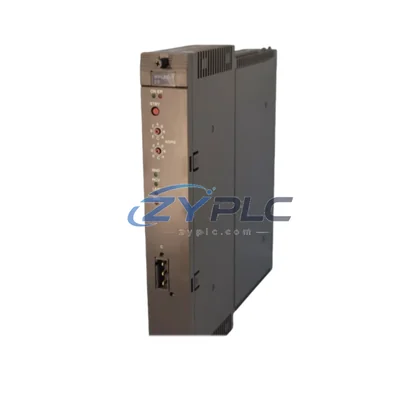
Honeywell TK-PRS021 Control Processor for TPS: Compatibility and Replacement Notes
The Honeywell TK-PRS021 is a high-performance control processor module engineered for deployment within the TotalPlant Solution (TPS) and TDC 3000 Distributed Control System (DCS) architecture. Rather than functioning as a standalone component, the TK-PRS021 occupies a critical position within a layered automation hierarchy — serving as the computational backbone that coordinates signal acquisition, logic execution, and real-time process regulation across the entire control system. Understanding its role requires examining how it interacts with every layer of the control architecture: from field-level I/O and power distribution, through network communication and redundancy design, up to the human-machine interface and supervisory control layers.
In modern industrial automation environments — spanning petrochemical refining, power generation, water treatment, metallurgical processing, and continuous manufacturing — the control processor is not merely a CPU card. It is the architectural anchor that determines system throughput, scan cycle consistency, fault tolerance, and long-term maintainability. The TK-PRS021 fulfills this role within the Honeywell TPS platform, providing deterministic control execution and seamless system integration with upstream and downstream system components.
Product Specification Table
| Parameter |
Specification |
| Part Number |
TK-PRS021 |
| Brand |
Honeywell |
| Series / Platform |
TPS (TotalPlant Solution) / TDC 3000 |
| Module Type |
DCS Control Processor Module |
| System Role |
Primary Control Execution Unit — Control Layer |
| Architecture Layer |
Control Layer (between I/O Layer and Network/Supervisory Layer) |
| Communication Capability |
Local Control Network (LCN), Universal Control Network (UCN) |
| Redundancy Support |
Hot-standby redundancy compatible (paired with redundant processor) |
| I/O Compatibility |
Compatible with TPS I/O Link modules and field termination assemblies |
| Power Requirements |
Supplied via TPS backplane power distribution (24 VDC regulated) |
| Installation Environment |
Rack-mounted, climate-controlled control room enclosure |
| Operating Temperature |
0°C to 60°C (standard industrial control room conditions) |
| system integration |
Full system integration with TPS historian, HMI, and engineering workstation |
| Origin |
United States |
| Warranty |
warranty terms confirmed during quotation — covered by ZYPLC quality assurance program |
| Availability |
Availability confirmed by RFQ, tested, ready for shipment arranged after confirmation |
System Compatibility Notes
The TK-PRS021 does not operate in isolation. Its value is fully realized only when it is correctly integrated within a complete TPS control node, where it coordinates with a precisely matched set of upstream and downstream components. At the power layer, the module relies on the TK-PSU001 or equivalent TPS power supply module to deliver stable, regulated DC power to the backplane. Power quality at this layer directly affects processor stability and scan cycle consistency — any ripple or transient at the power input can manifest as spurious faults or watchdog resets at the processor level.
At the I/O layer, the TK-PRS021 communicates with field signals through TPS I/O Link interface modules and associated field termination assemblies (FTAs), which provide the physical connection point for analog inputs, analog outputs, digital inputs, and digital outputs from field instruments and actuators. The processor’s ability to execute control algorithms at deterministic scan rates depends on the latency and integrity of this I/O link. Engineers deploying the TK-PRS021 must ensure that the I/O link loading does not exceed the processor’s rated capacity, particularly in high-density process control applications.
At the network layer, the TK-PRS021 connects to the Local Control Network (LCN) — Honeywell’s proprietary high-speed control network — through which it exchanges data with other control nodes, the History Module (HM), the Application Module (AM), and the Universal Station (US) HMI workstations. This network layer is the backbone of system-wide data consistency, enabling the TK-PRS021 to participate in coordinated control strategies that span multiple process units. In larger installations, the LCN may also interface with a Gateway module to bridge communication with Modbus, PROFIBUS, or OPC-based subsystems.
For redundancy-critical applications — such as those found in power plant boiler control, refinery distillation column regulation, or offshore platform safety systems — the TK-PRS021 is typically deployed in a hot-standby redundant pair, where a secondary processor module mirrors the primary’s execution state in real time. Switchover in the event of a primary processor fault occurs within milliseconds, ensuring process continuity without operator intervention. This redundancy architecture requires careful attention to backplane slot assignment, redundancy cable routing, and firmware version matching between the primary and standby units.
At the human-machine interface layer, operator visibility into the TK-PRS021’s control execution is provided through Honeywell Universal Stations or modern Experion PKS HMI consoles where migration has been performed. The processor’s real-time data — including loop status, alarm states, and control output values — is continuously streamed to the HMI layer via the LCN, enabling operators to monitor and intervene in process control without disrupting the underlying control execution. Engineering workstations running Honeywell Control Builder or legacy TPS Engineering Tools provide the configuration and diagnostic interface for the TK-PRS021, allowing engineers to modify control strategies, tune PID parameters, and perform online diagnostics without taking the processor offline.
Industrial Application Notes
The TK-PRS021 has established a proven track record across a wide range of industrial sectors where process reliability and control system longevity are paramount.
In petrochemical and refinery applications, the TK-PRS021 manages continuous regulatory control for distillation columns, heat exchangers, and reactor temperature loops. Its deterministic scan cycle ensures that cascade control strategies — where the output of one PID loop feeds the setpoint of another — execute with the timing precision required to maintain product quality and prevent runaway conditions. Plants operating legacy TPS systems in this sector frequently maintain strategic spare inventories of the TK-PRS021 to support rapid replacement during unplanned outages.
In power generation facilities, including coal-fired, gas turbine, and combined-cycle plants, the TK-PRS021 participates in boiler combustion control, turbine governor interfacing, and balance-of-plant automation. The module’s compatibility with the TPS redundancy architecture makes it suitable for safety-critical control loops where single-point failures cannot be tolerated. Maintenance teams in this sector value the module’s long-term availability and the ability to perform hot-swap replacement without full system shutdown.
In water and wastewater treatment facilities, the TK-PRS021 controls dosing systems, filtration sequences, and pump station automation. The relatively lower I/O density of these applications allows a single TK-PRS021 to manage multiple process areas, reducing overall system hardware costs while maintaining the reliability standards required for municipal water supply infrastructure.
In metallurgical and mining operations, the module supports continuous process control for smelting furnaces, ore processing conveyors, and flotation cell regulation. The harsh electromagnetic environment of these facilities places demands on the module’s noise immunity and grounding design — requirements that the TPS platform’s shielded backplane architecture is specifically designed to address.
In pharmaceutical and fine chemical manufacturing, where batch process control and regulatory compliance (FDA 21 CFR Part 11) are critical, the TK-PRS021’s integration with the TPS historian and audit trail functions supports the documentation requirements of validated production environments.
Product Compatibility FAQ
Q1: Is the TK-PRS021 compatible with both TPS and TDC 3000 system architectures, and can it be used in a mixed-generation control node?
The TK-PRS021 is designed for the TPS platform, which represents the evolutionary successor to the TDC 3000 architecture. In many installations, TPS and TDC 3000 components coexist within the same LCN network, and the TK-PRS021 can operate alongside legacy TDC 3000 modules provided that firmware versions and network configuration parameters are correctly aligned. Engineers undertaking mixed-generation deployments should verify backplane compatibility and LCN node address assignments prior to installation. ZYPLC’s technical team can assist with compatibility verification for specific site configurations.
Q2: What is the recommended procedure for replacing a failed TK-PRS021 in a live production environment, and how does the warranty terms confirmed during quotation apply to replacement units?
Replacement of a failed TK-PRS021 in a live system should follow Honeywell’s documented hot-swap procedure for TPS processor modules, which involves placing the redundant standby processor in control, physically removing the failed primary module, inserting the replacement unit, and allowing the system to synchronize the standby state to the new primary. All TK-PRS021 units supplied by ZYPLC are covered by a warranty terms confirmed during quotation from the date of shipment, which covers manufacturing defects and functional failures under normal operating conditions. Warranty claims are processed through ZYPLC’s quality assurance team, with replacement units dispatched within agreed lead times to minimize production impact.
Q3: How does the TK-PRS021 support long-term maintenance planning for aging TPS installations, and what is ZYPLC’s inventory commitment for this module?
As TPS systems age beyond their original design life, the availability of critical spare parts — particularly control processor modules — becomes a primary maintenance risk. ZYPLC maintains a dedicated inventory of tested and certified TK-PRS021 units to support customers operating legacy TPS installations where OEM supply channels have become unreliable or cost-prohibitive. Each unit undergoes functional testing prior to dispatch, and full traceability documentation is provided. ZYPLC’s system integration support service also assists customers in mapping the TK-PRS021’s role within their specific system architecture, ensuring that replacement units are correctly configured for their target control node before installation.