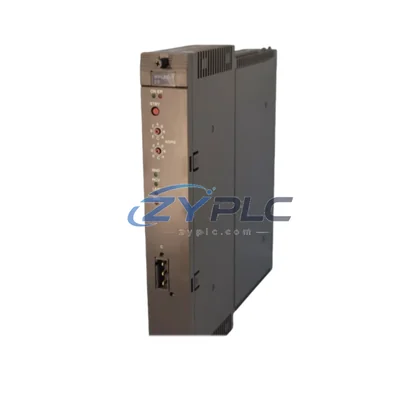
Invensys Triconex 3006 TMR CPU for Tricon Control System
The Invensys Triconex 3006 is a Triple Modular Redundancy (TMR) CPU module engineered for deployment within the Tricon safety instrumented system (SIS) platform. Rather than functioning as a standalone component, the 3006 CPU is the computational backbone of a fully integrated, fault-tolerant control architecture — one that spans the control layer, I/O layer, network layer, power layer, human-machine interface layer, and field execution layer simultaneously. Understanding its role within this layered system is essential for engineers designing high-availability automation solutions in safety-critical environments.
In a complete Tricon system architecture, the 3006 CPU module occupies the main chassis alongside redundant power supplies such as the Triconex 8312 or 8310 power supply modules, which deliver isolated, conditioned DC power to the backplane. The CPU communicates with distributed I/O modules — including digital input modules like the Triconex 3501 and 3503, digital output modules such as the 3601 and 3603, and analog I/O modules like the 3703E and 3805E — through the Tricon backplane bus, ensuring deterministic scan-cycle execution across all three redundant processing legs.
Product Specification Table
| Parameter |
Specification |
| System Role |
Triple Modular Redundancy (TMR) Central Processing Unit |
| Compatible Platform |
Invensys Triconex Tricon Safety System |
| Redundancy Architecture |
TMR — Three independent processing legs with voter logic |
| Backplane Compatibility |
Tricon main chassis backplane (7-slot and 15-slot) |
| Communication Capability |
TriStation 1131 programming interface; peer-to-peer TSAA protocol |
| Electrical Supply |
Powered via backplane from Triconex 8310/8312 power supply modules |
| Operating Temperature |
0°C to 60°C (32°F to 140°F) |
| Mounting |
Rack-mount, DIN-compatible Tricon main chassis |
| Certification Basis |
IEC 61508 SIL 3 capable safety architecture |
| Warranty |
warranty terms confirmed during quotation — Tested, inspected, and verified prior to shipment |
System Compatibility Notes
The Triconex 3006 CPU achieves its full operational value only when integrated within a coherent system architecture. At the power layer, the Triconex 8312 dual-input power supply module provides redundant AC/DC conversion, ensuring that a single power source failure does not interrupt CPU operation. The backplane distributes this conditioned power to all installed modules, including the 3006 CPU itself and any co-installed I/O modules.
At the I/O layer, the 3006 CPU manages signal acquisition from field instruments through modules such as the Triconex 3703E analog input module, which handles 4–20 mA process signals from pressure transmitters, flow meters, and temperature sensors. Digital field signals — emergency shutdown (ESD) pushbuttons, valve position feedback, and motor run status — are processed through the Triconex 3501 digital input module. Output commands to final control elements such as solenoid valves, motor starters, and shutdown actuators are issued through the Triconex 3601 digital output module, completing the field execution loop.
At the network and communications layer, the 3006 CPU interfaces with supervisory control and data acquisition (SCADA) systems and distributed control systems (DCS) via the Triconex Communication Module (TCM) or the Enhanced Intelligent Communication Module (EICM), supporting Modbus RTU, Modbus TCP/IP, and OPC DA protocols. This enables the Tricon system to exchange real-time process data with operator workstations running TriStation 1131 software, as well as with plant-wide historian servers and safety management systems.
For applications requiring expanded I/O capacity, the Triconex Remote Extender Module (RXM) allows the 3006 CPU to address remote I/O chassis located up to 300 meters from the main chassis, extending the system’s physical reach without compromising scan-cycle determinism or TMR integrity. This is particularly valuable in large-scale process plants where field junction boxes and marshalling panels are distributed across multiple equipment areas.
At the human-machine interface layer, operator stations running TriStation 1131 or third-party SCADA platforms connect to the Tricon network via Ethernet, providing real-time visibility into CPU health, I/O module diagnostics, and safety function status. The 3006 CPU continuously performs self-diagnostics across all three processing legs, flagging discrepancies between leg outputs and initiating voter arbitration to maintain safe output states — a capability that is transparent to the operator interface but critical to system integrity.
Industrial Application Notes
The Invensys Triconex 3006 TMR CPU is deployed across a wide range of safety-critical industries where process uptime and personnel protection are non-negotiable requirements.
In oil and gas processing and petrochemical plants, the 3006 CPU serves as the SIS controller for emergency shutdown (ESD) systems, high-integrity pressure protection systems (HIPPS), and fire and gas (F&G) detection systems. Its TMR architecture ensures that a single module failure — whether in the CPU, I/O, or power subsystem — does not result in a spurious trip or a failure to trip, both of which carry significant safety and production consequences.
In power generation and electrical utilities, the 3006 CPU is integrated into turbine protection systems, boiler management systems (BMS), and substation automation architectures. Its deterministic scan cycle and fault-tolerant design meet the stringent availability requirements of grid-connected generation assets, where unplanned shutdowns carry both financial and grid-stability penalties.
In water and wastewater treatment facilities, the Tricon system with the 3006 CPU manages chemical dosing interlocks, pump protection logic, and overflow prevention systems. The module’s ability to operate continuously in the presence of a single-point hardware fault makes it well-suited for unmanned or remotely monitored installations where maintenance response times may be extended.
In mining and metals processing, the 3006 CPU is applied in conveyor protection systems, crusher interlock logic, and ventilation safety systems in underground environments. Its wide operating temperature range and robust backplane design support reliable operation in environments with elevated vibration, dust, and humidity.
In pharmaceutical and fine chemical manufacturing, the 3006 CPU supports batch process safety interlocks and reactor protection systems, where IEC 61508 SIL 2 and SIL 3 compliance is mandated by process hazard analysis (PHA) and HAZOP studies.
Product Compatibility FAQ
Q1: Is the Triconex 3006 CPU compatible with both 7-slot and 15-slot Tricon main chassis configurations?
Yes. The 3006 CPU module is designed for installation in the Tricon main chassis and is compatible with both the 7-slot and 15-slot backplane configurations. When expanding system I/O capacity, additional I/O modules such as the Triconex 3703E or 3501 can be added to available chassis slots, and remote I/O expansion is achievable via the Triconex RXM without requiring a CPU upgrade. Always verify chassis revision compatibility with your system documentation before installation.
Q2: How does the 3006 CPU maintain system integrity during a single-module fault, and what is the maintenance procedure?
The TMR architecture of the 3006 CPU operates three independent processing legs simultaneously. If one leg produces an output that diverges from the other two, the voter logic isolates the faulting leg and continues safe operation on the remaining two legs — a 2-out-of-3 (2oo3) voting configuration. The faulting module can then be replaced online (hot-swap capable in most Tricon configurations) without interrupting the safety function. Replacement modules should be sourced from verified suppliers with documented testing records to ensure backplane and firmware compatibility. All replacement modules supplied by ZYPLC are covered under a warranty terms confirmed during quotation and are tested prior to shipment.
Q3: What long-term supply and obsolescence considerations apply to the Triconex 3006, and how should engineers plan for lifecycle management?
The Triconex 3006 is a mature platform module with an established installed base across global process industries. While Schneider Electric (successor to Invensys) continues to support the Tricon platform, engineers responsible for long-term asset management should maintain a strategic spare inventory of critical modules — including the 3006 CPU, power supply modules, and high-utilization I/O cards — to mitigate lead-time risk during unplanned failures. ZYPLC maintains availability confirmed by RFQ availability of the 3006 and related Tricon modules, with all units backed by a warranty terms confirmed during quotation, functional testing certification, and rapid global dispatch to minimize system downtime.