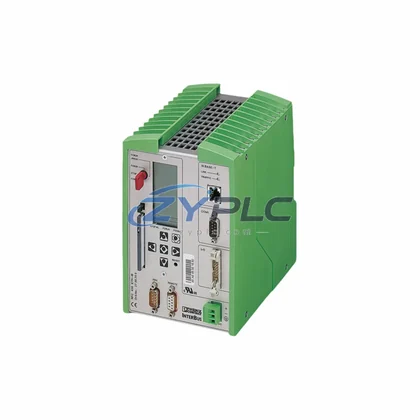
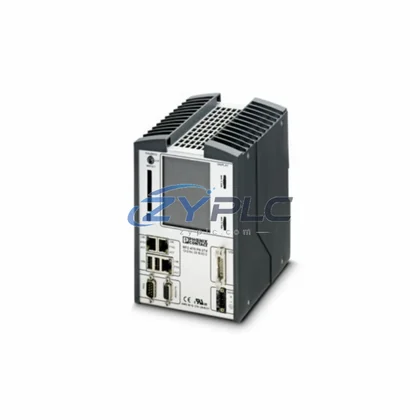
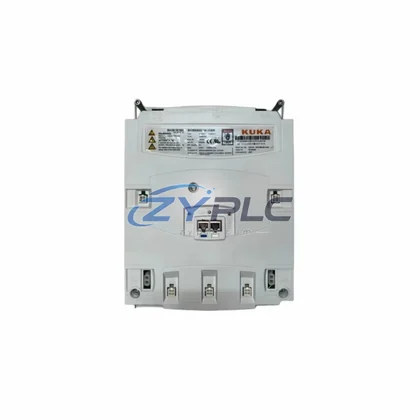
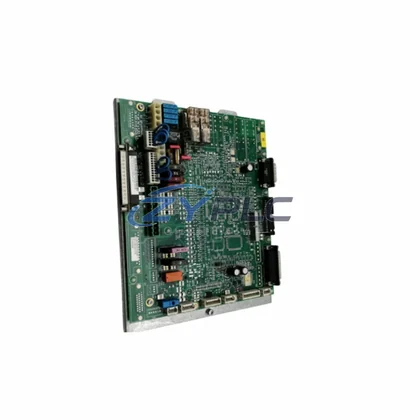
KUKA 00-291-556 Controller Module for KRC5
The KUKA 00-291-556 is a purpose-engineered controller module designed to operate at the core of the KRC5 robot controller platform. Within a fully integrated industrial automation architecture, this module serves as a critical bridge between the computational control layer and the physical execution layer — enabling deterministic signal processing, coordinated axis management, and seamless communication across the entire control hierarchy. Rather than functioning as a standalone component, the 00-291-556 is conceived as a system element: its value is fully realized only when deployed within a coherent KRC5-based control architecture where every layer — from the cabinet power supply to the teach pendant — operates in synchronized harmony.
In modern robotic automation, system architects must account for the interdependencies between the robot controller cabinet, the servo drive stack, the safety controller, the fieldbus gateway, and the higher-level PLC or SCADA layer. The KUKA 00-291-556 module is engineered to satisfy the demands of this multi-layer environment, providing stable, low-latency control signals that support both standard motion sequences and complex coordinated multi-axis operations. Its architecture is compatible with the KRC5 compact and standard cabinet variants, making it a versatile choice for system integrators working across automotive body-in-white lines, arc welding cells, material handling systems, and precision assembly stations.
Product Specification Table
| Parameter |
Specification |
| Part Number |
00-291-556 |
| Brand |
KUKA |
| Compatible Platform |
KRC5 Robot Controller (Standard & Compact) |
| System Role |
Controller Module — Control Layer Integration |
| Electrical Supply |
24 VDC (via KRC5 internal power distribution) |
| Communication Interface |
EtherCAT / PROFINET (KRC5 native bus architecture) |
| Installation Environment |
KRC5 controller cabinet, DIN-rail or backplane mount |
| Operating Temperature |
0°C to +45°C (cabinet ambient) |
| Ingress Protection |
IP20 (internal cabinet installation) |
| Country of Origin |
Germany |
| system integration |
Supported — compatible with KRC5 system bus and KUKA.WorkVisual configuration |
| Warranty |
warranty terms confirmed during quotation (ZYPLC) |
System Compatibility Notes
The 00-291-556 module does not operate in isolation. Its performance is intrinsically linked to the quality and compatibility of every adjacent component within the KRC5 controller cabinet and the broader automation cell. A well-engineered KRC5-based system typically integrates the following components alongside the 00-291-556:
The KRC5 Cabinet Power Supply Unit (PSU) provides the regulated 24 VDC rail that powers the controller module and its associated logic circuits. Voltage stability at this layer directly affects the determinism of the 00-291-556’s signal output. Paired with the KRC5 Safety Controller (KSC), the system achieves SIL 2 / PLd-compliant safe stop and safe speed monitoring — a mandatory requirement in collaborative and semi-collaborative robot deployments.
On the drive side, the KUKA KSD 48/10 Servo Drive and KSD 48/20 Servo Drive receive motion commands from the controller module via the internal EtherCAT bus, translating digital control signals into precise torque and velocity outputs at each robot joint. The synchronization between the 00-291-556 and the servo drive stack is what enables smooth, jerk-free multi-axis trajectories in high-speed pick-and-place or continuous-path welding applications.
At the human-machine interface layer, the KUKA smartPAD teach pendant connects to the KRC5 controller via a dedicated USB-based protocol, allowing operators to program, jog, and monitor the robot without interrupting the controller module’s real-time execution cycle. For remote monitoring and OPC-UA-based data acquisition, the KUKA.OfficeLite software environment and the KUKA Ethernet KRL communication package extend the 00-291-556’s connectivity to MES and SCADA systems.
In multi-robot or synchronized cell configurations, the KUKA.RoboTeam package enables the 00-291-556-equipped KRC5 controller to act as either master or slave within a coordinated motion group, sharing trajectory data across controllers via a high-speed Ethernet backbone. This architecture is particularly relevant in automotive spot welding lines where two or more robots must maintain precise spatial relationships throughout the weld cycle.
For I/O expansion, the KRC5 platform supports integration with PROFINET I/O devices and EtherCAT terminal modules (such as Beckhoff EK1100 coupler series), allowing the controller module to interface with distributed sensor arrays, pneumatic valve islands, and safety relay modules without requiring additional gateway hardware. This system integration capability ensures that the 00-291-556 can be deployed in both greenfield installations and brownfield upgrades with minimal rewiring.
Industrial Application Notes
The KUKA 00-291-556 controller module finds application across a broad spectrum of industrial sectors where robotic automation is deployed within layered control architectures:
Automotive Manufacturing: In body-in-white welding lines, the 00-291-556 manages the motion sequencing of spot welding robots operating in tight cycle times. Its deterministic EtherCAT communication ensures that gun closure, weld current trigger, and robot retract signals are synchronized to within microseconds, preventing weld quality deviations caused by timing jitter.
Arc Welding and Cutting: Integrated with KUKA’s arc welding technology packages, the controller module coordinates torch angle, travel speed, and wire feed rate across multi-pass weld programs. The module’s ability to maintain consistent path accuracy at varying speeds is critical for achieving certified weld quality in pressure vessel and structural steel fabrication.
Palletizing and Material Handling: In high-throughput logistics and packaging lines, the 00-291-556 enables smooth, high-speed palletizing cycles with dynamic payload adaptation. Its integration with conveyor tracking systems — via encoder input and fieldbus synchronization — allows the robot to pick moving targets without stopping the upstream production flow.
Electronics Assembly: In precision assembly stations for PCB handling, connector insertion, and optical inspection, the controller module’s fine motion control capabilities support sub-millimeter repeatability requirements. Combined with vision system integration via the KRC5’s Ethernet interface, the 00-291-556 enables adaptive assembly sequences that compensate for component placement tolerances in real time.
Process Industry and Hazardous Environments: In chemical, pharmaceutical, and food processing applications, the KRC5 platform — anchored by the 00-291-556 — supports hygienic design robots operating in washdown zones. The controller module’s sealed cabinet installation and compatibility with safety-rated I/O modules ensures compliance with industry-specific safety standards without compromising motion performance.
Product Compatibility FAQ
Q1: Is the KUKA 00-291-556 compatible with both KRC5 standard and KRC5 compact cabinet variants?
Yes. The 00-291-556 is designed for use within the KRC5 controller platform and is compatible with both the standard floor-standing cabinet and the compact wall-mount variant. System integrators should verify the specific cabinet configuration and backplane slot assignment using KUKA.WorkVisual during the project engineering phase to ensure correct module addressing and I/O mapping. If you are upgrading an existing KRC4-based cell to KRC5, note that the controller module architecture differs significantly and a full system migration plan is recommended.
Q2: How does the 00-291-556 support redundancy and long-term system availability in critical production environments?
The KRC5 architecture supports hot-standby configurations for selected system components, and the 00-291-556 is designed to facilitate rapid module replacement without requiring full system reconfiguration. ZYPLC supports RFQ sourcing for the 00-291-556 to support planned maintenance cycles and unplanned failure scenarios, backed by a warranty terms confirmed during quotation that covers manufacturing defects and functional failures under normal operating conditions. For mission-critical lines, we recommend maintaining at least one spare module on-site to minimize mean time to repair (MTTR) in the event of an unplanned outage.
Q3: What commissioning steps are required when installing the 00-291-556 as a replacement module in an existing KRC5 system?
Replacement of the 00-291-556 in an existing KRC5 installation typically involves: (1) backing up the current robot project and system configuration via KUKA.WorkVisual; (2) powering down the controller cabinet following the prescribed lockout/tagout procedure; (3) physically replacing the module and verifying connector seating and torque specifications; (4) restoring the project configuration and performing a cold start; (5) executing a full axis mastering verification and safety function test before returning the cell to production. ZYPLC’s technical support team is available to assist with commissioning guidance for customers who have purchased the module under our warranty terms confirmed during quotation program.