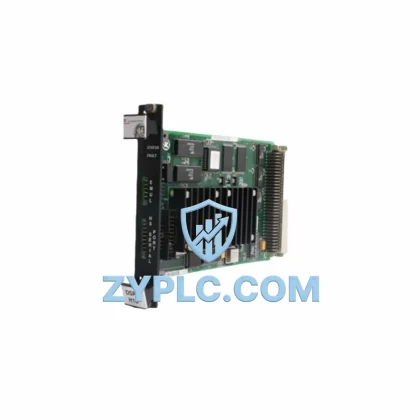
Matrox SOL2MEVCLB Frame Grabber for Solios
The Matrox SOL2MEVCLB is a dual-channel Camera Link frame grabber engineered for deployment within the Solios series architecture — a platform purpose-built for high-throughput machine vision integration in demanding industrial environments. Rather than functioning as a standalone image acquisition device, the SOL2MEVCLB is designed to operate as a coordinated node within a layered automation system, bridging the gap between the camera layer and the control layer with deterministic data throughput, low-latency signal processing, and seamless system integration into existing PLC and DCS architectures.
In modern industrial automation, the frame grabber occupies a critical position in the signal flow hierarchy. It sits between the physical imaging sensors and the software-defined processing environment, ensuring that raw pixel data is captured, buffered, and transferred to the host system with zero frame loss. The SOL2MEVCLB fulfills this role with precision, supporting full Camera Link Base, Medium, and Extended configurations, enabling engineers to select the appropriate bandwidth profile for each application without redesigning the surrounding architecture.
System architects integrating the SOL2MEVCLB into a broader control platform will find that its PCIe interface aligns naturally with industrial server and embedded computing platforms commonly used alongside Siemens SIMATIC S7-1500 CPUs, Rockwell Automation ControlLogix L8x controllers, and Mitsubishi MELSEC iQ-R series PLCs. The frame grabber’s deterministic acquisition cycle supports synchronization with external trigger signals sourced from these controllers, enabling pixel-accurate inspection timing that is coordinated with conveyor encoders, servo drives, and pneumatic actuators at the execution layer.
At the I/O layer, the SOL2MEVCLB interfaces with Camera Link-compliant industrial cameras through its dual MDR-26 connectors, supporting pixel clock rates up to 85 MHz per channel. This bandwidth envelope accommodates high-resolution line scan cameras used in web inspection, as well as area scan cameras deployed in component verification and surface defect detection. The dual-channel architecture allows engineers to consolidate two independent camera feeds onto a single PCIe slot, reducing backplane congestion and simplifying cable management within the control cabinet.
Network layer integration is achieved through the host system’s Ethernet or PROFINET interface, where acquired image data and inspection results are forwarded to SCADA platforms, MES systems, or cloud-based analytics engines. The SOL2MEVCLB operates transparently within this data pipeline, ensuring that vision results are available to upstream control logic within the cycle time constraints of the overall automation system. When paired with Matrox Imaging Library (MIL) software, engineers gain access to a comprehensive set of image processing tools — including blob analysis, pattern matching, OCR, and barcode reading — that can be embedded directly into the control workflow without requiring a separate vision controller.
From a power and installation perspective, the SOL2MEVCLB draws power exclusively from the PCIe slot, eliminating the need for auxiliary power connectors and simplifying integration into compact industrial PCs and embedded computing platforms. Its operating temperature range and vibration tolerance are consistent with the environmental requirements of industrial control cabinets, making it suitable for deployment in manufacturing cells, power distribution substations, petrochemical processing units, and water treatment facilities.
Long-term maintainability is a core design consideration for the SOL2MEVCLB. Its compatibility with the Matrox Solios driver ecosystem ensures that firmware updates, diagnostic utilities, and replacement units can be sourced and deployed without disrupting the surrounding control architecture. Engineers responsible for multi-site installations benefit from the consistent hardware interface and software API across the Solios product family, reducing the training burden and enabling standardized maintenance procedures across facilities.
All SOL2MEVCLB units supplied by ZYPLC are covered by a 12-Month Warranty, with stock available for immediate dispatch to support both planned system builds and emergency replacement scenarios.
Product Specification Table
| Parameter |
Specification |
| System Role |
Dual-Channel Camera Link Frame Grabber — Solios Series |
| SKU |
SOL2MEVCLB |
| Brand |
Matrox Imaging |
| Series |
Solios |
| Camera Link Configuration |
Base / Medium / Extended (per channel) |
| Number of Channels |
2 (independent) |
| Pixel Clock Rate |
Up to 85 MHz per channel |
| Host Interface |
PCI Express (PCIe) x4 |
| Camera Connector |
MDR-26 (Camera Link standard) |
| Power Supply |
PCIe slot-powered (no auxiliary connector required) |
| Operating Temperature |
0°C to 55°C (industrial cabinet rated) |
| Communication Capability |
Camera Link serial (CLSerial), trigger I/O, encoder input |
| Software Compatibility |
Matrox Imaging Library (MIL), DirectShow, TWAIN |
| OS Support |
Windows 10/11, Windows Server, Linux (64-bit) |
| Warranty |
12-Month Warranty (ZYPLC) |
| Origin |
Canada |
System Compatibility Notes
The SOL2MEVCLB achieves its full performance potential when deployed as part of a coordinated control system rather than as an isolated acquisition device. In a typical machine vision cell integrated into a discrete manufacturing line, the frame grabber operates in close coordination with a Siemens SIMATIC S7-1500 CPU, which manages the overall production sequence and issues hardware trigger signals to the SOL2MEVCLB via a digital output module such as the Siemens ET 200SP DI/DO interface. The trigger pulse is synchronized with a Heidenhain or Sick encoder mounted on the conveyor drive, ensuring that image acquisition occurs at a precise product position regardless of line speed variation.
At the camera layer, the SOL2MEVCLB connects to industrial Camera Link cameras — such as the Basler racer line scan series or the Teledyne DALSA Linea family — through its dual MDR-26 ports. The dual-channel capability allows two cameras to be operated simultaneously from a single frame grabber, reducing the number of PCIe slots consumed in the host industrial PC and simplifying the overall cabinet layout. Camera power is supplied through a separate 12V or 24V rail from the cabinet power supply, typically a Phoenix Contact QUINT or Siemens SITOP PSU series unit, ensuring that camera operation is isolated from the frame grabber’s PCIe power domain.
The host industrial PC — commonly a Beckhoff C6920 or Siemens IPC477E — runs the Matrox Imaging Library (MIL) application, which processes acquired frames and generates pass/fail decisions within the inspection cycle time. Results are forwarded to the PLC via a PROFINET or EtherNet/IP interface, where they are consumed by the control logic to actuate rejection mechanisms, diverters, or alarm outputs through the I/O layer. In redundant system designs, a secondary frame grabber and camera set can be configured in hot-standby mode, with switchover managed by the host application to maintain inspection continuity during hardware servicing.
For HMI integration, inspection statistics, defect images, and system health data are published to a Siemens SIMATIC HMI TP1500 or a web-based SCADA dashboard via OPC UA, providing operators with real-time visibility into vision system performance without requiring direct access to the frame grabber host. This layered architecture — from camera through frame grabber, host PC, PLC, and HMI — ensures that the SOL2MEVCLB contributes to system-wide consistency, traceability, and maintainability across the full production lifecycle.
Industrial Application Notes
The Matrox SOL2MEVCLB is deployed across a broad range of industrial sectors where high-speed image acquisition and deterministic control integration are essential. In automotive body panel manufacturing, the frame grabber supports multi-camera surface inspection cells that operate at line speeds exceeding 30 meters per minute, detecting paint defects, weld seam irregularities, and dimensional deviations with sub-millimeter resolution. The dual-channel architecture allows simultaneous top and bottom surface inspection from a single host PC, reducing the hardware footprint of the vision system within the production cell.
In pharmaceutical packaging lines, the SOL2MEVCLB is integrated into serialization and label verification systems where regulatory compliance requires 100% inspection of every unit. The frame grabber’s deterministic trigger response ensures that no unit passes through the inspection zone without being imaged, and its compatibility with GigE Vision and Camera Link cameras allows engineers to select the optimal sensor for each inspection task without changing the acquisition hardware.
Power generation and electrical substation applications leverage the SOL2MEVCLB for thermal imaging and partial discharge detection, where cameras are mounted on robotic inspection platforms that traverse switchgear rooms and transformer bays. The frame grabber’s PCIe interface provides the bandwidth required to stream high-resolution thermal images from FLIR or Optris cameras to the host analysis system, with results logged to the plant historian via OPC DA/UA.
In water treatment and desalination facilities, the SOL2MEVCLB supports membrane integrity inspection and filter media analysis systems, where cameras are deployed in harsh environments with high humidity and chemical exposure. The frame grabber’s industrial temperature rating and robust driver ecosystem ensure reliable operation across extended maintenance intervals, reducing the total cost of ownership for vision systems in these demanding applications.
Mining and mineral processing operations use the SOL2MEVCLB in ore sorting and conveyor monitoring systems, where high-speed line scan cameras capture images of material streams at throughput rates that exceed the capabilities of USB or GigE-based acquisition systems. The Camera Link interface’s deterministic data transfer eliminates the latency variability associated with network-based acquisition, ensuring that sorting decisions are made within the tight timing windows required by pneumatic ejector systems.
Product Compatibility FAQ
Q1: Is the SOL2MEVCLB compatible with both Base and Medium Camera Link camera configurations, and can different configurations be used on each channel simultaneously?
A1: Yes. The SOL2MEVCLB supports Camera Link Base, Medium, and Extended configurations independently on each of its two channels. This means engineers can connect a Base configuration camera on Channel 1 and a Medium configuration camera on Channel 2 simultaneously, without any performance penalty on either channel. Configuration is managed through the Matrox Imaging Library (MIL) driver, which automatically negotiates the appropriate pixel clock and data width settings for each connected camera. This flexibility is particularly valuable in multi-inspection systems where different camera types are required for different measurement tasks within the same control cell.
Q2: How does the SOL2MEVCLB integrate with PLC-based trigger architectures, and what is the minimum trigger pulse width supported?
A2: The SOL2MEVCLB accepts external hardware trigger signals through its auxiliary I/O connector, which is compatible with 5V TTL and 24V industrial logic levels when used with an appropriate signal conditioning interface. The minimum trigger pulse width is typically 1 microsecond, which is well within the output timing capabilities of standard PLC digital output modules from Siemens, Rockwell, Mitsubishi, and Omron. Trigger latency from input signal edge to acquisition start is deterministic and consistent across frames, making the SOL2MEVCLB suitable for high-speed applications where trigger jitter would result in positional errors in the acquired image. Engineers should ensure that the PLC output module selected for trigger generation has a specified output delay of less than 500 microseconds to maintain synchronization accuracy at line speeds above 1 meter per second.
Q3: What does the 12-Month Warranty cover, and what is the replacement process for units that fail during system operation?
A3: The 12-Month Warranty provided by ZYPLC covers manufacturing defects, component failures, and performance deviations from the published specification under normal operating conditions. In the event of a warranty claim, ZYPLC’s technical team will assess the failure mode and, where confirmed as a warranty-covered defect, dispatch a replacement unit from stock to minimize system downtime. Engineers are advised to maintain a spare SOL2MEVCLB in their site inventory for critical inspection applications where downtime has a direct impact on production output. ZYPLC maintains stock of the SOL2MEVCLB and related Solios series components to support both planned system builds and emergency replacement requirements. For warranty claims or technical support, contact ZYPLC at plc.sales@zyplc.com or +86 19859288691.
© 2026 ZYPLC. All rights reserved.
Original Source: https://zyplc.com
Contact: +86 19859288691 | plc.sales@zyplc.com