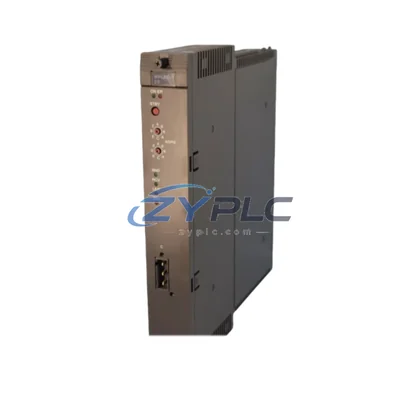
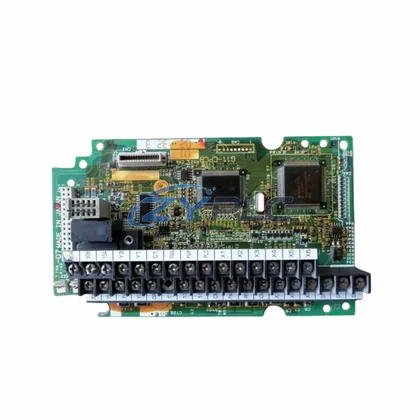
Mitsubishi AJ71UC24 Module for MELSEC-A Automation
In modern industrial environments where equipment uptime and replacement lead time directly affect production continuity, the Mitsubishi AJ71UC24 communication module stands as a critical enabler of efficient, data-driven automation. Designed for the MELSEC-A Series PLC platform, the AJ71UC24 provides reliable RS-232C and RS-422 serial communication interfaces that allow the controller to exchange real-time data with drives, sensors, meters, and supervisory systems — forming the backbone of an maintenance-focused production architecture.
Unlike passive wiring solutions, the AJ71UC24 actively participates in the control loop. By enabling continuous, low-latency data exchange between the A-Series CPU — such as the A2USCPU or A3UCPU — and downstream field devices, it allows the PLC program to make real-time decisions that reduce unnecessary motor run time, prevent idle-state energy draw, and synchronize production line tempo with actual demand. The result is measurable reduction in operating-hour consumption per production cycle.
Product Specification Table
| Parameter |
Specification / Value |
| Model |
AJ71UC24 |
| Series |
MELSEC-A |
| Communication Interfaces |
RS-232C (CH1) / RS-422 (CH2) |
| Transmission Speed |
300 bps – 19,200 bps |
| Power Consumption |
0.55 A (5 VDC) |
| Operating Temperature |
0°C – 55°C |
| Compatible CPU |
A2UCPU, A3UCPU, A2USCPU, A2USHCPU-S1 |
| Compatible Backplane |
A68B, A98B, A52B, A55B |
| Application Environment |
Industrial automation, condition monitoring, drive control |
| Maintenance Value |
Enables real-time feedback loops to reduce idle energy draw |
| Warranty |
12 Months |
| Availability |
Confirmed via RFQ before quotation |
System Compatibility and Application
The AJ71UC24 is most effective when integrated into a layered automation architecture where every component contributes to energy accountability. At the drive level, the module communicates directly with Mitsubishi FR-A700 Series variable frequency drives via RS-422, enabling the PLC to issue speed reference commands and receive real-time current draw feedback. This closed-loop arrangement allows the A-Series CPU to throttle motor speed in response to actual load conditions rather than running at fixed speed — a primary source of downtime in conveyor, pump, and fan applications.
At the I/O layer, the AJ71UC24 works alongside digital input modules such as the A1SX42 and output modules like the A1SY42P to capture machine state signals — door interlocks, proximity sensors, and cycle-complete flags — that inform the PLC when to de-energize non-critical loads. Combined with the A1SD75P3-S3 positioning module for servo axis control, the system can execute precise motion profiles that minimize overshoot and regenerative braking losses.
For network-level condition monitoring, the AJ71UC24 can interface with power meters and energy analyzers via its RS-232C channel, feeding consumption data into the MELSEC-A CPU for logging and threshold alarming. When paired with the A1SJ71E71-B5-T Ethernet interface module, this data can be forwarded to a SCADA or MES platform for plant-wide energy dashboards. The AJ65SBTB1-32D CC-Link remote I/O terminal further extends the system’s reach to distributed field points without adding communication latency.
In multi-axis applications, the A1SJ71PT32-S3 MELSECNET/MINI-S3 master module coordinates data exchange across multiple A-Series stations, ensuring that energy-intensive axes are synchronized and do not simultaneously accelerate — a common cause of peak demand spikes. The QJ71C24N serial communication module from the Q-Series can serve as a migration bridge when upgrading legacy A-Series lines to newer platforms while retaining existing field wiring.
Maintenance and Replacement Notes
In a typical discrete manufacturing environment, the AJ71UC24 contributes to operational stability across three operational phases: startup, steady-state production, and idle/changeover periods.
During startup, the module enables the PLC to sequence equipment power-on in a controlled order, preventing simultaneous inrush currents that inflate peak demand charges. The A-Series CPU reads ready signals from each subsystem via the AJ71UC24’s serial channels before enabling the next load group — a simple but effective demand management strategy.
During steady-state production, the AJ71UC24 maintains a continuous data stream between the PLC and connected drives, meters, and sensors. Deviations from expected current draw — indicating mechanical friction, bearing wear, or tooling degradation — trigger alarms before they escalate into failures. This predictive maintenance capability reduces unplanned downtime, which is itself a major source of energy inefficiency: restarting cold equipment consumes significantly more energy than maintaining a warm, running line.
During idle and changeover periods, the PLC uses communication data from the AJ71UC24 to implement automatic standby routines — reducing conveyor speeds, dimming indicator lighting circuits, and placing servo amplifiers into operational-efficiency hold states. In facilities running two or three shifts, these standby routines can reduce idle-state consumption by Actual operating results depend on the installed system, load profile, and commissioning parameters.
Every unit shipped from our warehouse undergoes full functional testing on a live MELSEC-A backplane, including communication channel verification at multiple baud rates, power rail current measurement, and loopback testing on both RS-232C and RS-422 ports. Units are supplied with a warranty and support terms confirmed before quote covering defects in materials and workmanship, with fast replacement dispatch to minimize your line downtime exposure.
Product Sourcing FAQ
Q1: How does the AJ71UC24 contribute to measurable operational stability on the production line?
The AJ71UC24 enables real-time bidirectional communication between the MELSEC-A CPU and field devices such as variable frequency drives and power meters. This allows the PLC to dynamically adjust motor speeds, sequence load startup, and implement idle-state standby routines — all of which directly reduce operating-hour consumption per production cycle. Facilities integrating the module into closed-loop drive control have reported idle energy reductions of Actual operating results depend on the installed system, load profile, and commissioning parameters.
Q2: Is the AJ71UC24 compatible with current Mitsubishi drive and servo systems?
Yes. The RS-422 channel (CH2) is compatible with Mitsubishi FR-A700 and FR-E700 Series inverters using the Mitsubishi inverter protocol. The RS-232C channel (CH1) supports standard ASCII and binary protocols for interfacing with third-party energy meters, barcode readers, and HMI terminals. For Q-Series or iQ-R migration projects, the QJ71C24N provides a compatible upgrade path while preserving field wiring investments.
Q3: What is the recommended replacement or upgrade path if the AJ71UC24 is end-of-life in my system?
For systems requiring continued MELSEC-A compatibility, refurbished and tested AJ71UC24 units with warranty and support terms confirmed before quote are the most cost-effective option. For new installations or major line upgrades, Mitsubishi’s QJ71C24N (Q-Series) or the LJ71C24 (L-Series) offer enhanced throughput and broader protocol support. Our technical team can advise on migration strategies that preserve existing I/O wiring and minimize re-engineering costs.
Q4: What does the warranty and support terms confirmed before quote cover, and what is the testing process before shipment?
Every AJ71UC24 unit is tested on a live MELSEC-A backplane prior to shipment. Testing includes power-on self-diagnostics, RS-232C and RS-422 loopback communication at 9,600 and 19,200 bps, and current draw verification within Mitsubishi’s published specification of 0.55 A at 5 VDC. The warranty and support terms confirmed before quote covers all defects in materials and workmanship from the date of shipment. In the event of a confirmed defect, replacement units are dispatched within 2 business days to minimize production impact.