Mitsubishi FX2-40AW Industrial Network Interface for FX2 Systems: Bridging Field Devices and Smart Factory Data Flows
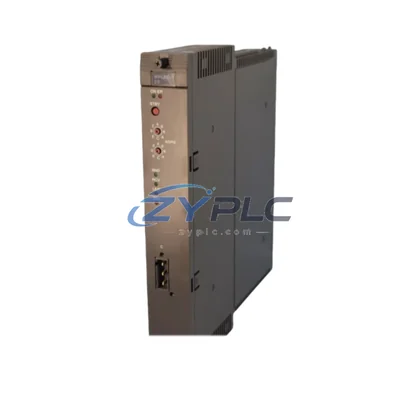
The Mitsubishi FX2-40AW is a 40-point I/O PLC base unit engineered for the FX2 Series platform, delivering reliable industrial network communication across complex automation environments. With AC power input and relay output architecture, this unit serves as a critical data link node between field-level sensors, actuators, and upper-level control systems — enabling seamless signal acquisition, protocol conversion, and real-time data transmission across the production floor.
In modern smart factory deployments, the FX2-40AW functions as the backbone of a layered communication architecture. From the moment a proximity sensor or thermocouple transmits a process signal, the FX2-40AW captures, processes, and routes that data upward through RS-232C and RS-485 serial communication channels to SCADA platforms, HMI terminals, and MES systems. This uninterrupted data chain eliminates information silos and gives plant engineers full visibility into machine states, cycle times, alarm conditions, and energy consumption — all in real time.
Compatibility & Integration Notes
| Parameter |
Specification |
| SKU |
FX2-40AW |
| Series |
Mitsubishi FX2 Series |
| I/O Points |
40 (24 Inputs / 16 Outputs) |
| Power Supply |
AC 100–240V |
| Output Type |
Relay Output |
| Communication Protocols |
RS-232C, RS-485, Mitsubishi Programming Protocol |
| Network Compatibility |
CC-Link (via expansion), MELSEC-NET compatible |
| HMI / SCADA Integration |
GOT Series HMI, SCADA via serial gateway |
| Programming Interface |
GX Developer, GX Works2 |
| System Application |
Machine Control, Remote I/O, Process Automation, Smart Factory |
| Warranty |
12 Months |
| Origin |
Japan |
Connected Automation Data Flow
The FX2-40AW sits at the intersection of field instrumentation and supervisory control, making it indispensable in multi-tier industrial network architectures. In a typical deployment, discrete signals from inductive sensors and photoelectric detectors feed directly into the FX2-40AW’s 24 digital inputs. Simultaneously, analog expansion modules — such as the FX2N-2AD or FX2N-4AD — extend the unit’s sensing capability to temperature, pressure, and flow measurements, all processed within the same FX2 Series control loop.
On the output side, the relay-based 16-point output section drives contactors, solenoid valves, and motor starters, while the RS-485 port connects to variable frequency drives such as the Mitsubishi FR-E740 inverter series. This direct drive-to-controller communication allows the FX2-40AW to issue speed reference commands and read back operational feedback — torque, frequency, fault codes — without any intermediate gateway hardware.
For HMI integration, the FX2-40AW communicates natively with Mitsubishi GOT2000 Series touchscreen panels via the dedicated programming port or RS-232C channel. Operators gain live access to process variables, alarm histories, and trend data directly on the shop floor. When plant-wide visibility is required, a serial-to-Ethernet gateway — such as the Mitsubishi QJ71C24N communication module — bridges the FX2-40AW’s serial data stream into the Ethernet backbone, making process data available to SCADA servers and MES platforms running on the corporate network.
In distributed control architectures, the FX2-40AW can serve as a local master or slave node within a CC-Link network, coordinating data exchange with remote I/O stations, intelligent device stations, and other MELSEC controllers including the FX2N-48MR and FX2N-64MR. This peer-to-peer and master-slave topology supports deterministic, low-latency communication across production cells — a prerequisite for synchronized multi-axis motion and coordinated process control.
Edge computing integration is also achievable: by connecting the FX2-40AW’s serial port to an industrial edge gateway, raw PLC data can be pre-processed locally and forwarded to cloud-based analytics platforms or digital twin environments. This positions the FX2-40AW not merely as a legacy controller, but as a viable node in IIoT-enabled smart factory ecosystems alongside newer MELSEC iQ-R Series controllers.
Solving Data Isolation in Industrial Sites
One of the most persistent challenges in industrial automation is protocol fragmentation — legacy equipment speaking proprietary serial protocols that cannot communicate directly with modern Ethernet-based SCADA or MES systems. The FX2-40AW addresses this through its flexible serial communication ports, which support both RS-232C and RS-485 interfaces. Using Mitsubishi’s dedicated communication protocol or the MODBUS RTU-compatible instruction set available through FX2N expansion boards, the FX2-40AW can act as a protocol bridge, translating field-device data into formats readable by upper-level systems.
Data isolation at the machine level is further eliminated through structured network segmentation. By deploying the FX2-40AW as a subnet controller within a larger MELSEC-NET or CC-Link hierarchy, plant engineers can aggregate data from multiple production lines into a single supervisory layer — enabling production transparency, OEE calculation, and predictive maintenance analytics without replacing existing field hardware.
Remote diagnostics capability is built into the FX2-40AW’s communication architecture. Via the RS-232C programming port and a connected modem or serial-to-Ethernet converter, maintenance engineers can remotely access the PLC’s program, monitor register values, and diagnose fault conditions without physical presence on the factory floor. This reduces mean time to repair (MTTR) and supports 24/7 operational continuity in unmanned or lights-out manufacturing environments.
System scalability is ensured through the FX2 Series expansion bus. The FX2-40AW supports connection of up to eight expansion modules — including analog I/O, high-speed counter, positioning, and communication boards — allowing the control system to grow alongside production requirements without a full platform migration. This modularity protects capital investment while enabling incremental smart factory upgrades.
Every FX2-40AW unit supplied by ZYPLC undergoes pre-shipment functional testing, verifying I/O operation, communication port integrity, and program execution before dispatch. All units are backed by a warranty terms confirmed during quotation and supported by RFQ-confirmed sourcing for rapid global fulfillment.
Industrial Connectivity FAQ
Q1: What communication protocols does the FX2-40AW support, and can it connect to modern SCADA systems?
The FX2-40AW supports RS-232C and RS-485 serial communication using Mitsubishi’s dedicated protocol. It can connect to SCADA systems via serial-to-Ethernet gateways or communication modules such as the QJ71C24N, enabling full integration with supervisory platforms including GENESIS64, Wonderware, and iFIX without replacing the base controller.
Q2: How does the FX2-40AW perform in terms of network latency and communication stability?
The FX2-40AW delivers deterministic scan-cycle performance with typical cycle times in the 1–10ms range depending on program size and I/O load. RS-485 multi-drop networks support up to 32 nodes at distances up to 500 meters, with built-in error detection ensuring communication integrity in electrically noisy industrial environments.
Q3: Can the FX2-40AW be expanded to support additional I/O or communication protocols?
Yes. The FX2 Series expansion bus supports up to eight additional modules, including FX2N-4AD analog input, FX2N-2DA analog output, FX2N-232-BD RS-232C board, and FX2N-485-BD RS-485 board. CC-Link connectivity is achievable via the FX2N-16CCL-M master module, enabling integration into plant-wide CC-Link networks alongside other MELSEC controllers.
Q4: What quality assurance and warranty coverage does ZYPLC provide for the FX2-40AW?
All FX2-40AW units supplied by ZYPLC are sourced from verified supply channels and undergo pre-shipment functional testing covering I/O verification, communication port checks, and operational validation. Each unit is covered by a warranty terms confirmed during quotation from the date of shipment, with technical support available for installation, commissioning, and network integration queries.