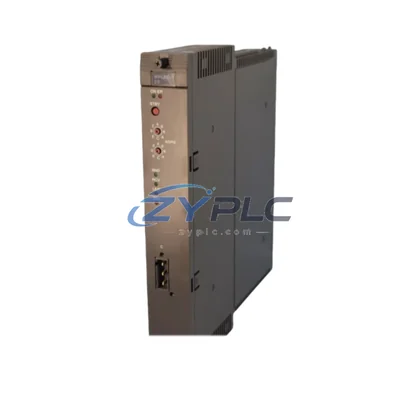
MKS MC20A-30190 Mass Flow Controller for 900 Series
In a fully integrated industrial automation or semiconductor process control system, every component must perform a defined role within a layered architecture. The MKS MC20A-30190 Mass Flow Controller is engineered to fulfill that role at the gas flow regulation layer, delivering precise, repeatable volumetric flow control that underpins process consistency across the entire control hierarchy. Rather than functioning as a standalone instrument, the MC20A-30190 is designed for system integration — operating in coordination with upstream pressure regulators, downstream process chambers, supervisory PLCs, and distributed I/O networks to maintain system-wide stability and traceability.
The MC20A-30190 belongs to MKS Instruments’ MC20A series, a platform recognized in semiconductor fabrication, chemical vapor deposition (CVD), etching, and industrial gas blending applications for its thermal mass flow sensing accuracy and fast response dynamics. Within the MKS 900 Series system architecture, this controller interfaces directly with MKS 900 Series signal conditioners and readout/control units, enabling analog or digital setpoint commands to be issued from a central process controller or SCADA system. This tight integration between the flow controller and the 900 Series readout platform eliminates signal conversion losses and ensures that flow data is accurately reflected at the supervisory layer without latency or calibration drift.
From a system architecture perspective, the MC20A-30190 occupies the field instrument layer, sitting between the process gas supply infrastructure and the reaction or treatment chamber. It receives setpoint commands from the control layer — typically a PLC such as an Allen-Bradley ControlLogix or Siemens S7-300 series controller — via analog 0–5 VDC or 4–20 mA signals, or through RS-485 digital communication depending on system configuration. The flow controller’s output signal is fed back to the I/O module layer, where it is processed by analog input cards and logged by the historian or DCS for real-time process monitoring and post-process analysis.
System engineers integrating the MC20A-30190 into a multi-zone gas delivery panel will find that its compact form factor and standard face-seal fittings allow it to be mounted alongside complementary MKS components such as the MKS 1179A general-purpose mass flow controller, MKS 640 pressure controller, and MKS PR4000B multi-channel readout and control unit. In multi-gas blending architectures, several MC20A-30190 units may operate in parallel, each controlling a distinct process gas, with their outputs coordinated by a ratio control algorithm running on the supervisory PLC. This parallel deployment model demands that each flow controller maintain consistent calibration and response characteristics — a requirement the MC20A-30190 meets through its thermally isolated sensor design and factory-calibrated flow curves.
At the network and communication layer, the 900 Series architecture supports integration with Ethernet-based SCADA platforms through gateway modules such as the MKS 937B multi-sensor system or third-party Modbus TCP/IP gateways. This allows the MC20A-30190’s real-time flow data to be aggregated alongside pressure, temperature, and valve position data from other field instruments, providing operators with a unified process view at the HMI layer. Compatible HMI platforms — including Siemens SIMATIC TP series panels and Rockwell PanelView terminals — can display flow trends, alarm states, and setpoint deviations in real time, enabling rapid operator response to process excursions.
For redundancy-critical applications such as semiconductor fab gas delivery or pharmaceutical batch processing, the MC20A-30190 can be deployed in a redundant flow path configuration, where a secondary flow controller of the same model is held in standby and automatically activated upon detection of a primary controller fault. This architecture requires coordination with the control layer’s fault detection logic and appropriate valve sequencing to ensure bumpless transfer. The provided with every MC20A-30190 unit supports long-term maintenance planning, reducing downtime risk and simplifying spare parts inventory management for maintenance engineers.
Installation and commissioning of the MC20A-30190 within a 900 Series architecture follows standard MKS procedures: the controller is mounted in the gas panel, connected to the 900 Series readout unit via the appropriate cable assembly, and zeroed under no-flow conditions before setpoint calibration is performed. Engineers should verify that the gas type, full-scale flow range, and inlet pressure conditions match the factory calibration parameters. For systems requiring re-calibration or gas conversion, MKS Instruments provides calibration services and conversion factors for common process gases including N₂, Ar, O₂, H₂, and specialty gases used in CVD and etch processes.
Product Specification Table
| Parameter |
Specification |
| System Role |
Field-level gas flow regulation within 900 Series control architecture |
| Full-Scale Flow Range |
30 SCCM (N₂ equivalent, per MC20A-30190 calibration) |
| Control Signal Input |
0–5 VDC / 4–20 mA analog; RS-485 digital (model dependent) |
| Output Signal |
0–5 VDC / 4–20 mA analog flow feedback |
| Accuracy |
±1% of full scale (typical) |
| Response Time |
<2 seconds to 98% of setpoint |
| Gas Compatibility |
N₂, Ar, O₂, H₂, and specialty process gases (with conversion) |
| Inlet Pressure |
Up to 100 PSIG (typical operating range) |
| Communication |
Analog 0–5 VDC / 4–20 mA; RS-485 (900 Series compatible) |
| Fitting Type |
Standard face-seal (VCR/VCO compatible) |
| Operating Temperature |
15–45°C ambient |
| Power Supply |
±15 VDC (via 900 Series readout or external supply) |
| Enclosure / Installation |
Panel or gas stick mount; compact inline form factor |
| Warranty |
— covers manufacturing defects and calibration integrity |
System Compatibility Notes
The MC20A-30190 achieves its highest value when deployed as part of a coordinated, multi-component control system. In a typical semiconductor process gas delivery architecture, the following components work in concert with the MC20A-30190:
- MKS 900 Series Readout/Control Unit — provides setpoint command, flow display, and analog I/O interface for the MC20A-30190, forming the direct control link between the supervisory PLC and the flow controller.
- MKS 1179A Mass Flow Controller — a complementary general-purpose MFC deployed in parallel gas lines within the same gas panel, sharing the 900 Series readout infrastructure.
- MKS 640 Pressure Controller — maintains upstream or downstream pressure stability, ensuring that the MC20A-30190 operates within its calibrated inlet pressure range for accurate flow delivery.
- MKS PR4000B Multi-Channel Readout — aggregates flow data from multiple MC20A-30190 units and other MKS instruments, providing a centralized display and control interface for multi-gas blending systems.
- MKS 937B Multi-Sensor System — integrates pressure and flow data from the gas delivery panel into a unified network interface, enabling Modbus or DeviceNet communication to the plant SCADA system.
- Pneumatic Shut-Off Valves (e.g., MKS 99 Series) — installed upstream and downstream of the MC20A-30190 to isolate gas lines during maintenance, purge cycles, or emergency shutdowns, coordinated by the PLC’s digital output modules.
- Analog Input Modules (e.g., Allen-Bradley 1756-IF16 or Siemens SM 331) — receive the 4–20 mA flow feedback signal from the MC20A-30190 and pass it to the PLC for closed-loop process control and historian logging.
- Supervisory PLC (e.g., Allen-Bradley ControlLogix L7x or Siemens S7-300) — executes the ratio control or recipe-based setpoint logic that commands the MC20A-30190 and coordinates gas delivery across all process zones.
- HMI Terminal (e.g., Siemens SIMATIC TP1200 or Rockwell PanelView Plus 7) — displays real-time flow trends, alarm states, and setpoint values sourced from the MC20A-30190 via the PLC, enabling operator oversight at the human-machine interface layer.
- DIN Rail Power Supply (e.g., Phoenix Contact QUINT series) — provides stable ±15 VDC to the MC20A-30190 and associated 900 Series readout units, ensuring clean power delivery that prevents signal noise and calibration drift.
Industrial Application Notes
The MKS MC20A-30190 is deployed across a broad range of process industries where precise gas flow control is critical to product quality and process repeatability. In semiconductor fabrication, it regulates precursor gas flows in CVD and ALD reactors, where flow accuracy directly determines thin film thickness uniformity and device yield. In flat panel display manufacturing, it controls etch gas delivery in plasma etch chambers, coordinating with pressure controllers and RF power systems to maintain stable plasma conditions.
In industrial gas blending applications — such as specialty gas production for calibration standards or medical gas mixtures — the MC20A-30190 operates as part of a multi-channel blending manifold, where each channel’s flow is independently controlled and verified against gravimetric or chromatographic references. In chemical process plants and petrochemical facilities, it is used in reactor feed gas control systems, where it interfaces with DCS platforms via analog I/O to maintain stoichiometric feed ratios under varying load conditions.
For research and laboratory automation environments, the MC20A-30190’s compact form factor and 900 Series compatibility make it suitable for benchtop gas delivery systems, where it can be controlled via PC-based software through the 900 Series USB or RS-232 interface. In all these applications, the and available factory recalibration service ensure that the instrument maintains its specified accuracy over its operational lifetime, supporting both production continuity and regulatory compliance requirements.
Product Compatibility FAQ
Q1: Is the MKS MC20A-30190 compatible with third-party PLC systems outside the MKS 900 Series ecosystem?
Yes. The MC20A-30190 outputs a standard 0–5 VDC or 4–20 mA analog signal that is compatible with any PLC analog input module accepting these signal ranges, including Allen-Bradley, Siemens, Mitsubishi, and Omron platforms. The MKS 900 Series readout unit is required for direct digital communication and display, but analog integration with third-party controllers is fully supported without additional hardware beyond standard signal wiring.
Q2: Can multiple MC20A-30190 units be operated simultaneously in a multi-gas blending architecture, and how is setpoint coordination managed?
Yes. Multiple MC20A-30190 units can be deployed in parallel within a single gas delivery panel, each connected to a dedicated channel on the MKS PR4000B or 900 Series multi-channel readout. Setpoint coordination is managed at the PLC level through ratio control or recipe-based logic, where the supervisory controller issues independent setpoints to each flow controller based on the target gas mixture composition. The analog feedback signals from each unit are monitored by the PLC’s analog input modules to verify actual flow against setpoint in real time.
Q3: What does the cover, and what maintenance actions are recommended to preserve calibration accuracy over the warranty period?
The covers manufacturing defects and calibration integrity under normal operating conditions. To preserve calibration accuracy, it is recommended to operate the MC20A-30190 within its specified inlet pressure and temperature ranges, perform periodic zero-flow verification (zeroing under no-flow conditions), and avoid exposure to corrosive or condensing gases outside the instrument’s specified gas compatibility list. If recalibration is required within the warranty period due to drift beyond specification, MKS Instruments’ calibration service can restore the instrument to factory accuracy. Maintaining a documented calibration log supports both warranty claims and regulatory audit requirements.