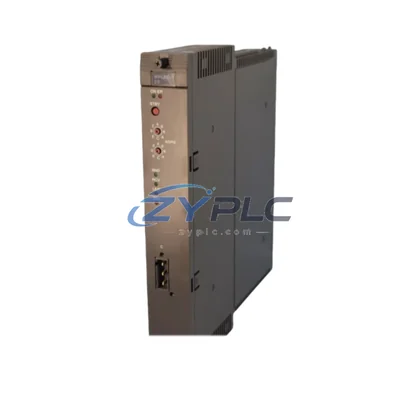
Omron CP1E-N40SDR-A PLC CPU Unit for CP1E
In modern industrial automation, a programmable logic controller is never an isolated device — it is the cognitive core of a layered control architecture that spans field-level sensing, I/O signal conditioning, network communication, power distribution, human-machine interaction, and final actuator execution. The Omron CP1E-N40SDR-A is engineered precisely for this role: a compact yet capable CPU unit that anchors the CP1E series control platform and enables consistent, scalable, and maintainable automation across a wide range of industrial environments.
The CP1E-N40SDR-A provides 40 built-in I/O points (24 DC inputs, 16 relay outputs) powered by an AC supply, making it immediately deployable in mixed-signal control panels where both digital sensing and relay-driven output switching are required. Its onboard USB port supports direct programming and monitoring via Omron CX-Programmer, while its serial communication port enables integration with peripheral devices, operator panels, and upstream supervisory systems. Within the CP1E architecture, this CPU unit is designed to coordinate seamlessly with expansion I/O modules, communication adapters, and analog signal processors — forming a coherent, unified control layer.
Product Specification Table
| Parameter |
Specification |
| System Role |
CPU Unit — Control Layer Master |
| Model |
CP1E-N40SDR-A |
| Brand / Series |
Omron / CP1E |
| Built-in I/O Points |
40 (24 Inputs DC, 16 Relay Outputs) |
| Power Supply |
AC 100–240 V |
| Output Type |
Relay |
| Program Capacity |
8K Steps |
| Data Memory |
8K Words |
| Communication Ports |
USB (peripheral), RS-232C (serial) |
| Expansion Capability |
Up to 3 expansion units |
| Operating Temperature |
0–55°C |
| Protection Rating |
IP20 (panel-mount) |
| Certification |
CE, UL |
| Warranty |
warranty terms confirmed during quotation |
System Compatibility Notes
The CP1E-N40SDR-A does not operate in isolation. Its value is fully realized when it is deployed as the central processing node within a coordinated CP1E-series control system. At the I/O expansion layer, modules such as the CP1W-20EDT1 (20-point transistor expansion unit) extend the CPU’s digital I/O capacity, enabling control of additional field devices without requiring a larger CPU chassis. For analog signal acquisition and output, the CP1W-AD041 (4-channel analog input) and CP1W-DA041 (4-channel analog output) modules integrate directly into the CP1E backplane, allowing the CPU to process continuous process variables such as temperature, pressure, and flow rate alongside its discrete I/O operations.
At the communication layer, the CP1W-CIF01 RS-232C adapter and CP1W-CIF11 RS-422A/485 adapter extend the CPU’s serial communication capability, enabling Modbus RTU master/slave configurations, host link connections, and multi-drop serial networks that connect the CP1E-N40SDR-A to variable frequency drives, smart sensors, and remote I/O terminals. For temperature-critical applications, the CP1W-TS002 thermocouple input unit and CP1W-MAD11 mixed analog I/O module provide direct sensor interfacing without external signal converters, reducing wiring complexity and improving signal fidelity.
At the power layer, the CJ1W-PA202 power supply unit — commonly used in adjacent CJ-series racks within the same control cabinet — provides stable 5 VDC bus power for I/O modules, ensuring that voltage fluctuations on the AC supply line do not propagate into the control logic layer. For larger CP1E deployments requiring a second CPU node or a redundant processing path, the CP1E-N60SDR-A (60-point relay output CPU) can be installed in a parallel panel section, sharing the same programming environment and tag database while handling a separate I/O domain.
At the human-machine interface layer, the NS5-SQ10-V2 touchscreen HMI connects to the CP1E-N40SDR-A via the RS-232C port, providing operators with real-time process visualization, alarm management, and parameter adjustment without requiring a separate SCADA workstation. This tight CPU-to-HMI integration, supported by Omron’s CX-Designer and NV-Designer toolchains, reduces commissioning time and ensures that display logic remains synchronized with the underlying control program throughout the system lifecycle.
Industrial Application Notes
The CP1E-N40SDR-A is well-suited for a broad range of industrial automation applications where compact form factor, relay output reliability, and serial communication flexibility are primary engineering requirements. In discrete manufacturing environments — such as assembly lines, conveyor systems, and packaging machinery — the CPU’s relay outputs provide robust switching for solenoid valves, motor contactors, and indicator lamps, while its high-speed counters support encoder-based position tracking and production counting.
In building automation and HVAC control applications, the CP1E-N40SDR-A manages fan coil units, chiller sequencing, and damper actuators through its relay outputs, while analog expansion modules monitor temperature and humidity sensors across multiple zones. The CPU’s Modbus RTU capability allows it to communicate with energy meters and building management systems, enabling centralized monitoring without replacing existing serial infrastructure.
In water treatment and pump station applications, the CP1E-N40SDR-A controls submersible pump contactors, level switch inputs, and chemical dosing relays within a compact panel footprint. Its AC power supply eliminates the need for a separate 24 VDC power rail for the CPU itself, simplifying panel design in remote installations where power quality may be variable. The warranty terms confirmed during quotation provides procurement teams with a defined support horizon, supporting lifecycle cost planning for infrastructure projects with multi-year operational commitments.
In food and beverage processing lines, the relay output architecture ensures galvanic isolation between the control circuit and high-current actuator loads, reducing the risk of electrical noise coupling back into the CPU’s input circuits. Combined with the CP1W-TS002 thermocouple module, the system can monitor oven temperatures, pasteurization stages, and cooling tunnel conditions within a single unified control program.
Product Compatibility FAQ
Q1: Can the CP1E-N40SDR-A be expanded with analog I/O modules, and how many expansion units are supported?
The CP1E-N40SDR-A supports up to 3 expansion units connected via the right-side expansion bus. Compatible analog modules include the CP1W-AD041 (4-channel analog input), CP1W-DA041 (4-channel analog output), and CP1W-MAD11 (mixed analog I/O). Each expansion unit occupies one slot, so a fully expanded system can combine digital I/O expansion, analog input, and analog output within the same CPU rack — without requiring an external I/O bus or communication gateway.
Q2: What communication protocols does the CP1E-N40SDR-A support, and how does it integrate with existing serial networks?
The CPU’s built-in RS-232C port supports Omron Host Link (FINS), Modbus RTU master/slave, and NT Link (for HMI connection). With the CP1W-CIF11 RS-422A/485 adapter installed, the system supports multi-drop Modbus RTU networks with up to 32 nodes, enabling integration with variable frequency drives, smart transmitters, and third-party serial devices without an external protocol converter. This system integration capability allows the CP1E-N40SDR-A to participate in existing serial architectures while maintaining a unified programming environment.
Q3: What does the warranty terms confirmed during quotation cover, and how does it support long-term system maintenance planning?
The warranty terms confirmed during quotation covers manufacturing defects, component failures, and functional non-conformance under normal operating conditions. For system integrators and end users, this warranty period aligns with typical commissioning and stabilization phases of industrial automation projects, ensuring that any latent hardware issues are addressed within the warranty window. ZYPLC maintains RFQ-confirmed sourcing of the CP1E-N40SDR-A and compatible expansion modules, enabling rapid replacement dispatch to minimize unplanned downtime during the warranty period and beyond.