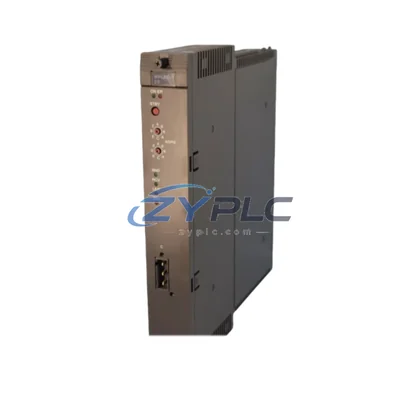
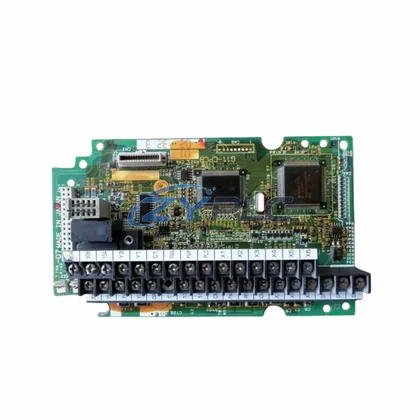
Omron TPM1A-40CDR-A Industrial Network Interface for Sysmac Systems
The Omron TPM1A-40CDR-A is a compact yet powerful programmable logic controller engineered for industrial network communication and smart factory integration. As a core node in the Sysmac automation architecture, this 40 I/O relay-output PLC bridges field-level devices and upper-level control systems through robust serial communication, enabling seamless data flow across every layer of the industrial network. Whether deployed in discrete manufacturing, process control, or building automation, the TPM1A-40CDR-A delivers the connectivity, reliability, and protocol flexibility that modern industrial sites demand.
Compatibility & Integration Notes
| Parameter |
Specification |
| Communication Protocol |
Modbus RTU, Host Link (SYSMAC WAY), RS-232C Serial |
| Interface Type |
RS-232C Port (D-Sub 9-pin), Peripheral Port |
| Transmission Capability |
Up to 115,200 bps serial; cyclic and event-driven data exchange |
| Network Compatibility |
Modbus RTU networks, OMRON Host Link networks, PC-based SCADA via serial gateway |
| System Application |
PLC-to-HMI, PLC-to-SCADA, PLC-to-Drive, Remote I/O expansion, Protocol conversion gateway |
| I/O Points |
24 Inputs / 16 Outputs (Relay) |
| Power Supply |
100–240 VAC |
| Origin |
Japan |
| Warranty |
warranty terms confirmed during quotation — Tested before shipment |
Connected Automation Data Flow
In a typical smart factory deployment, the TPM1A-40CDR-A sits at the heart of the field control layer, collecting discrete signals from proximity sensors, photoelectric sensors, and limit switches wired to its 24 digital inputs. These signals are processed by the Sysmac ladder logic engine and transmitted upstream via the RS-232C port to supervisory systems. When paired with an Omron CJ1W-SCU41-V1 serial communications unit installed in a CJ-series rack, the network can be extended to support simultaneous multi-port serial communication, enabling the TPM1A-40CDR-A to exchange data with multiple Modbus RTU slave devices on the same production line.
For HMI visualization, the TPM1A-40CDR-A communicates natively with the Omron NS8-TV01B-V2 touchscreen HMI over the Host Link protocol, delivering real-time process variables, alarm states, and production counters directly to the operator interface. In facilities where a more compact panel solution is preferred, the Omron NB7W-TW01B HMI panel serves as an equally capable visualization endpoint, supporting the same Host Link serial connection without additional protocol conversion hardware.
For upper-level SCADA integration, the TPM1A-40CDR-A’s Modbus RTU capability allows it to act as a Modbus slave device, feeding data to SCADA gateways or edge computing nodes. In architectures where EtherNet/IP connectivity is required at the controller level, engineers often deploy the Omron CJ1W-EIP21 EtherNet/IP unit alongside a CJ2M-CPU31 or CJ2M-CPU33 as the network master, with the TPM1A-40CDR-A handling local field I/O and forwarding aggregated data via serial link. This hybrid topology is common in phased smart factory upgrades where legacy serial infrastructure must coexist with modern Ethernet-based control networks.
Variable-speed drives and servo systems on the same production line — such as Omron 3G3MX2 series inverters — can be integrated into the Modbus RTU network managed by the TPM1A-40CDR-A, enabling closed-loop speed control, fault monitoring, and remote parameter adjustment from the SCADA layer. Power quality and supply stability for the entire control panel are typically ensured by the Omron S8VK-G series DIN-rail power supply, which provides regulated 24 VDC to the PLC, I/O modules, and communication interfaces throughout the network node.
For applications requiring expanded I/O capacity beyond the base 40 points, the TPM1A-40CDR-A supports connection of CPM1A-series expansion I/O units, allowing the local I/O count to scale with process requirements while maintaining a single network node address. This modular expansion capability is essential in assembly line control, conveyor management, and packaging automation where I/O demand grows incrementally.
Solving Data Isolation in Industrial Sites
One of the most persistent challenges in industrial automation is data isolation — the condition where field devices, PLCs, drives, and upper-level systems operate on incompatible protocols, preventing unified visibility and control. The Omron TPM1A-40CDR-A directly addresses this challenge through its dual-protocol serial architecture, supporting both Modbus RTU and OMRON Host Link (SYSMAC WAY) on the same physical RS-232C port, selectable via software configuration.
In facilities where legacy equipment communicates over proprietary serial protocols, the TPM1A-40CDR-A can be configured as a protocol conversion gateway, translating field-device data into Modbus RTU frames readable by modern SCADA platforms and industrial IoT gateways. This eliminates the need for dedicated protocol converters and reduces panel wiring complexity. Production line transparency is achieved by mapping all critical process variables — motor run states, sensor trip counts, cycle times, fault codes — into the PLC’s data memory and exposing them to the SCADA layer via cyclic polling or event-triggered reporting.
Remote diagnostics are supported through the peripheral port, which accepts the Omron CX-Programmer USB-to-peripheral cable, enabling engineers to connect a laptop directly to the PLC for online monitoring, program upload/download, and forced I/O testing without interrupting production. For sites with distributed control architecture, the serial network topology allows multiple TPM1A-40CDR-A units to be addressed as individual Modbus slaves under a single SCADA master, creating a scalable, low-cost remote monitoring infrastructure across geographically dispersed production cells.
System expansion is straightforward: the CPM1A expansion bus allows additional digital and analog I/O modules to be added as process requirements evolve, while the Host Link network supports up to 32 PLC nodes on a single RS-422/485 multi-drop link when used with an appropriate RS-232C-to-RS-485 converter. Every unit shipped by ZYPLC undergoes functional power-on testing and communication verification before dispatch, ensuring that the TPM1A-40CDR-A arrives ready for immediate integration into your control network.
Industrial Connectivity FAQ
Q1: What is the communication latency of the TPM1A-40CDR-A over Modbus RTU?
At 9,600 bps with standard Modbus RTU framing, typical response latency for a single register read is under 20 ms. At 38,400 bps or higher, latency drops to under 5 ms for most register transactions, making the TPM1A-40CDR-A suitable for real-time monitoring applications where sub-100 ms update cycles are required.
Q2: Is the TPM1A-40CDR-A compatible with third-party SCADA systems such as Wonderware, Ignition, or Siemens WinCC?
Yes. Any SCADA platform with a Modbus RTU or OPC-DA/OPC-UA driver can communicate with the TPM1A-40CDR-A via a serial-to-Ethernet gateway. Inductive Automation Ignition, for example, supports Modbus RTU natively through its built-in driver, enabling direct tag mapping from the PLC’s data registers to SCADA historian and alarm management systems.
Q3: Can the TPM1A-40CDR-A be integrated into an EtherNet/IP or PROFINET network?
The TPM1A-40CDR-A does not natively support EtherNet/IP or PROFINET. For Ethernet-based network integration, a serial-to-Ethernet gateway (such as the Moxa NPort series or equivalent) is used to bridge the RS-232C port to the Ethernet backbone, where the PLC appears as a Modbus TCP slave device accessible to EtherNet/IP or PROFINET masters via protocol conversion.
Q4: What warranty and pre-shipment testing does ZYPLC provide for the TPM1A-40CDR-A?
Every TPM1A-40CDR-A supplied by ZYPLC carries a warranty terms confirmed during quotation covering hardware defects and communication failures. Prior to shipment, each unit undergoes power-on functional testing, I/O point verification, and serial communication port validation. Units are shipped via DHL or FedEx with full tracking, and replacement or repair support is available throughout the warranty period.