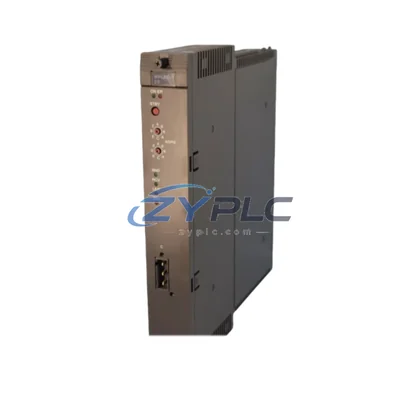
Pleiger PPC-IPC-S2 Controller for PPC-IPC
The Pleiger PPC-IPC-S2 is a high-performance PC-based controller purpose-built for integration within the PPC-IPC distributed control architecture. Designed to serve as the central processing node in layered automation systems, the PPC-IPC-S2 bridges the gap between supervisory control, real-time I/O processing, and fieldbus communication — delivering deterministic performance across complex industrial environments.
Within a typical PPC-IPC system rack, the PPC-IPC-S2 operates as the primary control CPU, coordinating signal acquisition from remote and local I/O modules, managing communication with upstream SCADA or DCS platforms, and executing logic sequences that govern process timing, interlocking, and safety response. Its architecture supports seamless expansion through backplane-connected modules, enabling engineers to scale processing capacity and I/O density without redesigning the control cabinet layout.
Product Specification Table
| Parameter |
Specification |
| System Role |
Primary PC-Based Control CPU |
| Brand |
Pleiger |
| Series |
PPC-IPC |
| Model |
PPC-IPC-S2 |
| Controller Type |
PC-Based / Embedded IPC |
| Communication Protocols |
PROFIBUS DP, PROFINET, Modbus TCP/RTU, Ethernet/IP |
| Backplane Interface |
Proprietary PPC-IPC System Bus |
| I/O Expansion |
Modular via PPC-IPC Backplane |
| Operating Environment |
-10°C to +55°C, DIN Rail / 19″ Rack Mount |
| Power Supply |
24 VDC Nominal |
| Protection Rating |
IP20 |
| Origin |
Germany |
| Warranty |
warranty terms confirmed during quotation |
System Compatibility Notes
The PPC-IPC-S2 is engineered to function as the computational backbone of a fully coordinated Pleiger control system. In a standard PPC-IPC rack configuration, the controller communicates directly with the PPC-IPC-S1 compact processing unit for redundant failover scenarios, ensuring uninterrupted process execution during primary CPU maintenance or fault conditions. Power delivery to the controller and its associated modules is managed through the PPC-IPC-PS24 power supply unit, which provides regulated 24 VDC with built-in overvoltage and short-circuit protection to maintain stable operation across all rack-mounted components.
For distributed signal acquisition, the PPC-IPC-S2 interfaces with the PPC-IPC-DI16 digital input module and the PPC-IPC-DO16 digital output module, enabling high-density discrete control across field devices such as solenoid valves, motor contactors, and limit switches. Analog process variables — including temperature, pressure, and flow — are captured through the PPC-IPC-AI8 analog input module, which supports 4–20 mA and 0–10 V signal ranges with 16-bit resolution for precise measurement accuracy.
Network-level coordination is achieved through the PPC-IPC-GW gateway module, which translates between PROFIBUS DP segments and Ethernet-based supervisory networks. This gateway enables the PPC-IPC-S2 to exchange process data with third-party PLCs, remote terminal units, and enterprise-level MES or ERP systems without protocol conversion bottlenecks. For installations requiring operator interaction at the machine level, the PPC-IPC-HMI7 seven-inch touchscreen panel provides local visualization of process states, alarm management, and parameter adjustment — reducing dependency on centralized control room access during commissioning and routine maintenance.
The PPC-IPC-BP8 eight-slot backplane serves as the physical interconnection framework for all rack-mounted modules, distributing power and data signals across the system bus with minimal latency. When additional relay-driven outputs are required for motor starting or heater control circuits, the PPC-IPC-RO8 relay output module provides eight channels of dry-contact switching rated for resistive and inductive loads up to 250 VAC.
Together, these components — the PPC-IPC-S1, PPC-IPC-PS24, PPC-IPC-DI16, PPC-IPC-DO16, PPC-IPC-AI8, PPC-IPC-GW, PPC-IPC-HMI7, PPC-IPC-BP8, and PPC-IPC-RO8 — form a cohesive, scalable control platform that addresses the full spectrum of industrial automation requirements from simple machine control to complex multi-loop process regulation.
Industrial Application Notes
The Pleiger PPC-IPC-S2 finds its strongest application in layered automation architectures where deterministic control, high-speed data throughput, and modular scalability are non-negotiable requirements. In manufacturing environments — particularly automotive assembly, pharmaceutical batch processing, and food and beverage packaging lines — the PPC-IPC-S2 manages recipe execution, motion sequencing, and quality inspection logic with cycle times that meet the demands of high-throughput production.
In power generation and distribution facilities, the controller coordinates turbine governor control, generator synchronization, and load shedding algorithms, interfacing with protective relays and circuit breaker controllers through hardwired discrete I/O and serial communication links. Water and wastewater treatment plants leverage the PPC-IPC-S2 for pump station control, chemical dosing regulation, and telemetry data aggregation across geographically distributed lift stations and reservoir sites.
Petrochemical and refining operations benefit from the controller’s ability to manage safety instrumented functions in coordination with dedicated SIS controllers, providing an additional layer of process monitoring that complements certified safety systems. In mining and metallurgical processing, the PPC-IPC-S2 handles conveyor sequencing, crusher control, and ore blending optimization — applications where environmental extremes and electrical noise demand robust hardware design and reliable communication pathways.
Across all these sectors, the PPC-IPC-S2 delivers consistent performance backed by Pleiger’s engineering heritage in precision industrial control. Every unit shipped from our facility undergoes functional verification and is covered by a comprehensive warranty terms confirmed during quotation, ensuring that your investment in control infrastructure is protected from day one. Our inventory management system maintains ready stock of PPC-IPC series components to minimize lead times and support urgent replacement requirements for critical production systems.
Product Compatibility FAQ
Q1: Is the PPC-IPC-S2 compatible with existing PPC-IPC series backplanes and I/O modules?
A1: Yes. The PPC-IPC-S2 is fully compatible with all current PPC-IPC series backplanes including the PPC-IPC-BP8. It communicates with all PPC-IPC I/O modules through the system bus, supporting hot-swap capability for select module types. system integration with existing rack configurations requires no additional hardware adapters or firmware modifications.
Q2: What redundancy options are available for the PPC-IPC-S2 in critical process applications?
A2: The PPC-IPC-S2 supports CPU redundancy when paired with a secondary PPC-IPC-S1 unit configured in hot-standby mode. Automatic failover is managed through the system bus with bumpless transfer of control outputs. Power redundancy is achieved by installing dual PPC-IPC-PS24 power supplies with diode-ORing modules. This architecture ensures continuous operation during single-point hardware failures, meeting the availability requirements of 24/7 process industries.
Q3: How does the warranty terms confirmed during quotation apply to the PPC-IPC-S2, and what support is available during commissioning?
A3: Every PPC-IPC-S2 controller ships with a warranty terms confirmed during quotation covering manufacturing defects and component failure under normal operating conditions. Our technical support team provides remote commissioning assistance including system configuration review, communication parameter verification, and I/O mapping validation. Extended warranty and on-site engineering support packages are available upon request for large-scale deployment projects.