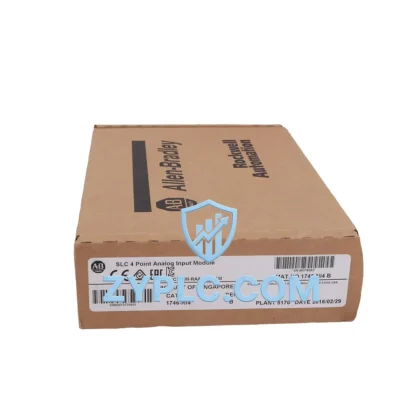
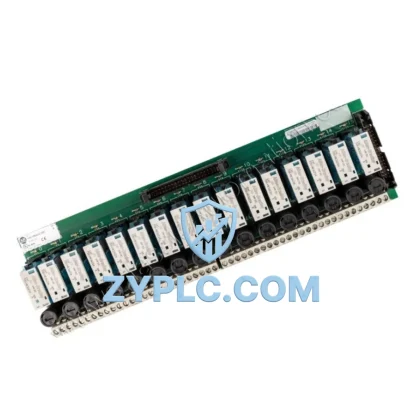
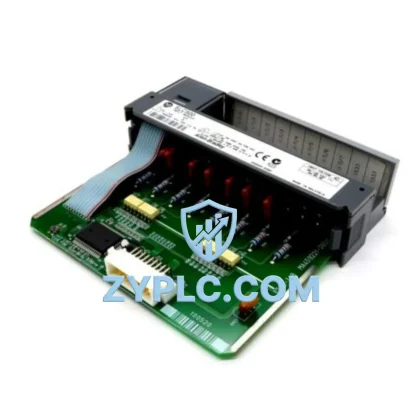
Schneider Electric TSX AEM1613 System-Ready Analog Input for Premium Control Architecture
The Schneider Electric TSX AEM1613 is a 16-channel analog input module engineered for seamless integration within the TSX Premium programmable logic controller platform. Designed to occupy a standard TSX rack slot, this module serves as the critical signal acquisition layer in multi-tier industrial automation architectures — translating real-world process variables into precise digital values that the TSX Premium CPU can act upon in real time. Whether deployed in continuous process control, discrete manufacturing, or hybrid automation environments, the TSX AEM1613 delivers the measurement accuracy, channel density, and system compatibility that modern industrial engineers demand.
In a fully layered control system, the TSX AEM1613 occupies the I/O layer, sitting between field instrumentation and the control layer managed by processors such as the TSX P57 354M or TSX P57 554M. Its 16 differential analog input channels support voltage and current signal types, enabling direct connection to transmitters, sensors, and transducers across a wide range of process industries. The module communicates with the CPU backplane via the TSX Premium rack bus, ensuring deterministic scan-cycle data delivery without additional gateway overhead.
System architects integrating the TSX AEM1613 benefit from its compatibility with the full TSX Premium rack ecosystem, including the TSX RKY 8EX and TSX RKY 12EX extension racks, which allow distributed I/O expansion across large control cabinets or remote marshalling panels. Power distribution within these racks is managed by dedicated power supply modules such as the TSX PSY 2600M or TSX PSY 5500M, ensuring stable 24 VDC bus voltage for all installed I/O modules including the AEM1613. This power architecture eliminates ground loops and reduces noise susceptibility on sensitive analog signal lines.
At the network and communication layer, the TSX AEM1613 operates within systems that leverage Modbus TCP/IP, Uni-Telway, and Fipio fieldbus protocols managed by the TSX Premium CPU or dedicated communication modules such as the TSX ETY 110 Ethernet module. This allows SCADA systems, historian servers, and MES platforms to retrieve analog process data with low latency, supporting real-time monitoring and closed-loop control strategies. In redundant architecture designs, the TSX AEM1613 can be paired with a hot-standby CPU configuration using the TSX SCP 114 or TSX SCP 111 serial communication processors to maintain continuous data acquisition even during primary controller failover events.
For human-machine interface integration, analog values acquired by the TSX AEM1613 are typically visualized on Magelis HMI panels or third-party SCADA workstations connected via the Ethernet network layer. Engineers using Unity Pro or PL7 Pro programming environments can map AEM1613 channel data directly to function blocks, PID loops, and alarm management routines, enabling sophisticated process control without custom driver development. The module’s channel-by-channel configuration — including input range selection, filtering, and fault detection — is managed entirely through software, reducing commissioning time and eliminating the need for hardware jumper changes.
From a maintenance and lifecycle perspective, the TSX AEM1613 supports hot-swap capability within the TSX Premium rack, allowing field engineers to replace a faulty module without powering down the entire control system. This capability is essential in high-availability applications such as power generation, water treatment, and continuous chemical processing, where unplanned downtime carries significant operational and safety consequences. Spare module inventory management is simplified by the module’s standardized form factor and broad compatibility across TSX Premium rack generations.
ZYPLC maintains verified stock of the TSX AEM1613 with full functional testing prior to shipment, supported by a 12-Month Warranty covering manufacturing defects and operational failures under normal industrial service conditions. Our technical team provides pre-sales architecture consultation to confirm module compatibility with your existing TSX Premium rack configuration, CPU firmware version, and Unity Pro project structure — ensuring Contextual Integration from day one of deployment.
Architecture Specification Table
| Parameter |
Specification |
| System Role |
Analog Input I/O Module — TSX Premium Platform |
| Number of Channels |
16 differential analog input channels |
| Input Signal Types |
Voltage (±10V, 0–10V) and Current (0–20mA, 4–20mA) |
| Resolution |
12-bit + sign (13-bit effective) |
| Conversion Accuracy |
±0.1% of full scale at 25°C |
| Isolation |
Channel-to-bus isolation; differential input configuration |
| Rack Compatibility |
TSX RKY 4EX, TSX RKY 8EX, TSX RKY 12EX |
| Communication Interface |
TSX Premium internal rack bus (backplane) |
| Power Supply |
Supplied via rack bus from TSX PSY series power modules |
| Operating Temperature |
0°C to +60°C |
| Storage Temperature |
-25°C to +70°C |
| Relative Humidity |
5% to 95% non-condensing |
| Mounting |
Standard TSX Premium rack slot (1 slot width) |
| Certifications |
CE, UL, cUL — IEC 61131-2 compliant |
| Country of Origin |
France |
| Warranty |
12-Month Warranty (ZYPLC verified stock) |
Coordinated Control System Design
The TSX AEM1613 achieves its full potential when deployed as part of a coordinated TSX Premium control system rather than as a standalone component. A typical architecture begins with the TSX P57 354M or TSX P57 554M CPU module, which manages the scan cycle and coordinates data exchange across all rack-mounted I/O modules. The AEM1613 feeds its 16-channel analog dataset directly into the CPU’s process image table, where Unity Pro function blocks execute PID control, ratio control, or cascade control algorithms on each scan cycle.
Digital I/O coordination is handled by companion modules such as the TSX DEY 32D2K discrete input module and the TSX DSY 32T2K discrete output module, which share the same rack bus and are scanned in the same CPU cycle as the AEM1613. This synchronized scanning ensures that analog measurements and digital actuator commands remain temporally consistent — a critical requirement in interlock and safety-related control sequences. Analog output functions, such as valve positioning or variable speed drive setpoint transmission, are managed by the TSX AEY 800 or TSX AEY 420 analog output modules, which complement the AEM1613’s input capability to form a complete closed-loop control layer.
For applications requiring communication with remote I/O stations or distributed field devices, the TSX ETY 110 Ethernet TCP/IP module or the TSX SCP 114 Modbus serial communication module can be installed in adjacent rack slots, extending the control architecture beyond the local cabinet. In redundant system designs, a secondary TSX Premium CPU rack with a mirrored AEM1613 installation provides hot-standby analog input capability, ensuring continuous process monitoring even during primary controller maintenance windows.
Application in Layered Automation Systems
The TSX AEM1613 is deployed across a broad spectrum of industrial sectors where multi-channel analog signal acquisition is fundamental to process control integrity. In power generation and electrical substation automation, the module acquires current transformer and voltage transformer secondary signals, feeding real-time electrical measurements to the TSX Premium CPU for load balancing, protection relay coordination, and energy management calculations. Its differential input configuration provides excellent common-mode noise rejection in electrically noisy substation environments.
In petrochemical and refinery applications, the TSX AEM1613 connects to pressure transmitters, temperature sensors (via signal conditioners), and flow meters distributed across process units. The module’s 4–20mA input compatibility aligns with the NAMUR standard signal range used by the majority of field-mounted process transmitters, simplifying wiring and eliminating the need for signal conversion hardware. Water and wastewater treatment plants rely on the AEM1613 for continuous monitoring of pH, dissolved oxygen, turbidity, and flow rate signals across multiple treatment stages, with the TSX Premium CPU executing automated dosing and aeration control based on the acquired data.
Mining and metallurgical processing facilities deploy the TSX AEM1613 in conveyor control systems, crusher monitoring applications, and flotation cell management, where simultaneous acquisition of multiple analog process variables is required for optimal throughput and equipment protection. Packaging and food processing lines use the module for tension control, fill-level measurement, and temperature profiling across multi-zone ovens and heat-seal stations. In all these applications, the module’s 12-Month Warranty and ZYPLC’s verified stock availability ensure that replacement modules can be sourced rapidly, minimizing the risk of extended production downtime due to I/O module failure.
Architecture Engineering FAQ
Q1: Is the TSX AEM1613 compatible with both TSX Premium and TSX Micro PLC platforms?
The TSX AEM1613 is designed exclusively for the TSX Premium rack platform and is not compatible with the TSX Micro series, which uses a different I/O bus architecture and module form factor. For TSX Micro applications requiring analog input, Schneider Electric offers dedicated analog extension modules within the TSX Micro product family. When integrating the AEM1613 into a TSX Premium system, confirm that your rack model (TSX RKY 4EX, 8EX, or 12EX) has an available slot and that your Unity Pro or PL7 Pro project configuration includes the module in the hardware catalog before commissioning.
Q2: Can the TSX AEM1613 be used in a redundant CPU architecture, and how is failover managed?
Yes. In a TSX Premium hot-standby redundancy configuration, the AEM1613 installed in the primary rack continues to acquire analog data during normal operation. Upon CPU failover, the standby CPU assumes control and reads the last valid analog values from the shared memory image. For applications requiring continuous analog acquisition during failover, engineers should evaluate installing mirrored AEM1613 modules in both the primary and standby racks, connected to the same field transmitters via signal splitters or loop-powered distributors. ZYPLC’s technical team can assist with redundancy architecture validation prior to procurement.
Q3: What does the 12-Month Warranty cover, and what is the replacement process if a module fails in service?
ZYPLC’s 12-Month Warranty covers the TSX AEM1613 against manufacturing defects and functional failures occurring under normal industrial operating conditions as defined by Schneider Electric’s published environmental specifications. The warranty period begins from the date of shipment. In the event of a module failure, contact ZYPLC at plc.sales@zyplc.com or +86 19859288691 to initiate a warranty claim. Our team will arrange expedited replacement shipment to minimize system downtime. Warranty claims require the original order reference and a brief description of the failure mode. Modules damaged by overvoltage, incorrect wiring, or operation outside specified environmental limits are evaluated on a case-by-case basis.
© 2026 ZYPLC. All rights reserved.
Original Source: https://zyplc.com
Contact: +86 19859288691 | plc.sales@zyplc.com