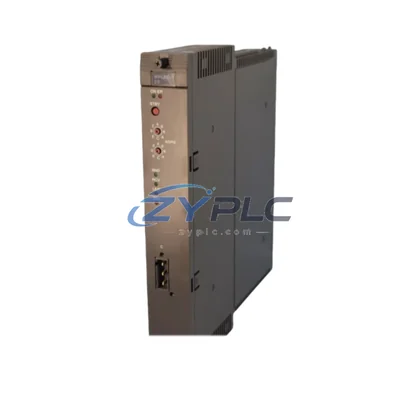
Woodward 9905-969 Speed Governor Controller for 9905 Series
The Woodward 9905-969 is a precision-engineered speed governor controller designed to occupy a critical position within the 9905 Series turbine and prime mover control architecture. Rather than functioning as a standalone device, the 9905-969 is conceived as a system-compatible component — one that integrates seamlessly across the control layer, I/O layer, power supply layer, and communication network to deliver consistent, reliable speed regulation in demanding industrial environments. Whether deployed in gas turbine power generation, steam turbine drive systems, or large-scale compressor trains, this controller provides the architectural backbone that ensures stable speed response, load sharing accuracy, and long-term operational continuity.
In a layered automation system, the 9905-969 sits at the intersection of the control layer and the execution layer. It receives setpoint commands from supervisory control systems or operator HMI panels, processes real-time speed feedback from magnetic pickup sensors or proximity probes, and issues precise actuator output signals to fuel control valves or hydraulic servo systems. This bidirectional signal flow — from the human-machine interface down through the governor to the final control element — defines the core value of the 9905-969 in any well-engineered control architecture.
Product Specification Table
| Parameter |
Specification |
| System Role |
Speed Governor Controller — Control Layer / Execution Interface |
| Compatible Series |
Woodward 9905 Series Turbine Control Platform |
| SKU / Part Number |
9905-969 |
| Brand |
Woodward |
| Product Type |
Speed Governor Controller |
| Input Signal |
Magnetic Pickup / Proximity Speed Sensor (MPU compatible) |
| Output Signal |
Analog actuator output (mA / VDC, series-dependent) |
| Power Supply |
24 VDC nominal (series-standard power rail) |
| Communication Capability |
Compatible with Woodward 9905 Series backplane and I/O expansion modules |
| Operating Temperature |
-40°C to +70°C (industrial grade) |
| Installation Environment |
Control cabinet / DIN rail / panel-mount per 9905 Series mechanical spec |
| Warranty |
— fully tested, verified operational before shipment |
| Origin |
United States |
System Compatibility Notes
The 9905-969 achieves its full potential when integrated within a coordinated Woodward 9905 Series control system. At the CPU and master control level, the Woodward 9907-164 and 9907-838 governor control modules serve as the primary processing units, managing load sharing logic, droop settings, and inter-unit communication. The 9905-969 interfaces directly with these modules through the 9905 Series backplane, ensuring that speed reference signals and actuator commands are transmitted without latency or signal degradation.
On the power supply layer, the Woodward 5501-470 power supply module provides the regulated 24 VDC rail that energizes the 9905-969 and associated I/O modules. Redundant power configurations — using dual 5501-470 units with automatic switchover — are commonly specified in critical turbine applications where downtime carries significant operational cost. The 9905-969 is designed to remain operational through power supply transitions, maintaining actuator output stability during switchover events.
For I/O expansion and signal conditioning, the Woodward 8200-1300 analog input module and 8290-184 digital I/O module extend the system’s sensing and switching capability. These modules connect to the 9905-969’s control environment through the shared backplane, allowing engineers to integrate additional speed sensors, temperature transmitters, pressure switches, and solenoid valve outputs without modifying the core governor logic. This modular I/O architecture is particularly valuable in retrofit projects where existing field wiring must be accommodated within a new control platform.
At the communication and network layer, the Woodward 8406-117 communication gateway module enables the 9905 Series system — including the 9905-969 — to exchange data with plant-level SCADA systems, DCS platforms, and remote monitoring infrastructure via Modbus RTU or other supported protocols. This system integration capability ensures that speed governor data, alarm states, and actuator positions are visible to operators at the HMI layer, supporting informed decision-making and rapid fault response.
For applications requiring advanced load sharing and synchronization, the Woodward 723PLUS digital speed control and the DSLC (Digital Synchronizer and Load Control) module are frequently deployed alongside the 9905-969. The 723PLUS handles isochronous load sharing in multi-generator configurations, while the DSLC manages synchronization to the grid or bus before breaker closure. Together with the 9905-969, these components form a complete turbine-generator control architecture capable of meeting utility-grade reliability standards.
Terminal modules such as the Woodward 5466-258 provide the physical wiring interface between field cables and the 9905 Series backplane, simplifying installation, reducing wiring errors, and enabling module replacement without disturbing field terminations. This design philosophy — separating the termination layer from the logic layer — significantly reduces maintenance time and supports hot-swap procedures in systems where continuous operation is required.
The Woodward 9905-797 is another compatible module within the 9905 Series ecosystem, often used in parallel with the 9905-969 in redundant governor configurations. Redundancy at the governor level is a standard requirement in critical applications such as offshore platform power generation, pipeline compressor stations, and combined heat and power (CHP) plants, where a single point of failure in the speed control loop is unacceptable.
Industrial Application Notes
The Woodward 9905-969 is deployed across a wide range of industrial sectors where precise speed control and system-level integration are non-negotiable requirements. In power generation facilities — including gas turbine plants, steam turbine stations, and diesel generator sets — the 9905-969 governs prime mover speed during startup, load pickup, load shedding, and shutdown sequences. Its ability to maintain speed within tight droop bands ensures stable frequency output and smooth load sharing between parallel generating units.
In the petrochemical and refining industry, the 9905-969 is commonly applied to gas compressor trains, boiler feed pump turbines, and process gas expanders. These applications demand governor controllers that can respond to rapid load changes without overspeed excursions, and the 9905-969’s fast actuator response and configurable droop settings make it well-suited to these dynamic process environments.
Water treatment and municipal utility applications benefit from the 9905-969’s reliability in pump drive turbine systems, where consistent speed regulation directly affects flow rates, pressure stability, and treatment process quality. Mining and metallurgical operations deploy the 9905-969 in large motor-driven compressors, hoisting systems, and rolling mill drives, where the governor’s ability to maintain speed under variable load conditions is critical to production continuity.
In packaging and discrete manufacturing lines, the 9905-969 supports coordinated drive control in multi-axis systems, ensuring that web tension, conveyor speed, and process timing remain synchronized across the production line. Its compatibility with the broader Woodward 9905 Series architecture means that engineering teams can standardize on a single control platform across multiple machine types, reducing training requirements, spare parts inventory, and long-term maintenance costs.
Product Compatibility FAQ
Q1: Is the Woodward 9905-969 compatible with existing 9905 Series backplanes and I/O modules already installed in my control cabinet?
A: Yes. The 9905-969 is designed for direct integration with the Woodward 9905 Series backplane architecture. It is compatible with standard 9905 Series I/O modules, power supply rails, and communication gateways. Before installation, verify the firmware revision of your existing 9907-series CPU modules to confirm compatibility with the 9905-969’s actuator output configuration. Our technical team can assist with pre-installation compatibility verification as part of the support service.
Q2: Can the 9905-969 be used in a redundant governor architecture, and what is required to implement hot-standby switchover?
A: The 9905-969 supports redundant governor configurations when paired with a compatible standby unit such as the Woodward 9905-797. Hot-standby switchover requires a redundancy management module and bumpless transfer logic configured within the 9907-series CPU. The switchover time is typically less than 100 milliseconds, ensuring that actuator output continuity is maintained during the transition. All units supplied under our are tested for redundancy switchover performance prior to shipment.
Q3: What long-term maintenance considerations apply to the 9905-969, and how does the support ongoing operations?
A: The 9905-969 is a solid-state electronic module with no mechanical wear components, making it suitable for long-term deployment in continuous-duty applications. Recommended maintenance includes periodic calibration of speed sensor inputs, verification of actuator output linearity, and inspection of backplane connector integrity. Our covers manufacturing defects and verified operational failures under normal service conditions. Extended support, including spare module stocking agreements and on-site commissioning assistance, is available through our industrial automation supply network.