YASKAWA JEVSA-YV250-E: Industrial Data Link for Smart Factory Vision Networks
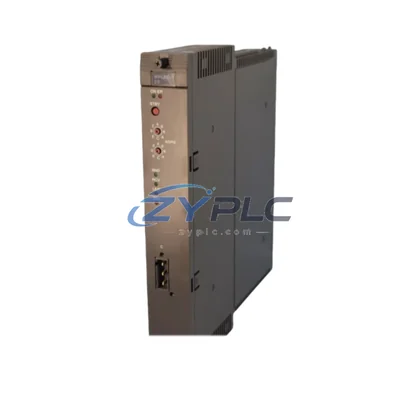
The YASKAWA JEVSA-YV250-E is a high-performance machine vision gateway controller from YASKAWA’s IV Series, engineered to serve as the critical communication bridge between vision inspection systems and the broader industrial automation network. In modern smart factory environments, vision data must flow seamlessly from camera sensors through PLCs, remote I/O modules, HMI panels, SCADA platforms, and MES systems — and the JEVSA-YV250-E is purpose-built to make that data flow reliable, real-time, and protocol-agnostic.
Supporting EtherNet/IP, PROFINET, and Modbus TCP, this controller eliminates the communication barriers that traditionally isolate vision subsystems from the plant-wide control architecture. Whether you are integrating inline inspection results into a YASKAWA MP3300 machine controller, feeding pass/fail signals to a YASKAWA SGDV servo drive, or pushing quality data upstream to a Wonderware or iFIX SCADA system, the JEVSA-YV250-E provides the deterministic, low-latency link that industrial production demands.
Compatibility & Integration Notes
| Specification |
Detail |
| SKU |
JEVSA-YV250-E |
| Brand / Series |
YASKAWA / IV Series |
| Supported Protocols |
EtherNet/IP, PROFINET, Modbus TCP |
| Interface Type |
Industrial Ethernet (RJ45), Digital I/O |
| Communication Role |
Vision Gateway / Protocol Converter |
| Network Compatibility |
YASKAWA MP Series, Siemens S7, Allen-Bradley ControlLogix, Schneider Modicon |
| System Applications |
SCADA, HMI, MES, Remote I/O, Edge Gateway Integration |
| Origin |
Japan |
| Warranty |
12 Months |
| Availability |
Available — Global Shipping |
Connected Automation Data Flow
In a typical smart factory deployment, the JEVSA-YV250-E sits at the intersection of the field device layer and the supervisory control layer. Signal acquisition begins at the camera and lighting level — IV Series vision sensors capture dimensional, color, and defect data at line speed. The JEVSA-YV250-E processes these results and immediately converts them into structured network packets compatible with the plant’s existing control infrastructure.
On the PLC side, the controller communicates natively with YASKAWA MP3300 and MP2600iec machine controllers via EtherNet/IP, delivering inspection outcomes as register data that can trigger downstream actuators, reject mechanisms, or conveyor routing logic without any additional protocol translation hardware. For Siemens-based lines, PROFINET connectivity allows direct integration with S7-1500 and S7-300 PLCs, while Modbus TCP extends compatibility to legacy Schneider Modicon M340 and M580 controllers.
Remote I/O expansion is handled through YASKAWA’s JEPMC-IO350 distributed I/O modules, which connect to the JEVSA-YV250-E’s network segment and relay digital signals to field devices — limit switches, proximity sensors, and pneumatic valve banks — without adding latency to the inspection feedback loop. HMI visualization is achieved through YASKAWA’s CP1W and CP1H operator panels, which display real-time inspection statistics, trend charts, and alarm states sourced directly from the vision controller’s data registers.
At the drive level, pass/fail outputs from the JEVSA-YV250-E can be mapped to YASKAWA SGDV-R70A and SGDV-2R8A servo amplifiers to adjust positioning or speed profiles in response to detected part variations — a capability critical in adaptive assembly and precision dispensing applications. For edge computing scenarios, the controller’s Ethernet port connects to industrial edge gateways such as the YASKAWA i3-Mechatronics platform, enabling local data aggregation, OPC-UA tunneling, and cloud forwarding to IIoT dashboards without burdening the PLC scan cycle.
SCADA integration is achieved through Modbus TCP polling from platforms such as Inductive Automation Ignition or GE iFIX, which map vision quality KPIs — yield rate, defect classification counts, cycle time — into historian databases for SPC analysis and production reporting. The JEVSA-YV250-E’s deterministic Ethernet stack ensures that SCADA poll responses arrive within the 10 ms window required for real-time dashboard refresh, even under high network load conditions.
Solving Data Isolation in Industrial Sites
One of the most persistent challenges in industrial automation is the data silo — vision systems that generate rich inspection data but cannot share it with the control layer, the quality system, or the enterprise network. The JEVSA-YV250-E directly addresses this by acting as a multi-protocol gateway that speaks the language of every layer in the automation hierarchy.
Protocol fragmentation is eliminated: a single JEVSA-YV250-E can simultaneously serve an EtherNet/IP scanner (PLC), a PROFINET controller (motion system), and a Modbus TCP master (SCADA) — all from one device, without external protocol converters or OPC servers. This reduces panel space, wiring complexity, and potential points of failure.
Remote monitoring and diagnostics are built into the network architecture. Maintenance engineers can access live vision controller status, communication health metrics, and alarm logs from any SCADA workstation or mobile HMI on the plant network, without physical access to the machine. This capability is especially valuable in hazardous environments — chemical processing, high-temperature furnace lines, and cleanroom semiconductor fabs — where minimizing human presence on the production floor is a safety and compliance requirement.
Production line transparency is achieved through continuous data streaming: every inspection cycle generates a timestamped result record that flows through the JEVSA-YV250-E to the MES layer, enabling real-time OEE calculation, defect Pareto analysis, and predictive quality alerts. System expansion is straightforward — additional IV Series vision sensors and JEPMC-IO350 remote I/O nodes can be added to the network segment without reconfiguring the gateway, supporting phased capacity increases as production volumes grow.
Industrial Connectivity FAQ
Q1: What is the communication latency of the JEVSA-YV250-E on an EtherNet/IP network?
The JEVSA-YV250-E is designed for deterministic industrial Ethernet communication. In standard EtherNet/IP implicit messaging mode, cycle times of 1–10 ms are achievable depending on network topology and PLC scan rate, making it suitable for high-speed inline inspection applications where real-time feedback is critical.
Q2: Is the JEVSA-YV250-E compatible with third-party PLCs and SCADA systems?
Yes. The JEVSA-YV250-E supports EtherNet/IP (compatible with Allen-Bradley ControlLogix and CompactLogix), PROFINET (compatible with Siemens S7 series), and Modbus TCP (compatible with Schneider Modicon, GE, and most SCADA platforms). This multi-protocol capability makes it suitable for mixed-vendor automation environments.
Q3: How is network stability maintained in electrically noisy factory environments?
The JEVSA-YV250-E is built to YASKAWA’s industrial-grade EMC standards, with shielded Ethernet port design and firmware-level watchdog and reconnection logic. In the event of a temporary network interruption, the controller automatically re-establishes communication sessions without requiring a manual restart, ensuring production continuity.
Q4: What does the cover, and is pre-shipment testing performed?
Every JEVSA-YV250-E unit supplied by ZYPLC undergoes functional communication testing prior to shipment, verifying protocol handshake, I/O response, and firmware integrity. The covers manufacturing defects and communication hardware failures under normal operating conditions. Global shipping is available with full export documentation support.