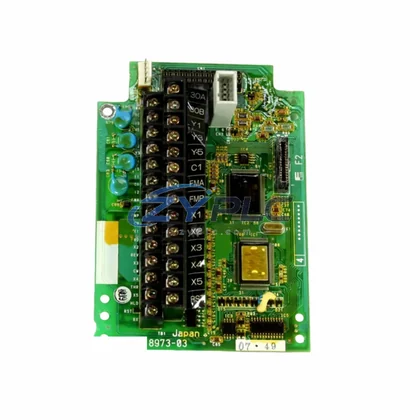
Yaskawa JZRCR-NTU01D-1 Power Supply for NX100
The Yaskawa JZRCR-NTU01D-1 is a dedicated power supply module engineered for seamless integration within the NX100 robot controller architecture. Rather than functioning as a standalone component, this module serves as the electrical backbone of a coordinated control system, delivering stable, conditioned power to the controller’s CPU board, I/O interface layers, servo amplifier communication buses, and peripheral expansion slots. In multi-axis robotic installations — such as those found in automotive body welding lines, arc welding cells, material handling systems, and precision assembly stations — the reliability of the power supply directly determines the uptime and determinism of the entire control loop. The JZRCR-NTU01D-1 is designed to meet these demands with consistent voltage regulation, thermal resilience, and compatibility with the NX100’s modular backplane architecture.
Within the NX100 controller family, the power supply module occupies a foundational role in the system hierarchy. It interfaces directly with the main CPU board — typically the JANCD-NCP01 or JANCD-NCP01B — which manages motion trajectory calculation, interpolation, and real-time task scheduling. The power supply ensures that the CPU board receives clean, uninterrupted DC power, preventing logic faults, watchdog resets, or communication dropouts that could compromise robot path accuracy or trigger emergency stops. This is especially critical in high-cycle applications where the controller must sustain continuous operation across multi-shift production schedules.
The NX100 controller’s I/O architecture relies on a structured signal flow between the CPU, the I/O base unit, and field-level devices. The JZRCR-NTU01D-1 supports this signal integrity by maintaining stable power rails across the backplane, ensuring that I/O modules such as the JANCD-NIO01 digital I/O board and analog interface cards receive consistent supply voltage. Any fluctuation at the power layer propagates directly into signal noise, false triggering, or communication latency — all of which the JZRCR-NTU01D-1 is designed to suppress through its regulated output architecture.
From a network and communication perspective, the NX100 platform supports DeviceNet, Ethernet/IP, and proprietary Yaskawa MECHATROLINK-II protocols for coordinating motion between the controller and external PLCs, vision systems, or safety controllers. The power supply module’s role in sustaining the communication interface boards — including the JANCD-NIF01 network interface card — is critical for maintaining deterministic data exchange cycles. In systems where the NX100 is integrated with a Siemens S7-300 PLC or an Allen-Bradley ControlLogix via a gateway, any power instability at the controller level can introduce latency or packet loss that disrupts synchronized motion sequences.
Redundancy and fault tolerance are increasingly important in modern robotic installations. While the NX100 architecture does not natively support hot-swap power redundancy in the same manner as large-scale DCS platforms, the JZRCR-NTU01D-1 is designed for rapid field replacement, minimizing mean time to repair (MTTR) in the event of a power module failure. Maintenance engineers benefit from the module’s standardized form factor, which allows it to be swapped without disturbing adjacent boards such as the servo control card JANCD-MSP01 or the safety I/O module JANCD-YSF21. This design philosophy supports lean maintenance strategies and reduces the need for extended production shutdowns.
In layered automation environments — where the NX100 controller sits beneath a SCADA or MES layer and above the servo drive and end-effector level — the power supply module’s contribution to system consistency is often underestimated. Engineers specifying replacement or spare components for NX100-based cells should treat the JZRCR-NTU01D-1 as a system-critical spare, maintaining at least one unit in inventory to support rapid recovery. Its compatibility with the NX100 controller chassis, combined with Yaskawa’s standardized connector and mounting interface, ensures that field replacement can be completed by a qualified technician within a single maintenance window.
All units supplied by ZYPLC are covered by a , with full system integration support to assist engineers in verifying compatibility with existing NX100 controller configurations, servo amplifier pairings, and system-level power budgets.
Product Specification Table
| Parameter |
Specification |
| System Role |
Primary Power Supply Module for NX100 Robot Controller |
| Compatible Controller |
Yaskawa NX100 Series |
| Input Voltage |
AC 200–230V, 50/60Hz (inferred from NX100 platform standard) |
| Output Voltage |
DC 5V / DC 24V regulated rails (backplane distribution) |
| Mounting Interface |
NX100 controller chassis backplane slot |
| Communication Support |
Backplane power bus; supports CPU, I/O, and network interface boards |
| Installation Environment |
Control cabinet, IP54 enclosure recommended, 0–45°C operating range |
| Cooling Method |
Forced air (controller chassis fan system) |
| Country of Origin |
Japan |
| Warranty |
(ZYPLC) |
System Compatibility Notes
The JZRCR-NTU01D-1 operates at the center of a tightly coordinated hardware ecosystem within the NX100 controller. At the processing layer, the JANCD-NCP01B CPU board depends on the power supply for uninterrupted logic power during motion program execution and real-time interpolation. The JANCD-NIF01 network interface board draws regulated power to sustain Ethernet and DeviceNet communication cycles with upstream PLCs and SCADA systems. At the servo layer, the SGDV series servo amplifiers receive motion commands from the NX100 CPU via the MECHATROLINK-II bus, and any power instability at the controller level can corrupt command packets and cause axis faults.
The JANCD-NIO01 digital I/O board handles discrete signal exchange with field devices — proximity sensors, pneumatic valve solenoids, gripper actuators — and relies on stable 24V supply from the power module to maintain signal integrity. The JANCD-MSP01 servo control card coordinates multi-axis motion profiles and requires consistent power to execute synchronized path calculations. For human-machine interface integration, the NX100 programming pendant (JZRCR-NPP01) connects to the controller via a dedicated interface that is also powered through the controller’s internal supply chain.
In cabinet-level designs, the NX100 controller is typically installed alongside a 24VDC DIN rail power supply (such as a Phoenix Contact QUINT or Siemens SITOP unit) that feeds field I/O and safety relay circuits independently of the controller’s internal supply. The JZRCR-NTU01D-1 handles only the controller’s internal power distribution, ensuring clean separation between control logic power and field device power — a best practice in industrial cabinet design that reduces noise coupling and simplifies fault isolation.
Industrial Application Notes
In automotive manufacturing, NX100-based robot cells are deployed for spot welding, arc welding, sealing, and assembly operations. The JZRCR-NTU01D-1 supports continuous multi-shift operation in these environments, where controller uptime directly impacts line throughput and OEE targets. In electronics assembly and precision manufacturing, the NX100 controller manages high-speed pick-and-place and dispensing operations where power supply stability directly affects path repeatability and cycle time consistency.
In steel and metal processing plants, NX100 controllers are integrated into cutting, grinding, and material handling cells where the electrical environment is characterized by high-frequency switching noise from variable frequency drives and resistance welding equipment. The JZRCR-NTU01D-1’s regulated output architecture provides the noise immunity required to sustain reliable controller operation in these demanding conditions. In food and beverage packaging lines, the NX100 platform supports hygienic robot applications where scheduled maintenance windows are short and spare parts availability is critical — making the JZRCR-NTU01D-1 an essential inventory item for maintenance teams.
For process industries including chemical, petrochemical, and water treatment facilities where robotic systems are used for sampling, inspection, or material transfer, the NX100 controller’s reliability depends on the integrity of its power supply module. ZYPLC maintains RFQ-based sourcing support of the JZRCR-NTU01D-1 to support rapid deployment and minimize production impact during unplanned maintenance events.
Product Compatibility FAQ
Q1: Is the JZRCR-NTU01D-1 compatible with all NX100 controller variants, and can it be used in dual-robot or multi-robot cell configurations?
The JZRCR-NTU01D-1 is designed specifically for the Yaskawa NX100 controller chassis and is compatible with standard NX100 configurations supporting up to 4-axis or 6-axis robot systems. In multi-robot cells where multiple NX100 controllers are networked via Ethernet or DeviceNet for coordinated motion, each controller requires its own dedicated power supply module. The JZRCR-NTU01D-1 is not shared across controllers. ZYPLC’s technical team can assist with compatibility verification for specific cell configurations under our and system integration support program.
Q2: What installation and commissioning steps are required when replacing the JZRCR-NTU01D-1 in an active production environment?
Replacement of the JZRCR-NTU01D-1 requires a controlled power-down sequence for the NX100 controller, including saving the current job and parameter files to the programming pendant or an external backup device. After physical replacement, the controller should be powered up in maintenance mode to verify that all CPU, I/O, and servo interface boards initialize correctly before resuming production. ZYPLC recommends that replacement be performed by a Yaskawa-certified technician and provides system integration documentation to support the commissioning process.
Q3: What does the cover, and how does ZYPLC support long-term spare parts availability for NX100 system components?
ZYPLC’s covers the JZRCR-NTU01D-1 against manufacturing defects and functional failures under normal operating conditions. Warranty claims are processed through our technical support team at plc.sales@zyplc.com. For long-term spare parts planning, ZYPLC supports RFQ-based sourcing of NX100-compatible components including CPU boards, I/O modules, servo interface cards, and communication boards, supporting customers with multi-year maintenance contracts and emergency supply programs. Contact our team at +86 19859288691 to discuss stocking agreements tailored to your production requirements.