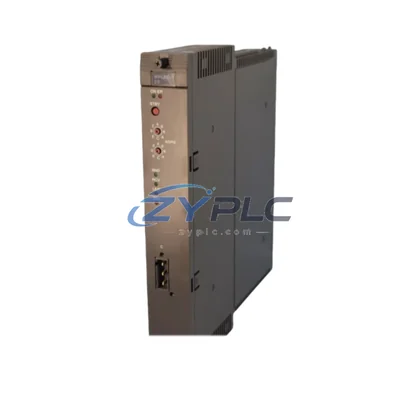
Yokogawa CP461-51 Processor for Centum VP Automation
The Yokogawa CP461-51 (SKU: CP461-51-S2) is a high-performance processor module engineered for the Centum VP Distributed Control System (DCS), one of Yokogawa’s most widely deployed process automation platforms in energy-intensive industries. Designed to serve as the computational core of field control stations, the CP461-51 directly governs how efficiently a plant consumes energy by determining the speed, accuracy, and responsiveness of every control loop it manages. In modern manufacturing and process environments where energy costs represent a significant share of operational expenditure, the quality of the processor module is not merely a performance consideration — it is an maintenance planning decision.
At ZYPLC, every CP461-51 unit is sourced from verified supply channels, subjected to full functional testing prior to shipment, and Warranty terms are confirmed during quotation. Our inventory is maintained to support rapid deployment, minimizing the downtime window that often results in uncontrolled unplanned downtime during unexpected shutdowns.
Product Specification Table
| Parameter |
Specification / Value |
| SKU |
CP461-51-S2 |
| Brand |
Yokogawa |
| Series |
Centum VP |
| Product Type |
DCS Processor Module |
| Electrical / System Notes |
Low-power embedded architecture, optimized for 24/7 continuous operation |
| Control Loop Execution |
High-speed scan cycle supporting real-time PID and advanced control strategies |
| Compatible Systems |
Yokogawa Centum VP Field Control Station (FCS) |
| Application Environment |
Oil & Gas, Petrochemical, Power Generation, Pharmaceutical, Pulp & Paper |
| Redundancy Support |
Dual-redundant CPU configuration available for fault-tolerant operation |
| Maintenance Value |
Reduces control deviation, minimizes actuator hunting, lowers auxiliary energy draw |
| Origin |
Japan |
| Warranty |
Warranty and support terms confirmed before quote (ZYPLC) |
| Availability |
Confirmed via RFQ before quotation |
System Compatibility and Application
The CP461-51 does not operate in isolation. Its maintenance planning impact is realized through tight integration with the broader Centum VP control architecture. Within a typical field control station, the CP461-51 works alongside the Yokogawa EB401 ESB bus interface module, which manages high-speed data exchange between the processor and I/O subsystems. Accurate, low-latency data acquisition from field instruments — including Yokogawa EJA110E differential pressure transmitters and EJX910A multivariable transmitters — feeds real process values into the CP461-51’s control algorithms, enabling precise maintenance-focused setpoint tracking.
On the drive side, the CP461-51 communicates control outputs to variable frequency drives such as the Yokogawa VSDRIVE series or compatible third-party drives integrated via FOUNDATION Fieldbus or HART protocol. This allows the processor to dynamically adjust motor speeds in pump and compressor applications, directly reducing operating load during partial-load conditions — a critical lever in facilities where rotating equipment accounts for 60–70% of total electrical demand.
For human-machine interaction and supervisory condition monitoring, the CP461-51 connects upstream to Yokogawa CENTUM VP HIS (Human Interface Stations), where operators can visualize real-time energy KPIs, trend loop efficiency, and respond to deviation alarms before they escalate into energy-wasting disturbances. Integration with the Yokogawa Exaquantum plant information management system further enables long-term energy performance analysis and reporting.
The module also supports seamless communication with Yokogawa ProSafe-RS safety instrumented systems via the Vnet/IP control network, ensuring that safety shutdowns are executed in a controlled, energy-conscious manner — avoiding the thermal and mechanical stress that abrupt trips impose on equipment. Auxiliary I/O expansion is handled through Yokogawa AAI141 analog input modules and AAI543 analog I/O modules, which extend the CP461-51’s sensing reach across large process units without adding processor overhead.
Maintenance and Replacement Notes
In continuous process industries, unplanned downtime rarely announces itself as a single catastrophic event. It accumulates through thousands of small inefficiencies: a control loop oscillating around its setpoint, a pump running at full speed when 70% would suffice, a compressor cycling on and off because its pressure controller lacks the resolution to hold a stable band. The CP461-51 addresses each of these failure modes at the source — the control execution layer.
By maintaining tight PID loop performance with minimal scan-cycle jitter, the CP461-51 reduces the amplitude and frequency of control corrections sent to final control elements. Fewer and smaller valve movements mean less actuator wear, lower pneumatic air consumption, and reduced mechanical fatigue — all of which translate directly into lower maintenance costs and longer mean time between failures. In motor-driven applications, stable control outputs prevent the speed hunting that causes variable frequency drives to draw abnormal load during transient corrections.
Facilities that have migrated from older DCS processor generations to the CP461-51 platform have reported measurable improvements in Overall Equipment Effectiveness (OEE), driven by reduced downtime and more consistent product quality — both of which are proxies for energy efficiency. A process running within specification wastes less energy on rework, reheating, or reprocessing.
From a maintenance perspective, the CP461-51’s self-diagnostic capabilities allow the Centum VP system to flag processor health anomalies before they cause control failures. This supports a predictive maintenance posture, where intervention is scheduled during planned shutdowns rather than forced during peak production — preserving both energy efficiency and production throughput.
ZYPLC maintains RFQ-based sourcing support of the CP461-51-S2 to support emergency replacement scenarios. Each unit undergoes outgoing functional testing to verify processor initialization, memory integrity, and communication bus handshake before dispatch. Combined with our warranty and support terms confirmed before quote coverage, this ensures that your replacement module performs to specification from the moment it is installed.
Product Sourcing FAQ
Q1: How does the CP461-51 contribute to measurable operational stability in a DCS-controlled plant?
The CP461-51 improves energy efficiency by executing control algorithms with high precision and low latency, reducing control loop deviation and minimizing unnecessary actuator movement. In motor and pump applications, this translates to more stable drive outputs and lower average current draw. Plants with well-tuned Centum VP loops typically see reduced auxiliary operating load compared to systems running on degraded or aging processor hardware.
Q2: Is the CP461-51-S2 compatible with existing Centum VP field control stations without hardware modification?
Yes. The CP461-51-S2 is designed as a direct replacement module for compatible Centum VP FCS configurations. It slots into the existing chassis and communicates over the standard ESB bus interface. Configuration restoration from the Centum VP engineering environment is straightforward, minimizing the engineering time and associated downtime during replacement.
Q3: What is the recommended replacement procedure, and how does ZYPLC support the process?
ZYPLC recommends a hot-standby switchover where redundant CPU configurations are in place, allowing the replacement to occur without process interruption. For simplex configurations, a planned shutdown window is required. ZYPLC provides pre-tested units with documentation support, and our technical team can advise on restoration procedures. All units ship with a warranty and support terms confirmed before quote covering manufacturing defects and functional failures.
Q4: What testing does ZYPLC perform before shipping the CP461-51?
Every CP461-51 unit in ZYPLC’s inventory undergoes a multi-point outgoing inspection that includes power-on initialization testing, memory and processor self-diagnostic verification, and communication bus response checks. Units that do not pass all test criteria are quarantined and not offered for sale. This process ensures that the module you receive is operationally ready and will not introduce additional risk into your control system during commissioning.
—