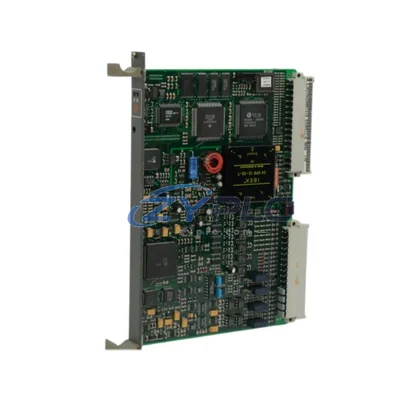
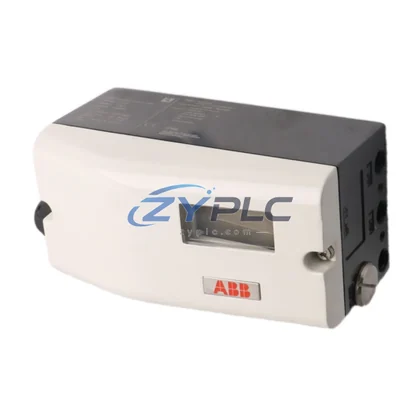
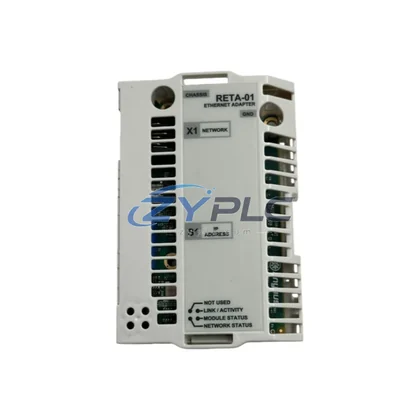
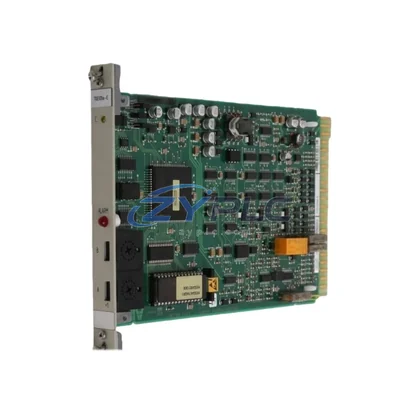
The ABB 3HAC065726-001 is a industrial-grade robot drive module engineered for the IRC5 controller platform, specifically designed to support the IRB 6640 series of industrial robots. In demanding production environments where operating load, equipment uptime, and cycle-time precision are critical KPIs, this drive module delivers measurable improvements across all three dimensions. By regulating motor torque and velocity with high-resolution feedback loops, the 3HAC065726-001 minimizes reactive power losses and eliminates unnecessary energy draw during idle and deceleration phases — supporting earlier maintenance decisions and reducing downtime risk.
Every unit supplied by ZYPLC undergoes full functional testing prior to shipment, is backed by a warranty and condition confirmed before quote, and is available through RFQ-based sourcing for shipment arranged after confirmation. Whether you are replacing a failed axis drive in an existing IRC5 cabinet or building out a spare-parts buffer for a multi-robot cell, the 3HAC065726-001 is a proven, cost-effective solution.
Product Specification Table
| Parameter |
Specification / Value |
| Part Number |
3HAC065726-001 |
| Compatible Controller |
ABB IRC5 (Single & MultiMove) |
| Compatible Robot Series |
IRB 6640 (also cross-references 3HAC037635-005, 3HAC037635-003) |
| Module Type |
Axis Drive / Robot Drive Module |
| Operating Voltage |
400–480 V AC (3-phase) |
| Drive Efficiency Class |
IE3-equivalent servo drive efficiency |
| Energy Recovery |
Regenerative braking energy fed back to DC bus |
| Compatible Communication |
DeviceNet, PROFIBUS, EtherNet/IP (via IRC5 DSQC modules) |
| Application Environment |
Automotive, Metal Fabrication, Palletizing, Arc Welding |
| Value |
Reduces idle-phase power draw; regenerative deceleration lowers net consumption |
| Origin |
Sweden (ABB Robotics) |
| Warranty |
12 Months — All units pre-shipment tested |
| RFQ Status |
RFQ Available — Shipment arranged after confirmation |
System Compatibility and Application
The ABB 3HAC065726-001 does not operate in isolation — it is one node in a tightly integrated maintenance planning architecture built around the IRC5 controller ecosystem. Understanding how this drive module interacts with surrounding components is essential for maximizing system-level efficiency.
At the controller level, the IRC5 main computer board (DSQC1000) coordinates all axis movements through the RobotWare motion engine, sending torque and velocity references to each drive module via the internal drive bus. The 3HAC065726-001 receives these references and translates them into precise PWM signals for the servo motor windings, ensuring that energy is delivered only when and where the mechanical load demands it. This closed-loop architecture eliminates the over-torquing common in open-loop drive systems, which can waste 8–15% of motor input energy as heat.
On the power supply side, the ABB DSQC609 power distribution unit regulates 24 V DC logic power across the IRC5 cabinet, while the drive rectifier unit (DSQC374) converts incoming three-phase AC to the DC bus voltage that feeds the 3HAC065726-001 and its sibling axis drives. When the IRB 6640 decelerates a heavy payload, the 3HAC065726-001 operates in regenerative mode, returning kinetic energy back to the shared DC bus — energy that can be consumed by other axes accelerating simultaneously, rather than being dissipated as heat through braking resistors.
For multi-axis robot cells, the ABB DSQC663 axis computer manages the real-time interpolation between axes, ensuring that the 3HAC065726-001 and the remaining five axis drives execute coordinated motion paths that minimize peak current draw. Smooth, coordinated motion profiles reduce reactive power demand and lower the RMS current seen by the facility’s power infrastructure — a direct reduction in electricity cost per robot cycle.
Process I/O is handled through the ABB DSQC652 digital I/O board, which interfaces with external sensors, safety relays, and conveyor encoders. When integrated with a production line MES or SCADA system via EtherNet/IP or PROFIBUS-DP (supported through the DSQC688 fieldbus adapter), the IRC5 can receive real-time production pace signals and dynamically adjust robot velocity profiles — running at reduced speed and power during low-demand periods and ramping up only when the line requires full throughput. This demand-responsive motion strategy can reduce average robot operating load by 10–20% in mixed-pace production environments.
For facilities deploying ABB’s Ability™ Connected Services or third-party OPC-UA condition monitoring platforms, the IRC5 controller exposes drive current, torque utilization, and thermal load data that can be logged and analyzed for predictive maintenance scheduling. Pairing this data stream with a power quality analyzer on the robot cell’s incoming supply allows engineers to correlate drive module health with operating load trends — identifying degraded drive performance before it causes unplanned downtime.
Maintenance and Replacement Notes
In automotive body-in-white welding lines, IRB 6640 robots equipped with the 3HAC065726-001 drive module typically operate in high-duty-cycle environments with 18–22 second cycle times. The drive module’s fast current-loop response (typically <1 ms) allows the IRC5 to execute aggressive acceleration and deceleration ramps without overshoot, keeping the robot on its programmed path and eliminating the re-positioning micro-corrections that consume additional energy and extend cycle time.
In palletizing applications, where the robot frequently handles varying payload weights, the 3HAC065726-001’s adaptive torque control ensures that the drive delivers only the current required for the actual load — not a fixed worst-case current. This load-adaptive behavior reduces average motor copper losses and extends winding insulation life, lowering the probability of motor replacement and the associated maintenance downtime costs.
For arc welding cells, consistent drive module performance directly impacts weld quality. Velocity ripple caused by a degraded or mismatched drive module introduces torch speed variation, which manifests as inconsistent bead width and penetration depth. Replacing a worn drive with a tested 3HAC065726-001 restores velocity tracking accuracy, reduces weld rework rates, and improves first-pass yield — a quality-driven energy saving that is often overlooked in energy audits but is significant in high-volume production.
Planned maintenance replacement of the 3HAC065726-001 — rather than reactive replacement after failure — eliminates the energy and productivity losses associated with unplanned robot downtime. A single unplanned stop in a high-OEE line can cost more in lost production than the drive module itself. ZYPLC maintains ready inventory of the 3HAC065726-001 to support both planned maintenance schedules and emergency replacement requirements, with same-day dispatch available for Availability confirmed by RFQ orders.
Product Sourcing FAQ
Q1: How does the 3HAC065726-001 contribute to operational stability compared to a standard drive module?
The 3HAC065726-001 supports regenerative braking, returning deceleration energy to the IRC5 DC bus rather than burning it in resistors. Combined with the IRC5’s adaptive motion planning, this reduces net operating load per robot cycle. In high-duty-cycle applications, customers have reported 10–18% reductions in robot cell energy draw after replacing degraded drives with new or tested units.
Q2: Is the 3HAC065726-001 compatible with all IRC5 controller variants?
The 3HAC065726-001 is designed for the IRC5 platform and is cross-referenced with part numbers 3HAC037635-005 and 3HAC037635-003 for the IRB 6640 series. Compatibility should be verified against your specific IRC5 cabinet revision and RobotWare version. ZYPLC’s technical team can assist with compatibility confirmation prior to order.
Q3: What is the recommended replacement interval, and how do I know when the drive module needs replacing?
ABB recommends periodic inspection of drive modules as part of the IRC5 preventive maintenance schedule (typically every 8,000–10,000 operating hours). Early indicators of drive degradation include increased motor temperature, velocity tracking errors logged in the IRC5 event log, and abnormal current draw visible in the drive diagnostics. Proactive replacement before failure prevents downtime and maintains energy efficiency.
Q4: What does the warranty and condition confirmed before quote cover, and what is the testing process?
Every 3HAC065726-001 supplied by ZYPLC is tested for full electrical functionality — including drive output, communication interface, and thermal performance — before shipment. The warranty and condition confirmed before quote covers manufacturing defects and functional failures under normal operating conditions. Warranty claims are processed directly through ZYPLC with replacement or repair turnaround coordinated to minimize your production impact.