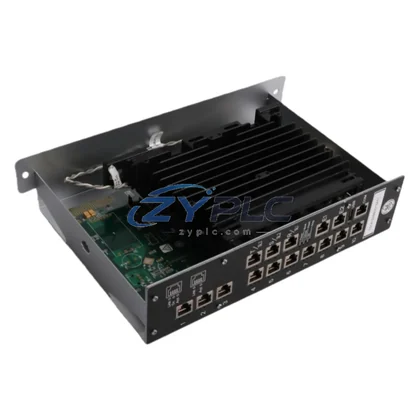
ABB GJR2396200R1210 83SR51E-E Control Module for Advant OCS Automation
The ABB GJR2396200R1210 83SR51E-E is a high-performance control module engineered for the ABB Advant OCS (Open Control System) platform — one of ABB’s most established distributed control architectures for process and discrete manufacturing environments. Designed to operate at the intersection of precision control and maintenance-focused automation, this module plays a central role in reducing unnecessary power consumption, improving equipment utilization rates, and enabling smarter production line pacing across industrial facilities.
In modern manufacturing, energy efficiency is no longer a secondary concern — it is a core operational metric. The GJR2396200R1210 addresses this directly by providing deterministic, low-latency control execution that eliminates idle cycles, reduces actuator overdrive, and ensures that motor control commands are issued only when process conditions demand them. This translates into measurable reductions in kWh consumption per production unit, particularly in applications involving variable-load machinery, conveyor systems, and multi-axis motion control.
Every unit supplied by ZYPLC undergoes full functional testing prior to shipment, is backed by a warranty terms confirmed during quotation, and is available from verified inventory for shipment arranged after confirmation. Our global logistics network ensures reliable delivery timelines for MRO procurement and emergency replacement scenarios alike.
Product Specification Table
| Parameter |
Specification / Value |
| Part Number |
GJR2396200R1210 |
| Sub-Model |
83SR51E-E |
| Brand |
ABB |
| Series |
Advant OCS |
| Module Type |
Control Module |
| Electrical / System Notes |
Low-power embedded control architecture; optimized for continuous 24/7 operation |
| Operating Efficiency |
Deterministic scan cycle execution; minimizes CPU idle overhead and redundant I/O polling |
| Compatible Systems |
ABB Advant OCS, AC 450, AC 110, Master Bus 300 (MB300) network |
| Application Environment |
Process automation, discrete manufacturing, maintenance planning, motor drive coordination |
| Maintenance Value |
Reduces actuator overdrive; supports demand-based control logic for variable-load equipment |
| Communication Protocol |
MASTERBUS / MB300; compatible with PROFIBUS and MODBUS gateway configurations |
| Origin |
Sweden (SE) |
| Warranty |
12 Months — All units tested before shipment |
System Compatibility and Application
The GJR2396200R1210 does not operate in isolation — its maintenance planning value is fully realized when integrated within a coordinated automation architecture. In a typical Advant OCS deployment, this control module interfaces directly with ABB AC 450 controller nodes to manage distributed process segments, while communicating upstream with ABB Industrial IT / System 800xA supervisory platforms for real-time energy dashboarding and KPI tracking.
On the drive side, the module’s output signals are commonly routed to ABB ACS800 series variable frequency drives (VFDs) and ACS550 drives, enabling precise motor speed regulation based on actual process demand rather than fixed-speed operation. This demand-following drive strategy is one of the most impactful levers for reducing motor load — in many facilities, motors running at 80% of rated speed consume only ~51% of full-load power (following the affinity law), and the GJR2396200R1210 provides the control logic backbone that makes this possible.
For servo-driven axes — common in packaging, press, and assembly lines — the module coordinates with ABB MicroFlex e150 servo drives and associated BSM series servo motors to synchronize motion profiles and eliminate unnecessary holding torque during idle phases. This reduces both electrical consumption and mechanical wear simultaneously.
Power quality and energy metering are handled by companion devices such as the ABB M2M energy meter modules and CM-series current monitoring relays, which feed consumption data back through the MB300 bus to the GJR2396200R1210 for closed-loop maintenance planning. On the I/O layer, ABB S800 I/O modules — including AI810 analog input and DI810 digital input cards — provide the sensor data (current, voltage, temperature, flow) that the control module uses to make maintenance decisions in real time.
HMI visibility is provided through ABB Panel 800 operator terminals or third-party SCADA systems connected via OPC-UA gateways, giving plant operators a live view of operating load trends, alarm states, and production efficiency ratios. The result is a fully instrumented automation loop where every watt consumed is accounted for and every control action is justified by process need.
Maintenance and Replacement Notes
Consider a mid-scale chemical blending facility running three parallel reactor lines, each controlled by an Advant OCS node equipped with the GJR2396200R1210. Prior to optimization, each line ran its agitator motors at fixed speed regardless of batch phase — consuming peak power even during low-viscosity mixing stages. By implementing demand-based speed references through the ACS800 VFDs, coordinated by the GJR2396200R1210’s control logic, the facility achieved a 22–28% reduction in agitator motor load without any change to batch cycle time.
In discrete manufacturing — such as automotive body panel stamping — the module’s deterministic scan cycle ensures that press drives receive motion commands with sub-millisecond jitter, allowing the line to run at its optimal mechanical cadence without the energy-wasting micro-stops caused by control latency. Fewer micro-stops mean fewer inrush current events, which directly reduces peak demand charges on the facility’s electricity tariff.
Predictive maintenance is another dimension where the GJR2396200R1210 contributes to energy efficiency. By continuously monitoring motor current signatures through the S800 AI810 analog inputs, the control system can detect early-stage bearing degradation or rotor imbalance — conditions that cause motors to draw 5–15% more current than normal. Early detection allows scheduled maintenance during planned downtime rather than emergency shutdowns, preserving both energy efficiency and production throughput.
ZYPLC maintains availability subject to RFQ confirmation of the GJR2396200R1210 83SR51E-E and can support urgent MRO requirements with same-day quotation and rapid international shipping. All units are sourced from traceable supply chains, tested on functional test benches, and shipped with full documentation.
Product Sourcing FAQ
Q1: How does the GJR2396200R1210 contribute to measurable operational stability on the production line?
The module enables demand-based control logic — issuing drive and actuator commands only when process conditions require action. When paired with ABB ACS800 or ACS550 variable frequency drives, this eliminates fixed-speed motor operation and allows speed to track actual load demand, typically reducing motor load by Actual operating results depend on the installed system, load profile, and commissioning parameters.
Q2: Is the GJR2396200R1210 compatible with modern communication protocols and condition monitoring systems?
Yes. The module operates natively on the ABB MASTERBUS / MB300 network and can interface with PROFIBUS DP and MODBUS RTU networks via gateway modules. It is fully compatible with ABB System 800xA and Industrial IT maintenance planning layers, enabling real-time power consumption data to be aggregated and visualized at the supervisory level.
Q3: Can this module replace a faulty GJR2396200R1210 in an existing Advant OCS system without reconfiguration?
In most cases, yes — the GJR2396200R1210 83SR51E-E is a direct form-fit-function replacement within compatible Advant OCS controller racks. However, firmware version alignment should be verified against the existing system configuration. ZYPLC’s technical team can assist with compatibility verification prior to shipment upon request.
Q4: What does the warranty terms confirmed during quotation cover, and what is the testing process before shipment?
Every GJR2396200R1210 unit supplied by ZYPLC undergoes a multi-stage functional test: power-on self-test, communication bus handshake verification, I/O channel integrity check, and thermal stress screening. The warranty terms confirmed during quotation covers manufacturing defects and functional failures under normal operating conditions. Units that fail any test stage are quarantined and not shipped. Replacement or refund is provided for any unit that fails within the warranty period.