ABB ACS350-03E-05A6-4 VFD for ACS350: Compatibility and Replacement Notes
The ABB ACS350-03E-05A6-4 is a 2.2 kW three-phase variable frequency drive engineered for seamless integration within the ABB ACS350 series control architecture. Rated at 5.6 A output current and designed for 380–480 V AC supply networks, this drive occupies a critical position in the motor control layer of distributed automation systems. Rather than functioning as a standalone inverter, the ACS350-03E-05A6-4 is conceived as a system-compatible component — one that coordinates with upstream controllers, downstream actuators, I/O modules, communication gateways, and human-machine interfaces to deliver consistent, scalable, and maintainable drive performance across the full automation hierarchy.
In modern industrial control architectures, the variable frequency drive is not merely a speed regulator. It is a node in a layered automation system that must respond to commands from the control layer, report status to the supervisory layer, synchronize with adjacent drives and I/O modules, and maintain operational continuity under fault conditions. The ACS350-03E-05A6-4 is designed with this architectural reality in mind, offering a combination of embedded fieldbus compatibility, configurable digital and analog I/O, and a compact DIN-rail-friendly form factor that simplifies panel integration and reduces commissioning time on the plant floor.
Product Specification Table
| Parameter |
Specification |
| System Role |
Motor Control Layer — Variable Frequency Drive |
| SKU / Model |
ACS350-03E-05A6-4 |
| Brand / Series |
ABB / ACS350 |
| Power Rating |
2.2 kW (3 HP) |
| Output Current |
5.6 A (Heavy Duty) |
| Supply Voltage |
380–480 V AC, Three-Phase |
| Frequency Range |
0–500 Hz |
| Control Mode |
Scalar (V/Hz), Vector (Sensorless) |
| Digital Inputs |
6 × Programmable DI |
| Analog Inputs |
2 × AI (0–10 V / 0–20 mA) |
| Relay Outputs |
1 × Relay Output |
| Communication |
Embedded Modbus RTU; Optional PROFIBUS DP, DeviceNet, CANopen via fieldbus adapter |
| Protection Class |
IP20 (standard); IP54 with optional kit |
| Ambient Temperature |
-10°C to +40°C (operating) |
| Installation |
DIN Rail / Panel Mount |
| Country of Origin |
Finland |
| Warranty |
warranty terms confirmed during quotation (ZYPLC) |
System Compatibility Notes
The ACS350-03E-05A6-4 achieves its full potential when deployed as part of a coordinated control system rather than as an isolated drive. In a typical ABB-centric automation architecture, the drive receives speed and torque references from an ABB AC500 PLC or an ABB 800xA DCS via Modbus RTU or a PROFIBUS DP fieldbus adapter module such as the FPBA-01. The AC500 CPU module manages the process logic, while the ACS350-03E-05A6-4 executes the motor control commands with millisecond-level response, ensuring tight synchronization between the control layer and the motor actuation layer.
At the I/O layer, the drive’s six programmable digital inputs interface directly with field devices — limit switches, proximity sensors, and safety relays — without requiring an intermediate I/O expansion module for basic applications. For more complex installations, the drive can be paired with ABB’s IOEC I/O extension modules or third-party distributed I/O blocks connected via the same fieldbus backbone, allowing the system designer to scale the I/O architecture without redesigning the drive wiring.
Power supply integrity is maintained through coordination with ABB’s UPS modules and line filters. The ACS350-03E-05A6-4 is compatible with ABB’s NOCH0010-60 EMC filter and CHK-01 choke modules, which suppress conducted emissions and protect the drive’s input rectifier from supply-side disturbances — a critical consideration in facilities where multiple drives share a common bus with sensitive instrumentation.
For human-machine interface integration, the drive supports the ACS-AP-I and ACS-AP-S assistant control panels, which provide local parameter access, fault history review, and drive-to-drive parameter copy functionality. These panels can be mounted remotely on the cabinet door, maintaining operator access without opening the enclosure. In SCADA-connected installations, the drive’s Modbus RTU interface feeds real-time speed, current, and fault data to supervisory systems such as ABB’s System 800xA or third-party SCADA platforms via a Modbus TCP gateway.
Redundancy considerations are addressed through the drive’s configurable fault response logic. In applications where motor continuity is critical — such as cooling water pumps in power generation or ventilation fans in tunnel systems — the ACS350-03E-05A6-4 can be configured to execute a controlled coast-to-stop or maintain last-known speed reference upon communication loss, preventing abrupt process interruptions. For full drive redundancy, system architects typically pair the ACS350-03E-05A6-4 with a bypass contactor circuit and a second standby drive, with changeover logic managed at the PLC level.
Terminal module coordination is handled through ABB’s standard wiring practices. The drive’s control terminals are compatible with Phoenix Contact and Weidmüller terminal blocks commonly used in ABB control cabinets, simplifying integration into existing panel layouts. Cable management and grounding follow ABB’s ACS350 hardware manual recommendations, ensuring EMC compliance in installations adjacent to sensitive analog instrumentation.
Industrial Application Notes
The ACS350-03E-05A6-4 is deployed across a wide range of industrial sectors where compact, reliable motor control is required within a structured automation hierarchy. In manufacturing and packaging lines, the drive controls conveyor motors, indexing tables, and filling pump drives, receiving speed references from a central PLC and reporting operational status to the MES layer via OPC-UA gateways. Its sensorless vector control mode delivers adequate torque accuracy for most packaging applications without the cost and complexity of encoder feedback.
In water and wastewater treatment facilities, the ACS350-03E-05A6-4 manages submersible pump motors and aeration blowers, operating under PID control loops that respond to level sensors and flow transmitters. The drive’s built-in PID controller reduces the processing load on the master PLC in simple single-loop applications, while its Modbus RTU interface ensures full integration with plant-wide SCADA systems in more complex multi-pump installations.
In the power generation and electrical substation sector, the drive controls auxiliary motor loads such as cooling fans, oil pumps, and valve actuators. Its wide supply voltage tolerance accommodates the voltage fluctuations common in industrial power networks, and its configurable undervoltage trip threshold allows system engineers to tune the drive’s response to site-specific power quality conditions.
In mining and metallurgical applications, the drive operates in high-dust, high-vibration environments where its IP20 enclosure is supplemented by a sealed control cabinet. The drive’s robust thermal management and configurable switching frequency allow it to operate reliably at elevated ambient temperatures, extending service intervals and reducing unplanned downtime in remote installations where maintenance access is limited.
In petrochemical and process industries, the ACS350-03E-05A6-4 controls agitator motors, transfer pumps, and compressor auxiliaries within hazardous area control panels. While the drive itself is not ATEX-rated, it is routinely installed in purged and pressurized enclosures adjacent to ATEX-certified motor starters, with the drive’s analog output providing speed feedback to the DCS for process optimization.
Product Compatibility FAQ
Q1: Is the ACS350-03E-05A6-4 compatible with ABB AC500 PLCs and third-party SCADA systems via Modbus RTU?
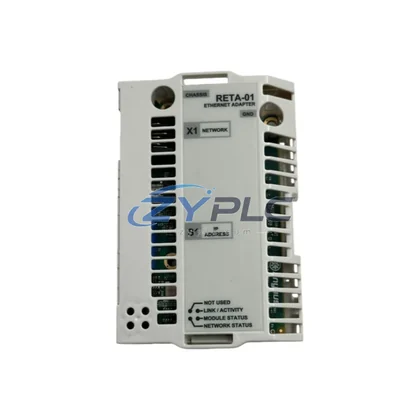
Yes. The ACS350-03E-05A6-4 includes an embedded Modbus RTU interface on its standard control board, supporting RS-485 communication at configurable baud rates up to 115,200 bps. It can be addressed as a Modbus slave device by any Modbus RTU master, including ABB AC500 CPUs, Siemens S7 series PLCs with RS-485 communication modules, and third-party SCADA gateways. For PROFIBUS DP or DeviceNet integration, the optional FPBA-01 or FDNA-01 fieldbus adapter modules are installed in the drive’s option slot without requiring hardware modification to the drive itself. The warranty terms confirmed during quotation covers the drive and all factory-installed option modules.
Q2: Can the ACS350-03E-05A6-4 be used in a redundant drive architecture, and what changeover logic is required?
The ACS350-03E-05A6-4 supports redundant drive configurations through external bypass contactor circuits. In a typical 1+1 redundant arrangement, both the duty drive and the standby drive are wired to the motor through a motorized changeover contactor, with the changeover logic implemented in the master PLC. The drive’s digital output relay can signal a fault condition to the PLC, triggering automatic changeover within the PLC scan cycle. ABB’s ACS350 hardware manual provides recommended wiring diagrams for bypass configurations. ZYPLC supplies matched pairs of ACS350-03E-05A6-4 units for redundant installations, both covered under the warranty terms confirmed during quotation, ensuring consistent parameter sets and firmware versions between duty and standby drives.
Q3: What commissioning steps are required when integrating the ACS350-03E-05A6-4 into an existing ACS350 system architecture, and how does the warranty terms confirmed during quotation apply to field-commissioned units?
Commissioning the ACS350-03E-05A6-4 in an existing ACS350 architecture follows ABB’s standard startup wizard procedure, accessible via the ACS-AP-I control panel or the Drive Composer PC tool. Key steps include motor nameplate data entry, control mode selection (scalar or sensorless vector), I/O configuration, fieldbus address assignment, and PID parameter tuning if the built-in controller is used. For replacement units in an existing installation, the parameter set from the outgoing drive can be uploaded via the ACS-AP-S panel’s parameter copy function and downloaded to the new unit in minutes, minimizing process downtime. ZYPLC’s warranty terms confirmed during quotation covers manufacturing defects and component failures under normal operating conditions. Units that have been commissioned and are operating within the drive’s rated specifications remain fully covered. ZYPLC’s technical team provides pre-shipment parameter loading on request, reducing on-site commissioning time for remote or time-critical installations.