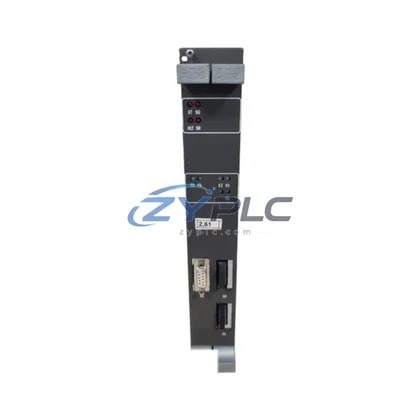
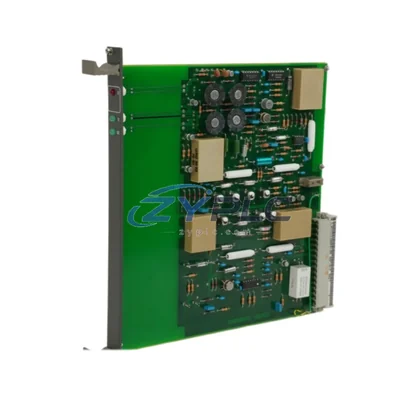
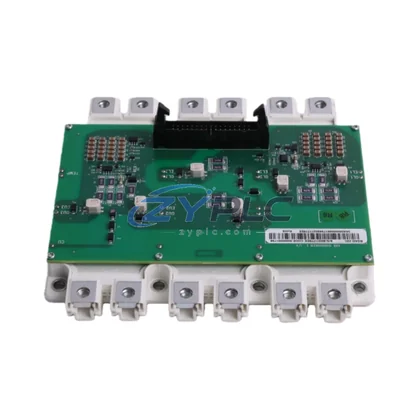
ABB CMA133 3DDE300413 Terminal Board: Control System and system integration for MOD 300
The ABB CMA133 3DDE300413 Terminal Board is a precision-engineered signal termination and wiring interface module designed for deployment within ABB’s MOD 300 Distributed Control System (DCS) architecture. As a foundational component of the field I/O layer, the CMA133 3DDE300413 provides the critical physical and electrical bridge between field instrumentation and the DCS controller subsystem, enabling reliable signal conditioning, loop integrity, and structured cable management across complex industrial automation environments.
In modern process control architectures, terminal boards are not peripheral accessories — they are load-bearing elements of system reliability. The CMA133 3DDE300413 is engineered to meet the demanding requirements of continuous-process industries where signal fidelity, installation consistency, and long-term maintainability are non-negotiable. Its design supports structured wiring discipline, reduces commissioning time, and ensures that field signals arrive at the controller layer with full integrity and traceability.
Every unit supplied by ZYPLC is covered by a warranty terms confirmed during quotation and has been verified through functional inspection prior to dispatch, ensuring that your system integration proceeds without component-level uncertainty.
Product Specification Table
| Parameter |
Specification |
| Part Number |
CMA133 / 3DDE300413 |
| Manufacturer |
ABB (ASEA Brown Boveri) |
| Product Type |
Terminal Board / Signal Termination Module |
| Compatible Platform |
ABB MOD 300 Distributed Control System (DCS) |
| System Role |
Field I/O Termination — Signal Interface Layer |
| Signal Types Supported |
Analog Input/Output, Digital I/O (platform-dependent) |
| Electrical Interface |
Screw-terminal field wiring connections; backplane connector to I/O module |
| Installation Method |
DIN rail or panel-mount within MOD 300 I/O cabinet |
| Communication Capability |
Passive termination; interfaces with MOD 300 I/O bus via paired I/O module |
| Operating Temperature |
0°C to +60°C (typical industrial DCS environment) |
| Country of Origin |
Sweden |
| system integration |
Fully compatible with MOD 300 I/O subsystem for seamless system integration |
| Warranty |
warranty terms confirmed during quotation — all units tested prior to shipment |
| Availability |
RFQ Available — global shipping available |
System Compatibility Notes
The CMA133 3DDE300413 Terminal Board operates as a structured wiring node within the ABB MOD 300 DCS, and its value is best understood in the context of the full control system architecture it supports. In a typical MOD 300 installation, the system is organized across multiple functional layers: the controller layer, the I/O termination layer, the field bus and communication layer, the power distribution layer, the human-machine interface layer, and the field execution layer. The CMA133 sits at the intersection of the I/O termination and field execution layers, making it a critical enabler of system-wide signal coherence.
At the controller layer, ABB MOD 300 systems are typically anchored by processor modules such as the ABB DSPC110 or DSPC172 CPU boards, which handle real-time process logic, loop calculations, and system-level coordination. These controllers communicate with the I/O subsystem through dedicated backplane buses, where the terminal board’s role becomes essential: every field signal that reaches the CPU must first pass through a properly terminated and shielded wiring interface.
The CMA133 3DDE300413 pairs directly with ABB MOD 300 I/O modules — including analog input modules such as the DSDP110 and digital output modules such as the DSDO110 — to form a complete signal chain from field device to controller. The terminal board provides the physical screw-terminal interface for field cables, while the I/O module handles signal conversion, scaling, and bus communication. This modular pairing approach is central to MOD 300’s maintainability philosophy: field wiring remains connected to the terminal board while the I/O module can be replaced or serviced independently, dramatically reducing mean time to repair (MTTR) in live production environments.
Power distribution within the MOD 300 cabinet is typically managed through ABB power supply modules such as the DSSB110 or equivalent 24VDC distribution units, which feed both the I/O modules and the field loop power circuits terminated at the CMA133. Proper power architecture ensures that signal ground references are maintained consistently across all termination points, preventing ground loop interference that can corrupt analog measurements in sensitive process applications.
For communication-intensive architectures, the MOD 300 system may incorporate DSCL110 or similar communication link modules that extend the I/O bus across cabinet boundaries or interface with higher-level SCADA and historian systems. The terminal board’s role in maintaining clean, labeled, and traceable field wiring directly supports the diagnostic transparency required when troubleshooting communication anomalies across distributed I/O nodes.
At the human-machine interface layer, operators interact with the process through ABB operator stations or third-party HMI panels connected via the MOD 300 plant network. The data quality displayed on these interfaces is a direct function of the signal integrity maintained at the I/O termination layer — making the CMA133 3DDE300413 an invisible but indispensable contributor to operator situational awareness and process safety.
In redundant system designs, MOD 300 architectures may deploy paired I/O modules and dual terminal board configurations to ensure that a single component failure does not interrupt process monitoring or control. The CMA133’s passive termination design makes it inherently compatible with redundant I/O strategies, as field wiring can be distributed across primary and secondary termination paths without active component dependencies.
Industrial Application Notes
Oil, Gas, and Petrochemical Processing: In upstream and downstream hydrocarbon processing facilities, the ABB MOD 300 DCS has been widely deployed for decades to manage continuous process variables including temperature, pressure, flow, and level. The CMA133 3DDE300413 Terminal Board provides the structured field wiring interface required for intrinsically safe loop terminations, HART-enabled transmitter connections, and multi-conductor cable management in hazardous area control rooms. Its compatibility with the MOD 300 I/O architecture ensures that legacy installations can be maintained and extended without requiring full system migration.
Power Generation and Utilities: Thermal power plants, combined-cycle facilities, and utility substations operating ABB MOD 300 systems rely on terminal boards like the CMA133 to maintain signal integrity across long cable runs from turbine hall instrumentation to the central control room. In these environments, the terminal board’s role in maintaining consistent shield grounding and cable segregation is critical to preventing electromagnetic interference from high-voltage switching equipment.
Chemical and Pharmaceutical Manufacturing: Batch and continuous chemical processes demand precise analog signal management for reactor temperature control, feed flow regulation, and product quality monitoring. The CMA133 3DDE300413 supports the structured I/O termination required for GMP-compliant installations, where cable traceability, labeled terminations, and documented wiring configurations are mandatory for regulatory audit readiness.
Water and Wastewater Treatment: Municipal and industrial water treatment facilities using ABB MOD 300 for pump control, dosing system management, and effluent monitoring benefit from the CMA133’s robust termination design, which withstands the humid and corrosive cabinet environments common in water treatment applications.
Mining and Metals Processing: In mineral processing plants and smelting operations, where vibration, dust, and thermal cycling place extreme demands on control system hardware, the CMA133 3DDE300413 provides a reliable termination point that maintains connection integrity under conditions that would compromise less robust wiring interfaces.
Product Compatibility FAQ
Q1: Is the CMA133 3DDE300413 compatible with all MOD 300 I/O module variants, and can it be used in mixed-generation MOD 300 cabinets?
The CMA133 3DDE300413 is designed for use within the ABB MOD 300 DCS I/O subsystem and is compatible with the standard MOD 300 I/O module form factor and backplane connector specification. In mixed-generation MOD 300 cabinets — where early and later revision I/O modules may coexist — the terminal board’s passive termination design ensures compatibility as long as the paired I/O module matches the signal type and channel configuration. We recommend verifying the specific I/O module part number and revision against your system’s engineering documentation before installation. Our technical team can assist with compatibility confirmation prior to order.
Q2: How does the CMA133 support system redundancy, and what is the recommended installation approach for high-availability MOD 300 architectures?
In high-availability MOD 300 architectures, redundancy is typically implemented at the I/O module level, with dual I/O modules sharing a common field wiring termination or using separate terminal boards for primary and secondary signal paths. The CMA133 3DDE300413’s passive design makes it suitable for both approaches. For critical loops requiring full redundancy, the recommended practice is to use separate terminal boards for primary and secondary field wiring, ensuring that a single terminal board failure does not affect both control paths. This approach also simplifies maintenance, as each terminal board can be inspected and replaced independently without disturbing the redundant signal path.
Q3: What does the warranty terms confirmed during quotation cover, and what is the process for warranty claims or technical support after installation?
All CMA133 3DDE300413 Terminal Boards supplied by ZYPLC are covered by a warranty terms confirmed during quotation from the date of shipment. The warranty covers manufacturing defects, functional failures under normal operating conditions, and component-level faults identified during installation or commissioning. Units are functionally tested prior to dispatch to minimize the risk of DOA (dead-on-arrival) failures. In the event of a warranty claim, customers should contact ZYPLC directly with the order reference, a description of the observed fault, and installation details. Our technical support team will coordinate replacement or repair on a priority basis to minimize system downtime. For ongoing technical support, pre-sales compatibility consultation, and spare parts planning, contact us at +86 19859288691 or plc.sales@zyplc.com.