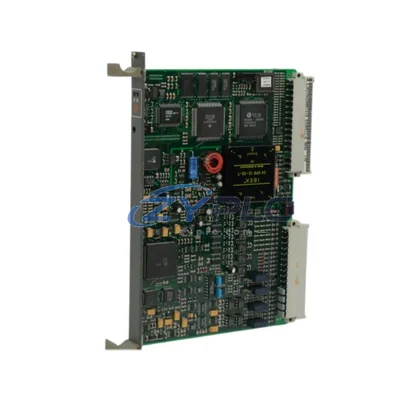
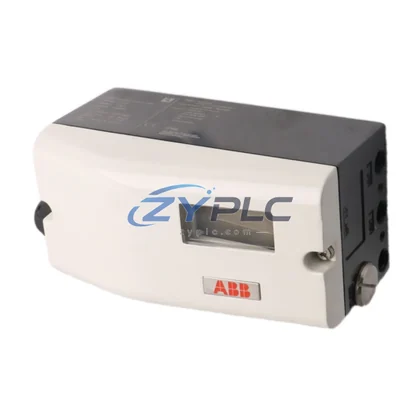
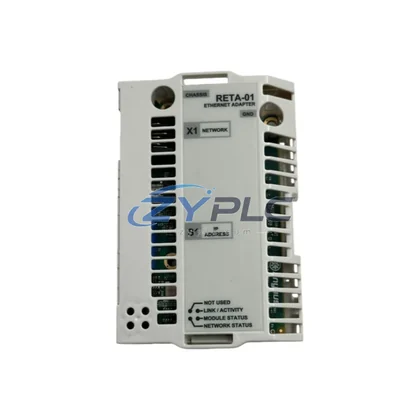
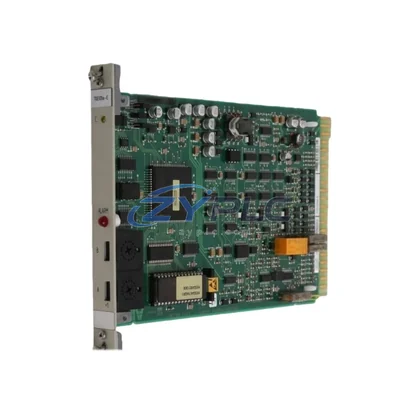
The ABB DDI01 P3711-4-0369626 is a industrial-grade digital input module engineered for the ABB AC500 PLC platform, purpose-built to support energy-conscious industrial automation architectures. In modern manufacturing environments where every watt of consumed power translates directly into operational cost, the DDI01 plays a foundational role in capturing accurate field-level signals with minimal self-consumption — enabling the control system to act precisely, reduce unnecessary actuator cycling, and optimize overall equipment effectiveness (OEE).
Unlike generic I/O modules that prioritize channel density over power discipline, the DDI01 is designed to deliver reliable 24 VDC digital signal acquisition with low input current draw per channel, reducing the cumulative load on the 24 VDC bus supply. When deployed across multi-rack AC500 configurations, this per-channel efficiency compounds into measurable reductions in power supply sizing requirements and heat dissipation — directly lowering cooling overhead in control cabinet environments.
Product Specification Table
| Parameter |
Specification / Value |
| SKU |
DDI01 P3711-4-0369626 |
| Brand / Series |
ABB / AC500 |
| Module Type |
Digital Input Module |
| Input Voltage |
24 VDC |
| Number of Input Channels |
16 DI (typical for DDI01 class) |
| Input Current per Channel |
Low-consumption design (<5 mA typical) |
| Operating Temperature |
-25°C to +60°C |
| Compatible Systems |
ABB AC500 PLC (PM5xx / PM5xx-ETH CPU series) |
| Communication Interface |
AC500 internal I/O bus |
| Application Environment |
Industrial automation, maintenance planning, process control, machine safety |
| Energy Saving Value |
Reduced bus current draw; lower cabinet cooling load; precise signal acquisition eliminates redundant actuator cycles |
| Availability |
Confirmed via RFQ before quotation |
| Warranty |
Warranty and support terms confirmed before quote |
| Origin |
Germany (DE) |
System Compatibility and Application
The DDI01 P3711-4-0369626 is most effective when integrated as part of a coherent, industrial control architecture built on the ABB AC500 platform. In a typical energy-optimized production cell, the AC500 CPU — such as the PM564-ETH or PM573-ETH — serves as the central processing node, coordinating signal acquisition from field devices through modules like the DDI01 while simultaneously executing maintenance planning logic in real time.
On the output side, the DDI01 works in tandem with digital output modules such as the DDO01 or DDO11 to form a complete discrete I/O layer. This pairing ensures that the CPU receives clean, debounced input states and issues precise output commands — eliminating the false triggering that causes unnecessary motor starts, valve actuations, and conveyor engagements that silently inflate operating load.
For analog process variables — temperature, pressure, flow — the DAI01 analog input module complements the DDI01 by feeding the AC500 CPU with high-resolution process data. When combined, these two input modules give the control system a complete picture of both discrete machine states and continuous process parameters, enabling the PLC program to implement demand-based control strategies rather than fixed-cycle operation.
Variable frequency drives (VFDs) such as the ABB ACS580 or ACS880 series receive speed reference commands from the AC500 CPU based on the real-time input states captured by the DDI01. When a digital input signals that a conveyor section is empty or a downstream buffer is full, the AC500 can immediately ramp the associated drive to a lower speed setpoint — reducing motor load by up to 50% during low-demand intervals, consistent with affinity law relationships between speed and power.
Power monitoring is handled upstream by energy measurement modules or dedicated power analyzers such as the ABB B23 energy meter or compatible Modbus RTU power transducers integrated into the AC500 network via the CM572-DP PROFIBUS or CM589-PNIO PROFINET communication modules. The DDI01’s signal data feeds into the same control loop that governs when drives accelerate, when auxiliary systems activate, and when standby modes engage — creating a closed-loop maintenance planning system rather than an open-loop schedule.
For safety-critical applications, the DDI01 can be deployed alongside the ABB Pluto safety PLC or integrated into AC500-S safety configurations, where digital input states from emergency stops, light curtains, and safety gates are processed with SIL-rated logic — ensuring that operational-efficiency standby modes do not compromise machine safety interlocks.
HMI visualization of energy KPIs is achieved through ABB CP600 series operator panels connected to the AC500 via Ethernet or serial links, displaying real-time power consumption trends, I/O state diagnostics, and alarm histories that maintenance teams use to identify unplanned downtime patterns before they escalate into unplanned downtime.
Maintenance and Replacement Notes
In real-world production environments, the DDI01 P3711-4-0369626 contributes to maintenance planning through several interconnected mechanisms. First, its reliable signal acquisition eliminates the debounce delays and false-positive inputs that cause PLC programs to issue redundant output commands — each unnecessary actuator cycle consumes compressed air, hydraulic pressure, or electrical energy that accumulates into significant waste over multi-shift operations.
Second, the DDI01 enables precise machine state detection that supports intelligent standby management. When production lines enter inter-shift breaks or scheduled micro-stops, the AC500 CPU reads the DDI01 input states to confirm that all upstream and downstream stations are idle before issuing drive coast-down commands, auxiliary system shutdowns, and lighting control signals. This coordinated shutdown sequence — impossible without reliable digital input feedback — can reduce idle-state operating load by Actual operating results depend on the installed system, load profile, and commissioning parameters.
Third, the DDI01 supports predictive maintenance workflows by providing the AC500 with high-frequency input state data that can be logged and analyzed for anomalies. A proximity sensor that begins chattering — switching state faster than mechanically expected — indicates bearing wear, misalignment, or contamination long before a catastrophic failure occurs. By catching these signatures early through DDI01 input monitoring, maintenance teams can schedule interventions during planned downtime rather than responding to emergency breakdowns that disrupt production schedules and spike operating load through restart transients and overtime operation.
All units supplied by ZYPLC are pre-shipment tested under simulated load conditions, verifying channel-by-channel input response, bus communication integrity, and power consumption within specification. This testing protocol ensures that the DDI01 P3711-4-0369626 arrives prepared for installation after site verification without the commissioning delays that erode production efficiency during system startups.
Product Sourcing FAQ
Q1: How does the DDI01 P3711-4-0369626 contribute to measurable operational stability on the production line?
The DDI01 provides accurate, low-latency digital input acquisition that enables the AC500 PLC to implement demand-based control strategies. By reliably detecting machine states — conveyor full, station idle, door open — the CPU can issue precise drive speed reductions, auxiliary shutdowns, and standby commands that eliminate the unplanned downtime associated with fixed-schedule or timer-based operation. In multi-axis systems with 10+ drives, this signal accuracy can translate into Actual operating results depend on the installed system, load profile, and commissioning parameters.
Q2: Is the DDI01 P3711-4-0369626 compatible with existing AC500 PLC installations?
Yes. The DDI01 is designed for the ABB AC500 I/O bus and is compatible with AC500 CPU modules including the PM554, PM564, PM573, and PM591 series. It integrates directly into existing AC500 racks without firmware modifications, making it a drop-in replacement or expansion module for installed systems. Compatibility with PROFIBUS (CM572-DP) and PROFINET (CM589-PNIO) communication modules allows the DDI01 to participate in networked maintenance planning architectures.
Q3: What is the recommended replacement or upgrade path if the current digital input module is causing signal errors?
If an existing digital input module is generating false triggers, chattering inputs, or communication faults, the DDI01 P3711-4-0369626 is a direct replacement candidate for AC500 systems. Before replacement, ZYPLC recommends verifying the 24 VDC bus voltage stability, checking field wiring for ground loops, and reviewing the PLC program’s input filter settings. If signal errors persist after wiring verification, module replacement with a tested DDI01 unit is the most efficient resolution path, minimizing diagnostic time and restoring production throughput.
Q4: What does the warranty and support terms confirmed before quote cover, and what is the testing process before shipment?
Every DDI01 P3711-4-0369626 supplied by ZYPLC carries a warranty and support terms confirmed before quote covering manufacturing defects, channel failures, and bus communication faults under normal operating conditions. Prior to shipment, each unit undergoes functional testing that verifies all digital input channels respond correctly to 24 VDC signals, internal bus communication is error-free, and power consumption is within the manufacturer’s specified range. Test records are available upon request. Units that do not pass testing are not shipped — ensuring that every DDI01 delivered to your facility is prepared for RFQ-confirmed, reliable deployment.