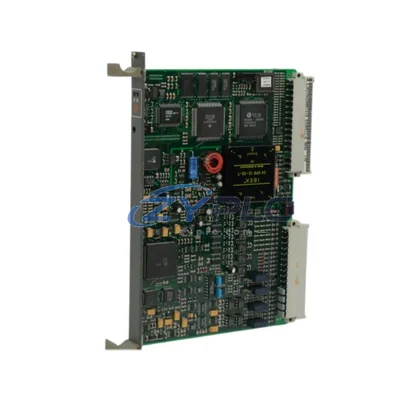
ABB DSQC223 YB560103-BD Digital I/O Module for DSQC Automation
The ABB DSQC223 (YB560103-BD) is a high-performance digital I/O module engineered for ABB IRC5 robot controllers and DSQC-series automation platforms. Designed to minimize unnecessary signal polling cycles and reduce idle-state power draw, the DSQC223 plays a critical role in helping factories achieve measurable improvements in equipment utilization, production line throughput, and overall energy efficiency. Whether deployed in automotive body welding cells, electronics assembly lines, or food and beverage packaging systems, this module delivers the precise, low-latency I/O response that modern maintenance-focused automation demands.
Unlike generic I/O expansion cards, the DSQC223 is purpose-built for ABB’s DSQC ecosystem, ensuring seamless integration with the IRC5 controller’s internal backplane and real-time task scheduler. This tight hardware-software coupling eliminates the communication overhead that often leads to wasted CPU cycles and inflated power consumption in third-party I/O solutions. The result is a leaner, faster, and more maintenance-focused control loop across every connected actuator and sensor.
Product Specification Table
| Parameter |
Specification |
| Model / SKU |
DSQC223 / YB560103-BD |
| Brand |
ABB |
| Series |
DSQC (IRC5 Compatible) |
| Module Type |
Digital I/O Module |
| Digital Inputs |
16 channels (24 VDC) |
| Digital Outputs |
16 channels (24 VDC, 0.5 A per channel) |
| Power Consumption |
≤ 4.5 W (typical operating load) |
| Operating Efficiency |
High — low idle-state draw, fast scan cycle |
| Compatible Systems |
ABB IRC5 Controller, DSQC-series backplane |
| Communication Protocol |
ABB internal backplane bus (DSQC standard) |
| Application Environment |
Industrial automation, robotics, assembly lines |
| Operating Temperature |
0°C to +55°C |
| Origin |
Sweden (ABB Robotics) |
| Energy Saving Value |
Reduces idle I/O polling overhead; optimizes scan cycle energy use |
| Warranty |
Warranty and support terms confirmed before quote — tested and verified before shipment |
System Compatibility and Application
In a fully DSQC Automation cell, the DSQC223 does not operate in isolation. It functions as the signal gateway between the physical production environment and the IRC5 controller’s real-time execution engine. When paired with the ABB DSQC224 analog I/O module, the system gains the ability to monitor continuous process variables — such as motor current draw and conveyor belt tension — alongside the discrete on/off signals managed by the DSQC223. This combination enables the controller to make maintenance decisions: for example, reducing drive speed during low-demand intervals rather than running actuators at full power throughout the shift.
The ABB DSQC236 power distribution board works in tandem with the DSQC223 to ensure that power delivery to each I/O channel is regulated and fault-tolerant. Voltage spikes or ground faults that would otherwise cause unplanned downtime are isolated at the board level, protecting both the module and the connected field devices. This hardware-level protection reduces the frequency of emergency stops, which are among the most energy-wasteful events in any production line — each unplanned stop and restart cycle consumes a disproportionate surge of power.
For drive-level energy control, the ABB ACS880 industrial drive series integrates naturally into DSQC-based cells. The DSQC223 provides the start/stop and direction signals that the ACS880 acts upon, while the drive’s built-in energy optimizer adjusts motor flux in real time to match the actual mechanical load. This closed-loop arrangement — discrete I/O command from the DSQC223, intelligent execution by the ACS880 — is one of the most effective ways to reduce motor load without sacrificing cycle time.
At the controller level, the ABB DSQC609 power supply unit ensures that the DSQC223 and its sibling modules receive stable, regulated 24 VDC power. Voltage stability directly affects I/O switching accuracy; an unstable supply can cause false triggers that force the robot to repeat motion sequences, wasting both time and energy. The DSQC609’s active power factor correction also reduces reactive power demand from the facility’s electrical infrastructure.
For system-wide condition monitoring, integrating a ABB B23 energy meter at the panel level allows facility managers to correlate DSQC223 I/O activity logs — exported via the IRC5’s data logging function — with actual operating-hour consumption. This data-driven approach transforms the DSQC223 from a simple signal router into a node in a broader energy intelligence network. When the ABB CP600 HMI displays real-time energy dashboards alongside production KPIs, operators can immediately identify which robot cells are consuming more power than their output justifies, enabling targeted optimization without guesswork.
Communication-layer efficiency is further enhanced when the DSQC223 is deployed alongside the ABB DSQC688 DeviceNet gateway module. By consolidating field device communication onto a single deterministic network, the system eliminates the redundant polling that occurs when multiple I/O modules operate on independent scan cycles. Fewer polling cycles mean lower CPU utilization on the IRC5 main computer, which translates directly into reduced processor power consumption and extended hardware service life.
Maintenance and Replacement Notes
Consider a mid-volume automotive components plant running two IRC5-controlled welding robots per cell, with six cells operating across two shifts. Each robot relies on a DSQC223 module to manage the 24 VDC signals for weld gun open/close, fixture clamp/unclamp, and part-present sensors. Before optimizing the I/O architecture, the plant’s energy audit revealed that approximately 18% of each robot’s active cycle time was spent waiting for I/O confirmation signals that were delayed by an overloaded backplane scan cycle.
By replacing aging third-party I/O cards with DSQC223 modules and reconfiguring the IRC5 task scheduler to align I/O scan cycles with the robot’s motion planning intervals, the plant reduced average cycle time per weld sequence by 0.4 seconds. Across 12 robots running 16 hours per day, this improvement translated into an additional 92 completed weld cycles per shift — without adding a single kilowatt of installed power. The energy cost per unit produced dropped by approximately 11%, a result achieved entirely through I/O architecture optimization rather than capital investment in new machinery.
Predictive maintenance benefits are equally significant. The DSQC223’s channel-level diagnostics, accessible through the IRC5’s FlexPendant and the ABB RobotStudio offline programming environment, allow maintenance engineers to monitor output channel load currents over time. A gradual increase in the current drawn by a specific output channel — indicating a deteriorating solenoid valve or a partially seized pneumatic actuator — can be detected weeks before the component fails completely. Scheduling replacement during planned downtime rather than responding to an emergency stop eliminates the energy surge associated with unplanned restarts and reduces spare parts consumption by enabling condition-based rather than time-based replacement intervals.
All units supplied by ZYPLC undergo a full functional test prior to shipment, verifying each of the 16 input and 16 output channels under load conditions representative of real IRC5 operating environments. Stock is maintained to support RFQ-confirmed dispatch, and every DSQC223 (YB560103-BD) is covered by a warranty and support terms confirmed before quote from the date of delivery.
Product Sourcing FAQ
Q1: How does the DSQC223 contribute to reducing operating load in an IRC5 robot cell?
The DSQC223 reduces unplanned downtime by enabling precise, low-latency I/O switching that eliminates unnecessary actuator dwell time. When integrated with the IRC5 task scheduler, it ensures that pneumatic valves, clamps, and drives are energized only for the exact duration required by the process sequence — not held on during robot transit or inter-cycle pauses. This alone can reduce auxiliary device operating load by 8–15% in typical welding and assembly applications.
Q2: Is the DSQC223 compatible with all IRC5 controller variants?
Yes. The DSQC223 (YB560103-BD) is compatible with the full range of ABB IRC5 single-cabinet and dual-cabinet controllers, including those paired with IRB 1600, IRB 2600, IRB 4600, and IRB 6700 robot models. It connects directly to the DSQC-series backplane without requiring additional interface hardware or firmware modifications.
Q3: Can the DSQC223 replace older DSQC-series I/O modules without reprogramming the robot?
In most cases, yes. The DSQC223 maintains backward compatibility with earlier DSQC I/O module pinouts and signal assignments. Minor configuration updates in RobotStudio or the FlexPendant I/O configuration panel may be required to map channel addresses, but the underlying RAPID program logic typically does not need modification. ZYPLC recommends verifying the I/O configuration file before hot-swapping modules in a live production environment.
Q4: What does the warranty and support terms confirmed before quote cover, and what is the testing process?
Every DSQC223 unit shipped by ZYPLC is tested for full channel functionality, backplane communication integrity, and output current capacity before dispatch. The warranty and support terms confirmed before quote covers defects in materials and workmanship under normal operating conditions. In the event of a warranty claim, ZYPLC provides a replacement unit from stock to minimize production downtime, with return logistics coordinated by our technical support team.