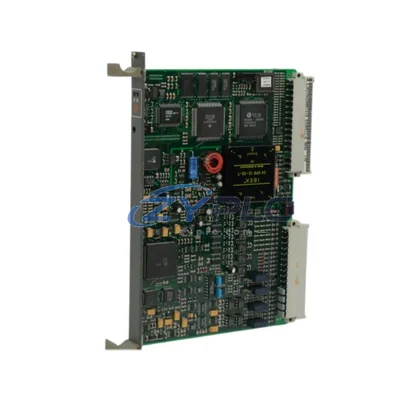
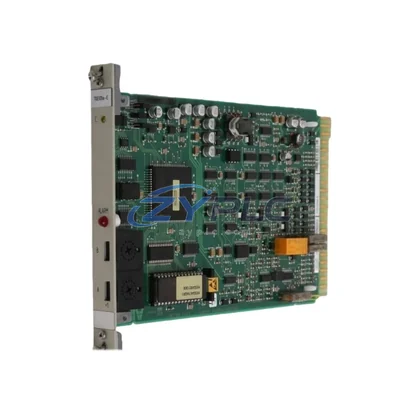
The ABB EZINP-771 is a precision-engineered industrial input module designed to operate as an integral component within the ABB INFI 90 Distributed Control System (DCS) architecture. Rather than functioning as a standalone device, the EZINP-771 is purpose-built to serve a defined role within a layered automation hierarchy — acquiring field-level analog signals and delivering conditioned data upward through the control network to the central processing and supervisory layers. Understanding its position within the full system stack is essential for engineers responsible for system design, expansion, and long-term maintenance.
In a complete INFI 90 control architecture, the EZINP-771 occupies the I/O layer, interfacing directly with field transmitters, sensors, and process instruments. Its conditioned signal outputs feed into the INFI 90 Nodebus or Controlway communication backbone, where data is consumed by the IMMFP12 or IMMFP02 Multi-Function Processors — the computational core of the INFI 90 system. This signal flow ensures that process variables such as temperature, pressure, flow, and level are accurately represented at the control layer, enabling closed-loop regulation and supervisory logic execution.
Product Specification Table
| Parameter |
Specification |
| System Role |
Analog Input Module — I/O Layer, INFI 90 DCS |
| Compatible Platform |
ABB INFI 90 / Bailey Controls DCS |
| Module Type |
Industrial Input Module (Analog Signal Acquisition) |
| Communication Interface |
INFI 90 Nodebus / Controlway |
| Signal Input Type |
Analog (4–20 mA / 1–5 VDC, field-configurable) |
| Electrical Supply |
Powered via INFI 90 backplane (NKTU01 / NKTU02 termination unit) |
| Installation Environment |
DIN-rail or rack-mount within INFI 90 cabinet enclosure |
| Operating Temperature |
0°C to 60°C (standard industrial range) |
| system integration |
Full system integration with INFI 90 processor and I/O bus |
| Warranty |
warranty terms confirmed during quotation — functional and electrical performance guaranteed |
| Condition |
Tested, inspected, and ready for system deployment |
| Origin |
Germany (ABB / Bailey Controls manufacturing) |
System Compatibility Notes
The EZINP-771 does not operate in isolation. Its value is realized through tight coordination with adjacent modules across all system layers. At the power layer, the INFI 90 system relies on the NPSM01 or NPSM02 Power Supply Modules to deliver stable, regulated DC power to the backplane, ensuring that input modules like the EZINP-771 receive consistent electrical supply without voltage fluctuation that could compromise signal accuracy.
At the backplane and rack layer, the EZINP-771 is installed into an INFI 90 module rack — typically the NKTU01 or NKTU02 termination unit assembly — which provides the physical and electrical interface between the module and the field wiring. The rack architecture supports hot-swap capability in redundant configurations, allowing the EZINP-771 to be replaced during live system operation without process interruption, a critical feature in continuous manufacturing and power generation environments.
At the processing layer, the IMMFP12 Multi-Function Processor reads the conditioned analog values from the EZINP-771 via the Nodebus, executes configured control algorithms, and generates output commands directed to analog output modules such as the IMDSO14 or IMASO01. This closed-loop signal path — from field sensor through EZINP-771 to processor to output module — forms the fundamental control loop of the INFI 90 architecture.
For systems requiring communication with higher-level SCADA or DCS supervisory platforms, the INFI 90 architecture incorporates communication gateway modules such as the IMCIS02 or INICT03A, which translate Nodebus data into Modbus RTU, PROFIBUS DP, or OPC-compatible formats. The EZINP-771’s data is thus accessible at the network layer without any modification to the module itself, demonstrating the inherent system integration capability of the INFI 90 platform.
At the human-machine interface layer, operators interact with process data — including values sourced from the EZINP-771 — through INFI 90-compatible HMI workstations or modern OPC-connected SCADA systems. The seamless data path from field input to operator display is a hallmark of the INFI 90 system’s layered architecture, and the EZINP-771 is a foundational element of that path.
Industrial Application Notes
The ABB EZINP-771 finds application across a broad range of process industries where the INFI 90 DCS platform has been deployed. In power generation facilities — including coal-fired, gas turbine, and combined-cycle plants — the EZINP-771 acquires analog signals from boiler instrumentation, turbine sensors, and generator monitoring circuits, feeding real-time data to the INFI 90 control processors that manage combustion optimization, load dispatch, and protective relay coordination.
In petrochemical and refinery environments, the EZINP-771 supports continuous process monitoring across distillation columns, heat exchangers, and reactor vessels. Its ability to handle 4–20 mA transmitter signals from pressure, temperature, and flow instruments makes it a versatile acquisition module for both regulatory control loops and safety instrumented system (SIS) data acquisition paths.
Water treatment and wastewater management facilities operating INFI 90 systems rely on the EZINP-771 for monitoring pump station parameters, chemical dosing feedback, and effluent quality measurements. The module’s stable performance in variable ambient conditions — typical of outdoor pump stations and treatment basins — makes it well-suited for these demanding environments.
In mining and mineral processing operations, where INFI 90 systems control conveyor drives, crusher circuits, and flotation cell processes, the EZINP-771 provides reliable analog input acquisition from load cells, belt scales, and level sensors. Its compatibility with the INFI 90 backplane architecture ensures that system expansions — adding new measurement points as production capacity grows — can be accomplished without architectural redesign.
Metallurgical and steel mill applications similarly benefit from the EZINP-771’s role in temperature and flow monitoring across furnace control systems, rolling mill drives, and cooling water circuits. The module’s warranty terms confirmed during quotation and tested condition provide plant engineers with confidence in system reliability during critical production campaigns.
Product Compatibility FAQ
Q1: Is the EZINP-771 compatible with all INFI 90 rack configurations, and can it be mixed with other I/O modules in the same rack?
The EZINP-771 is designed for installation in standard INFI 90 module racks and is fully compatible with the NKTU01 and NKTU02 termination unit assemblies. It can coexist in the same rack with other INFI 90 I/O modules — including analog output modules such as the IMASO01 and digital I/O modules such as the IMDSO14 — provided that the rack’s slot assignments and Nodebus addressing are correctly configured in the INFI 90 engineering workstation. Mixed-module rack configurations are standard practice in INFI 90 system design and do not require any hardware modification to the EZINP-771.
Q2: How does the EZINP-771 support system redundancy, and what is the recommended approach for redundant input configurations?
In INFI 90 architectures requiring redundant analog input acquisition, the EZINP-771 can be deployed in paired configurations where two modules monitor the same field signal through separate termination paths. The INFI 90 Multi-Function Processor — typically the IMMFP12 — supports redundant I/O scanning, selecting the primary module’s value under normal conditions and automatically switching to the secondary module upon detection of a fault condition. This redundancy architecture is particularly important in power generation and petrochemical applications where loss of a critical measurement point could trigger an unplanned process shutdown. Our team can advise on the specific rack slot assignments and processor configuration required for your redundancy design.
Q3: What does the warranty terms confirmed during quotation cover, and what support is available for installation and commissioning of the EZINP-771?
The warranty terms confirmed during quotation covers all functional and electrical performance parameters of the EZINP-771 as tested and documented prior to shipment. If the module fails to perform within its specified operating parameters during the warranty period under normal installation and operating conditions, a replacement or repair will be provided at no additional cost. For installation and commissioning support, our engineering team is available to assist with Nodebus addressing, termination unit wiring verification, and INFI 90 engineering workstation configuration. We maintain inventory of the EZINP-771 and related INFI 90 components to support both immediate replacement needs and planned system expansion projects.