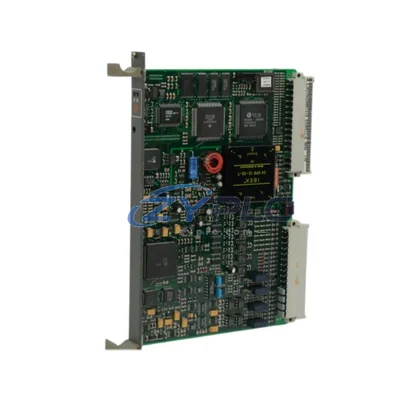
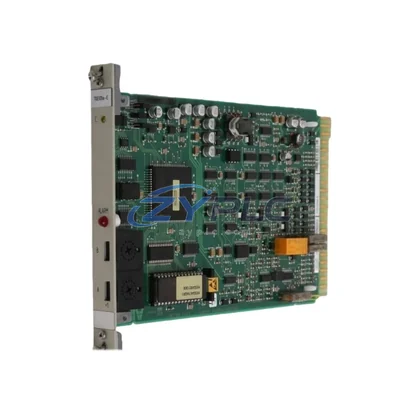
The ABB GJR2374800R0210 81EA11D-E (81EA11D-E) is a dedicated analog input module engineered for deployment within the ABB Advant AC 160 Distributed Control System (DCS) architecture. As a precision signal acquisition component, it occupies a critical position in the I/O layer of the control hierarchy, bridging field-level instrumentation with the process controller and enabling accurate, real-time data delivery across the full automation stack. Understanding this module’s role requires viewing it not as a standalone device, but as an integral node within a layered, coordinated control system where every component — from the CPU rack to the field terminal — must operate in synchronized harmony.
In modern industrial automation, the integrity of analog signal acquisition directly determines the quality of process control decisions. The GJR2374800R0210 81EA11D-E is designed to receive, condition, and digitize analog process signals — typically 4–20 mA current loops or voltage inputs — from field transmitters measuring pressure, temperature, flow, and level. These conditioned values are then passed upward through the Advant AC 160 backplane bus to the central processing unit, where control algorithms execute closed-loop regulation. Any degradation in signal fidelity at the I/O layer propagates directly into control instability, making the selection of a system-matched, architecture-native analog input module essential for long-term plant reliability.
The Advant AC 160 platform is a proven DCS architecture widely deployed across power generation, chemical processing, oil and gas, water treatment, and heavy manufacturing industries. Its modular rack-based design allows engineers to configure scalable I/O assemblies tailored to the specific signal density and redundancy requirements of each application. The GJR2374800R0210 81EA11D-E integrates natively into this ecosystem, ensuring full electrical and firmware compatibility without the signal conversion overhead or latency penalties associated with third-party I/O substitutions.
Product Specification Table
| Parameter |
Specification |
| System Role |
Analog Input Module — I/O Layer, Advant AC 160 DCS |
| Full Part Number |
GJR2374800R0210 / 81EA11D-E |
| Brand / Manufacturer |
ABB (ASEA Brown Boveri), Germany |
| Compatible Platform |
ABB Advant AC 160 Distributed Control System |
| Module Type |
Analog Input (AI) |
| Signal Type |
4–20 mA / 0–10 V (process standard) |
| Backplane Interface |
Advant AC 160 rack bus (native) |
| Installation Environment |
Industrial control cabinet, DIN rail / rack mount |
| Operating Temperature |
0°C to +55°C (standard industrial range) |
| Origin |
Germany (DE) |
| Warranty |
Warranty and support terms confirmed before quote — all units tested prior to dispatch |
| system integration |
Native Advant AC 160 architecture — no protocol conversion required |
System Compatibility Notes
The GJR2374800R0210 81EA11D-E does not operate in isolation. Its value is realized through its coordinated interaction with every other layer of the Advant AC 160 control architecture. At the controller level, the AC 160 CPU module — such as the DSPC110 or DSPC172 processor boards — executes the control program and polls the analog input module cyclically, reading digitized process values and feeding them into PID loops, interlocks, and sequence logic. The scan cycle synchronization between the CPU and the I/O modules is fundamental to control loop stability, and the native backplane communication of the 81EA11D-E ensures zero-latency, deterministic data transfer within the rack.
At the power supply layer, the Advant AC 160 system relies on dedicated rack power supply modules — such as the DSPU130 or equivalent AC 160 power units — to deliver regulated 24 VDC to all I/O modules including the GJR2374800R0210. Stable power delivery is non-negotiable for analog signal accuracy; even minor voltage ripple can introduce measurement error in sensitive 4–20 mA circuits. Engineers specifying replacement or expansion modules must verify that the existing power budget accommodates the additional I/O load.
On the digital I/O side, the analog input module works alongside digital input modules such as the DSDI110 and digital output modules like the DSDO110, which handle discrete on/off signals from limit switches, solenoid valves, and motor starters. Together, the analog and digital I/O modules populate the AC 160 rack, forming a complete field interface assembly. The rack backplane — the DSSR122 or equivalent AC 160 subrack — provides the physical and electrical interconnect for all installed modules, and its slot configuration must be verified during any module replacement or system expansion project.
For communication and supervisory integration, the Advant AC 160 architecture typically employs the MasterBus 300 or PROFIBUS DP communication interfaces, connecting the DCS controller to SCADA systems, historian servers, and operator workstations. The analog values acquired by the GJR2374800R0210 81EA11D-E are ultimately transmitted through these communication layers to the HMI level, where operators monitor process trends and issue setpoint adjustments. HMI terminals compatible with the Advant platform — including legacy Advant Station 500 operator interfaces — display the real-time analog data streams that originate at the I/O module level.
In redundant system designs, critical analog input channels may be duplicated across paired modules installed in redundant racks, with the AC 160 system performing automatic switchover in the event of a module fault. This redundancy architecture is particularly common in power plant boiler control, refinery distillation column management, and water treatment dosing systems, where loss of a single analog input can trigger a process shutdown. Specifying genuine ABB Advant-series modules — rather than generic substitutes — ensures that the redundancy switchover logic functions as designed, without compatibility-induced delays or false fault signals.
Industrial Application Notes
The GJR2374800R0210 81EA11D-E finds application across a broad spectrum of process industries where the Advant AC 160 DCS platform has been deployed. In thermal power generation, the module acquires analog signals from boiler drum level transmitters, steam flow meters, and combustion air pressure sensors, feeding the data to the AC 160 controller for coordinated burner management and drum level control. Accurate analog acquisition at this layer is safety-critical, as deviations in drum level or steam pressure can trigger turbine trips and plant shutdowns.
In petrochemical and refinery applications, the module interfaces with temperature transmitters on distillation column trays, pressure sensors on reactor vessels, and flow transmitters on feed and product streams. The AC 160 DCS uses these analog inputs to maintain precise column temperature profiles and reactor pressure envelopes, optimizing yield while preventing runaway conditions. The module’s compatibility with standard 4–20 mA HART-capable transmitters allows integration with modern smart field devices without requiring additional signal converters.
For water and wastewater treatment facilities, the GJR2374800R0210 81EA11D-E monitors analog signals from pH sensors, turbidity analyzers, dissolved oxygen probes, and flow meters across treatment stages. The AC 160 controller uses these inputs to regulate chemical dosing pumps, aeration blowers, and filtration backwash cycles. Long-term reliability of the analog input module is particularly important in water treatment, where continuous 24/7 operation is required and unplanned maintenance shutdowns carry regulatory and public health implications.
In mining and mineral processing environments, the module operates in control cabinets monitoring crusher load currents, conveyor belt scales, flotation cell levels, and thickener rake torques. The harsh electrical environment of mining facilities — characterized by high-voltage motor switching transients and ground noise — demands robust analog input hardware with strong common-mode rejection, a characteristic of the ABB Advant I/O module family. The Warranty and support terms confirmed before quote provided with each unit reflects confidence in the module’s ability to perform reliably even in demanding industrial environments.
Product Compatibility FAQ
Q1: Is the GJR2374800R0210 81EA11D-E directly compatible with all Advant AC 160 rack configurations, and are there any slot restrictions?
The 81EA11D-E is designed for native installation in ABB Advant AC 160 subrack assemblies. Slot placement should be verified against the original system configuration documentation, as some AC 160 rack variants enforce slot-type restrictions for analog versus digital I/O modules. Engineers should cross-reference the rack’s I/O assignment table and confirm that the firmware version of the AC 160 CPU supports the module’s channel configuration. No external signal converters or protocol adapters are required — system integration is achieved through the native backplane interface.
Q2: How does replacing this analog input module affect the overall system architecture, and what commissioning steps are required after installation?
Replacing the GJR2374800R0210 81EA11D-E in a live AC 160 system requires careful coordination with the control system’s hot-swap or cold-swap procedures, depending on the rack’s redundancy configuration. After physical installation, engineers should verify channel address mapping in the AC 160 engineering tool, confirm analog input scaling parameters (range, engineering units, alarm limits) match the original configuration, and perform a loop check against each connected field transmitter. The Warranty and support terms confirmed before quote covers manufacturing defects and ensures that any module-level failure identified during commissioning or early operation will be addressed without additional cost.
Q3: What is the recommended long-term maintenance strategy for analog input modules in an Advant AC 160 system, and how does maintaining spare inventory reduce lifecycle risk?
For Advant AC 160 systems operating in critical process environments, the recommended strategy is to maintain a minimum of one spare analog input module per rack assembly, stored in anti-static packaging in a climate-controlled environment. Given that the AC 160 platform is a mature architecture with limited OEM production, sourcing replacement modules through specialist industrial automation suppliers — with verified Warranty and support terms confirmed before quote coverage and pre-shipment functional testing — is essential for minimizing mean time to repair (MTTR). Proactive spare parts management, combined with periodic module diagnostics through the AC 160 engineering interface, significantly extends system operational life and defers costly full-system migrations.