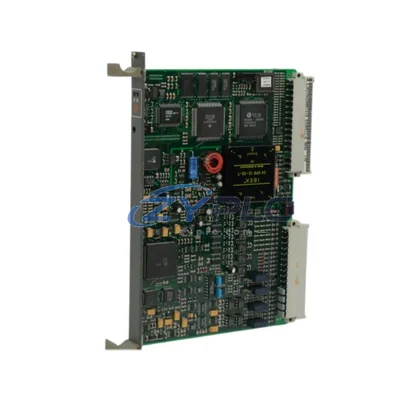
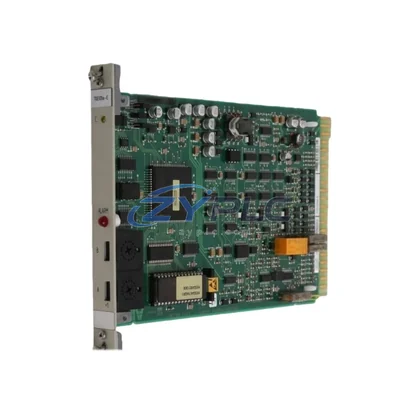
ABB GJR2389800R1210 81ET03M-E: Industrial Data Link and Smart Factory Connectivity in AC500 Architecture
In the era of smart manufacturing, every temperature signal carries operational intelligence — and the path that signal travels from field sensor to SCADA dashboard defines the reliability of the entire production system. The ABB GJR2389800R1210 81ET03M-E, the 81ET03M-E Temperature Input Module within the ABB AC500 PLC platform, is engineered to be a precision industrial network interface: converting raw thermal signals from RTD probes and thermocouples into structured, protocol-ready data that flows seamlessly across PROFIBUS DP, Modbus RTU/TCP, and EtherNet/IP networks to PLC controllers, HMI panels, SCADA gateways, and upper-level MES systems.
The AC500 series is ABB’s flagship modular PLC platform, designed for demanding industrial environments spanning discrete manufacturing, power distribution, chemical processing, water treatment, and mining. Within this architecture, the GJR2389800R1210 81ET03M-E mounts directly onto the AC500 I/O expansion backplane and communicates with the host CPU via the high-speed S500 internal bus — a deterministic, low-latency communication channel that ensures temperature data reaches the control layer in real time, without the delays or conversion losses associated with standalone transmitters or external protocol bridges.
Compatibility & Integration Notes
| Parameter |
Specification |
| Product SKU |
GJR2389800R1210 81ET03M-E |
| Brand / Series |
ABB / AC500 |
| Module Type |
Temperature Input Module (RTD / Thermocouple) |
| Communication Interface |
S500 Internal Bus (AC500 Backplane) |
| Protocol Compatibility |
PROFIBUS DP, Modbus RTU/TCP, EtherNet/IP (via AC500 CPU gateway) |
| Supported Sensor Types |
PT100, PT1000, Ni100, Ni1000; Type J/K/T/E/R/S/B Thermocouples |
| Input Channels |
Up to 3 channels, independently configurable per channel |
| Resolution |
16-bit analog-to-digital conversion |
| Network Compatibility |
PROFIBUS DP Master/Slave, Modbus TCP/IP, EtherNet/IP, OPC-UA (via CPU) |
| System Application |
AC500 PLC, SCADA/HMI Integration, Remote I/O, Smart Factory Automation |
| Operating Temperature |
-25°C to +60°C |
| Power Supply |
24 VDC via AC500 backplane bus |
| Origin |
Germany |
| Warranty |
Warranty and support terms confirmed before quote — Functional Testing Included |
Connected Automation Data Flow
The industrial data chain anchored by the GJR2389800R1210 81ET03M-E begins at the process boundary, where PT100 RTD probes monitor motor winding temperatures, Type K thermocouples measure furnace zone temperatures, and Ni1000 sensors track ambient conditions in climate-controlled production areas. These raw analog signals — millivolt outputs from thermocouples, resistance values from RTDs — are acquired by the 81ET03M-E’s input channels, converted with 16-bit resolution, and transmitted as calibrated engineering-unit values across the AC500 S500 backplane to the host CPU module.
In a standard AC500 control cabinet, the CPU — such as the ABB PM573-ETH or the higher-capacity ABB PM591-ETH — receives this temperature data and executes configured control logic: PID regulation for thermal process control, high-temperature alarm generation for equipment protection, and trend data buffering for predictive maintenance analytics. The CPU simultaneously drives an ABB CP635 HMI panel or ABB CP600 series touchscreen mounted on the cabinet door, providing operators with real-time temperature visualization, alarm acknowledgment, and setpoint adjustment without interrupting the production cycle.
For plants with distributed control architectures, the AC500 CPU relays temperature data upstream via a PROFIBUS DP communication module — such as the ABB CI502-PBUS — connecting the 81ET03M-E’s readings to a plant-wide PROFIBUS network. This enables SCADA systems including ABB System 800xA, Wonderware InTouch, Ignition, or Siemens WinCC to receive live temperature values from multiple AC500 nodes across the facility, supporting centralized monitoring, alarm management, and historical data archiving. In EtherNet/IP environments, the ABB CI511-ETHIP adapter module routes the same temperature data to Rockwell ControlLogix supervisory controllers or MES platforms, eliminating the need for dedicated protocol converters between the ABB and Rockwell control layers.
For remote I/O expansion in large facilities — steel mills, paper plants, offshore platforms — the AC500 platform supports ABB S500-eCo remote I/O stations connected via PROFIBUS or Modbus RTU, allowing additional temperature input modules to be deployed near field equipment without running long analog signal cables across the plant floor. Variable frequency drives such as the ABB ACS880 series can simultaneously report internal thermal diagnostics to the same AC500 CPU via PROFIBUS or EtherNet/IP, creating a unified thermal monitoring layer that spans both process instrumentation and drive systems within a single SCADA view. The entire rack is powered by an ABB CP-E 24/5.0 DIN rail power supply, with redundant power options available for continuous-process applications in pharmaceutical batch manufacturing and chemical production.
Solving Data Isolation in Industrial Sites
Thermal data isolation — temperature readings locked inside standalone instruments, legacy PLCs, or proprietary drive systems with no path to the plant’s SCADA or MES layer — remains one of the most persistent obstacles to production line transparency in industrial facilities. The GJR2389800R1210 81ET03M-E, as a native AC500 I/O module, eliminates this isolation by providing a standardized, bus-integrated temperature acquisition point that is immediately visible to the AC500 CPU and, through it, to any connected supervisory system via PROFIBUS DP, Modbus TCP, EtherNet/IP, or OPC-UA.
In multi-vendor environments where an ABB AC500 system manages utilities alongside a Siemens S7-300 or Mitsubishi Q-series controller managing production lines, the AC500 CPU can act as a protocol gateway and data concentrator — aggregating temperature inputs from the 81ET03M-E and forwarding them via Modbus TCP or OPC-UA to a unified SCADA server. This eliminates the need for separate temperature transmitters with independent communication outputs, reducing wiring complexity, cabinet footprint, and long-term maintenance overhead.
For production line transparency and Industry 4.0 compliance, the module’s 16-bit resolution enables statistical process control (SPC) and trend analysis at the SCADA level. Engineers configure alarm bands, deviation alerts, and historical logging within ABB Automation Builder, then visualize results on connected HMI panels or export data to cloud-based analytics platforms via edge gateway devices. System expansion is equally seamless: additional 81ET03M-E modules are added to the AC500 rack as monitoring requirements grow, with no changes to the CPU program structure beyond channel mapping in the I/O configuration table — a critical advantage for phased capacity upgrades in continuous process industries where production downtime carries significant cost.
Industrial Connectivity FAQ
Q1: What communication protocols does the GJR2389800R1210 81ET03M-E support for SCADA and gateway integration?
The 81ET03M-E communicates via the AC500 S500 internal backplane bus and does not carry an independent external communication port. SCADA and gateway integration is achieved through the AC500 CPU module, which supports PROFIBUS DP, Modbus RTU/TCP, EtherNet/IP, and OPC-UA depending on the CPU variant and installed communication modules. This architecture allows temperature data to reach any major SCADA platform — ABB System 800xA, Wonderware, Ignition, WinCC — without additional protocol converters, reducing system complexity and single-point failure risk.
Q2: How does the module handle communication latency and network stability in real-time control applications?
The S500 internal bus operates as a deterministic, synchronous communication channel within the AC500 backplane, ensuring that temperature data is transferred to the CPU within each PLC scan cycle — typically 1–10 ms depending on CPU configuration. This eliminates the variable latency associated with external fieldbus communication for I/O data, making the 81ET03M-E suitable for closed-loop temperature control applications where thermal deviation response time is critical. Network stability at the SCADA level is governed by the CPU’s fieldbus communication modules, which support watchdog timers, redundant network paths, and automatic reconnection protocols.
Q3: Is the GJR2389800R1210 81ET03M-E compatible with both RTD and thermocouple sensors simultaneously, and can it expand with the system?
Yes. Each input channel is independently configurable for RTD (PT100, PT1000, Ni100, Ni1000) or thermocouple (Type J, K, T, E, R, S, B) input via ABB Automation Builder software, allowing mixed sensor installations within a single module. For system expansion, additional 81ET03M-E modules are recognized by the CPU during hardware configuration scan — existing program logic remains intact, and engineers only map new channels to process variables in the I/O configuration table. This plug-and-expand capability supports phased plant upgrades without production downtime.
Q4: What does the Warranty and support terms confirmed before quote cover, and how is the module tested before shipment?
Every GJR2389800R1210 81ET03M-E unit supplied by ZYPLC undergoes pre-shipment functional testing, including channel-level signal simulation, S500 bus communication verification, and full power-on diagnostics. The Warranty and support terms confirmed before quote covers manufacturing defects, functional failures under normal operating conditions, and firmware-related issues. Warranty claims are processed with priority support, and replacement units are dispatched via DHL or FedEx express to minimize production downtime. For technical pre-sales consultation or RFQ, contact ZYPLC at plc.sales@zyplc.com or +86 19859288691.