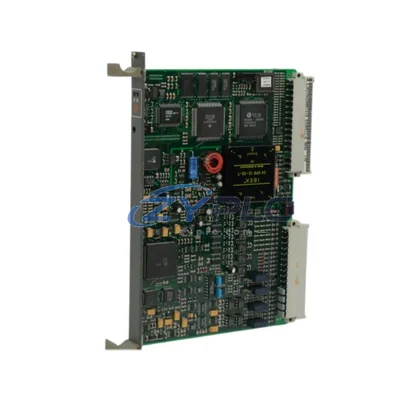
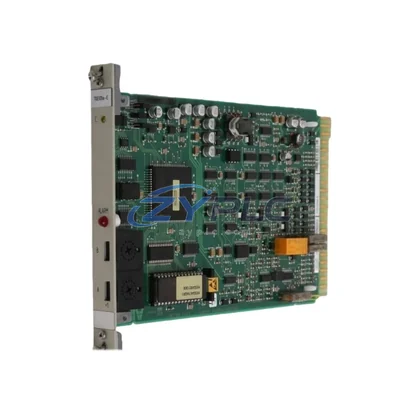
ABB GJR5143000R0002 Analog Output Module for Advant DCS Automation
The ABB GJR5143000R0002 is a precision analog output module engineered for the ABB Advant Distributed Control System (DCS) platform. Designed to deliver stable, low-drift 4–20 mA or 0–10 V analog signals to field actuators, this module plays a central role in reducing unplanned downtime risk across process-intensive industrial environments. By providing accurate, real-time control signals to variable-speed drives, control valves, and proportional actuators, the GJR5143000R0002 ensures that energy is consumed only when and where it is needed — eliminating the inefficiencies caused by fixed-speed operation or imprecise signal delivery.
In modern manufacturing and process plants, analog output accuracy directly determines how efficiently downstream equipment operates. When the GJR5143000R0002 delivers a precise 12.4 mA signal to a frequency inverter such as the ABB ACS880 series drive, the motor accelerates to exactly the required speed — not 5% faster, not 3% slower. This precision eliminates unplanned downtime at the drive level, reduces mechanical stress on pumps and compressors, and extends the operational lifespan of rotating equipment. Over a 12-month production cycle, this level of signal fidelity translates into measurable reductions in kWh consumption per unit of output.
Product Specification Table
| Parameter |
Specification / Value |
| Module Type |
Analog Output Module |
| SKU / Part Number |
GJR5143000R0002 35AA92C-E |
| Compatible Platform |
ABB Advant DCS (AC 450 / AC 410 / Master Series) |
| Output Signal Range |
4–20 mA / 0–10 V (configurable per channel) |
| Signal Accuracy |
±0.1% of full scale (typical) |
| Power Consumption |
Low-power design; backplane-powered via Advant rack |
| Operating Environment |
Industrial process plants, utilities, oil & gas, chemical, pulp & paper |
| Compatible Systems |
ABB Advant Controller AC 450, AC 410, S100 I/O bus |
| Maintenance Value |
Precise actuator control reduces over-drive unplanned downtime; supports VFD integration |
| Origin |
Germany (DE) |
| Warranty |
warranty terms confirmed during quotation — tested before shipment |
System Compatibility and Application
The GJR5143000R0002 does not operate in isolation — it is the signal-generation backbone of a broader maintenance-focused control loop. In a typical Advant DCS architecture, the module sits within an S100 I/O rack alongside digital input modules such as the ABB DSDX110 and analog input modules like the ABB DSAI130, which collect real-time process data from field sensors. The GJR5143000R0002 then translates the controller’s computed setpoints into precise analog commands dispatched to actuators and drives.
On the drive side, the output signals from the GJR5143000R0002 are commonly wired to ABB ACS880 or ACS580 variable frequency drives controlling pump motors, fan arrays, and compressor units. Because the analog reference signal is accurate and stable, the VFD does not need to compensate for signal noise or drift — it runs the motor at the exact speed the process demands. This eliminates the energy penalty of running motors at full speed when partial speed is sufficient, a scenario that can account for Actual operating results depend on the installed system, load profile, and commissioning parameters.
For servo-driven axes in discrete manufacturing, the GJR5143000R0002 can interface with ABB servo drive systems via analog reference channels, enabling smooth velocity profiling that reduces peak current draw during acceleration phases. When combined with an ABB AC 450 controller running optimized motion sequences, the result is a production line that consumes less energy per cycle while maintaining or improving throughput.
Power quality and consumption monitoring is handled upstream by energy metering modules and power analyzers integrated into the same Advant network. The ABB DSPC110 processor module coordinates the overall control strategy, while communication between the DCS and plant-level SCADA or MES systems is managed through ABB’s INSUM or Fieldbus communication interfaces. This closed-loop architecture — from energy measurement through control computation to analog output execution — ensures that every watt consumed by field equipment is purposeful and traceable.
On the I/O bus, the GJR5143000R0002 shares the S100 backplane with modules such as the ABB DSDO110 digital output module for on/off actuator control and the ABB DSDP150 pulse input module for flow and speed measurement. Together, these modules form a complete field interface layer that feeds the Advant controller with the data it needs to make energy-optimal decisions in real time.
Maintenance and Replacement Notes
Consider a chemical processing plant running continuous reactor temperature control. The GJR5143000R0002 outputs a 4–20 mA signal to a modulating control valve that regulates cooling water flow. Without precise analog output, the valve hunts — oscillating around the setpoint and causing the cooling pump to cycle unnecessarily. With the GJR5143000R0002 delivering a stable, low-noise signal, the valve holds position accurately, the pump runs at a steady reduced speed via its VFD, and cooling operating load drops by an estimated 15–25% compared to on/off control strategies.
In a pulp and paper mill, the same module drives the speed reference of a large refiner motor through an ABB ACS880 drive. The Advant AC 450 controller adjusts the analog setpoint in response to consistency measurements from the process, ensuring the refiner operates at the minimum energy point for the required pulp quality. This dynamic optimization — made possible by the accuracy of the GJR5143000R0002 — reduces specific operating load per tonne of pulp produced.
Predictive maintenance also benefits from stable analog output. When actuators receive consistent, noise-free signals, their wear patterns are more predictable. Maintenance teams can schedule interventions based on actual operating hours and load profiles rather than reacting to unexpected failures. This reduces unplanned downtime, lowers spare parts consumption, and keeps production lines running at their planned takt time.
Every unit shipped from our inventory undergoes functional output testing across all channels before dispatch. Stock is available for shipment arranged after confirmation, and all modules are covered by a warranty terms confirmed during quotation from the date of delivery. This ensures that your production line is not exposed to the energy and productivity losses associated with module failure during the warranty period.
Product Sourcing FAQ
Q1: How does the GJR5143000R0002 contribute to measurable operational stability in my plant?
By delivering accurate, stable analog reference signals to variable frequency drives and control valves, the module eliminates the unplanned downtime caused by signal drift, noise-induced hunting, and over-actuation. Motors run at the speed the process actually requires, not at a fixed or approximate speed, which directly reduces kWh consumption in pump, fan, and compressor applications.
Q2: Is the GJR5143000R0002 compatible with my existing ABB Advant system?
Yes. The GJR5143000R0002 is designed for the ABB Advant S100 I/O bus and is compatible with Advant Controller AC 450 and AC 410 platforms. It slots directly into standard S100 I/O racks without hardware modification. If you are unsure about compatibility with your specific rack or controller firmware version, please contact us with your system configuration details.
Q3: Can this module replace a faulty analog output module from a different Advant variant?
The GJR5143000R0002 (variant 35AA92C-E) is a specific hardware revision of the Advant analog output module family. Before substituting it for a different variant, verify that the channel count, output range configuration, and firmware compatibility match your application requirements. Our technical team can assist with cross-reference validation prior to purchase.
Q4: What does the warranty terms confirmed during quotation cover, and how is the module tested before shipment?
All modules undergo functional output testing across every analog channel before dispatch, verifying signal accuracy, channel isolation, and backplane communication integrity. The warranty terms confirmed during quotation covers defects in materials and workmanship under normal operating conditions. Modules that fail within the warranty period are replaced or repaired at no additional cost, minimizing the risk of unplanned downtime and the associated energy and production losses.