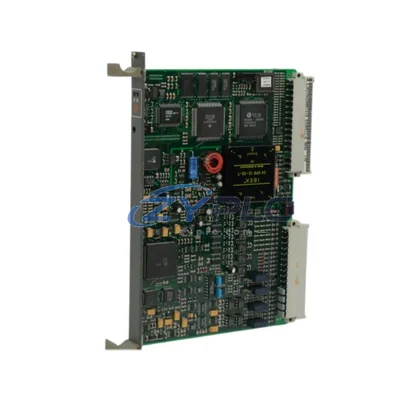
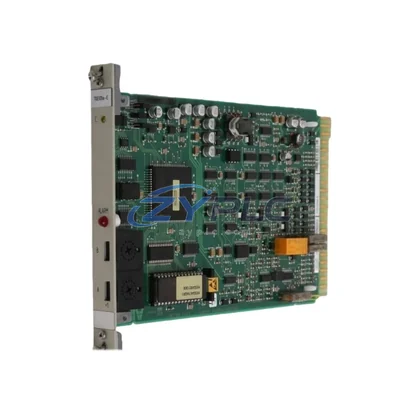
ABB PFEA113-20 Tension Controller for PFEA Series
In modern industrial automation, a tension controller is never a standalone device — it is a precision node embedded within a layered control architecture. The ABB PFEA113-20 is engineered to fulfill exactly this role: a dedicated tension measurement and control module designed for seamless integration into ABB’s PFEA Series system platform, delivering consistent signal fidelity, closed-loop responsiveness, and long-term operational stability across demanding process environments.
The PFEA113-20 occupies a critical position in the I/O and signal conditioning layer of a distributed control system. It receives analog load cell signals, processes tension feedback in real time, and transmits conditioned output to the supervisory control layer — whether that is an ABB AC500 PLC, an 800xA DCS node, or a third-party SCADA interface. Its role is not merely to measure tension, but to anchor the entire web or strip handling process within a coherent, synchronized control loop.
Product Specification Table
| Parameter |
Specification |
| System Role |
Tension Measurement & Closed-Loop Control Module |
| Series Platform |
ABB PFEA Series |
| Input Signal |
Load cell / strain gauge analog input (mV/V) |
| Output Signal |
Analog output (0–10 V / 4–20 mA), configurable |
| Supply Voltage |
24 V DC (±15%) |
| Communication |
Fieldbus-ready; compatible with PROFIBUS, PROFINET via gateway modules |
| Mounting |
DIN rail, panel-mount compatible |
| Operating Temperature |
0°C to +55°C |
| Protection Class |
IP20 (panel installation) |
| Certifications |
CE marked; compliant with IEC 61131 control environment standards |
| Warranty |
warranty terms confirmed during quotation — covered by ZYPLC quality assurance program |
System Compatibility Notes
The PFEA113-20 achieves its full potential when deployed within a coordinated ABB control architecture. In a typical web tension control system for paper, film, or metal strip processing, the PFEA113-20 works in concert with the PFEA111-65 tension amplifier module, which provides the excitation voltage for load cells and pre-amplifies the raw millivolt signal before it reaches the PFEA113-20 for closed-loop computation. Together, these two modules form the sensing backbone of the tension control subsystem.
At the supervisory level, the PFEA113-20 interfaces with an ABB AC500 PLC — such as the PM891 or PM895 CPU modules — which orchestrates the broader machine sequence, including dancer roll positioning, nip pressure control, and speed synchronization across multiple drive zones. The AC500’s modular I/O architecture, using AI830A analog input modules and DO820 digital output modules, allows the tension signal to be cross-referenced with speed feedback from ABB ACS880 variable frequency drives, enabling true closed-loop tension regulation across winding, unwinding, and intermediate draw sections.
For fieldbus communication, the CI867K01 PROFIBUS DP communication interface module bridges the PFEA113-20’s analog output into the digital control network, allowing the AC500 or 800xA DCS to receive tension data as a process variable over a deterministic fieldbus. This eliminates analog signal degradation over long cable runs and improves noise immunity in electrically harsh environments such as steel mills or chemical processing plants.
Terminal connectivity is managed through TU830V1 termination units, which provide clean, labeled wiring points for load cell cables, power supply, and output signal routing. In redundant architectures, a secondary PFEA113-20 can be configured in hot-standby mode, with switchover logic managed by the AC500 CPU, ensuring zero-interruption tension control during module maintenance or unexpected faults.
At the human-machine interface layer, an ABB CP600 HMI panel displays real-time tension curves, setpoint deviation alarms, and historical trend data, giving operators immediate visibility into web behavior without requiring access to the engineering workstation. This system integration between the PFEA113-20, the AC500, the ACS880 drives, and the CP600 HMI creates a unified, diagnostics-ready tension control platform that reduces commissioning time and simplifies long-term maintenance.
Industrial Application Notes
The PFEA113-20 is deployed across a wide range of process industries where material tension is a critical quality parameter. In paper and board manufacturing, it controls web tension between press sections and dryer groups, preventing sheet breaks and ensuring uniform caliper. In flexible packaging and film extrusion lines, it maintains consistent tension across laminating, slitting, and rewinding stations, directly impacting seal integrity and roll geometry.
In metal processing — including cold rolling mills, strip galvanizing lines, and coil coating systems — the PFEA113-20 provides the precision tension feedback required to maintain strip flatness and prevent edge waviness at high line speeds. Its fast response time and stable analog output make it suitable for dynamic tension control in acceleration and deceleration phases.
In textile and nonwoven production, the module supports multi-zone tension profiling across warping, weaving, and finishing machines. In wire and cable manufacturing, it monitors conductor tension during stranding and insulation extrusion, preventing conductor breakage and ensuring consistent lay length. Across all these applications, the PFEA113-20’s compatibility with ABB’s broader automation ecosystem — including the AC500 PLC platform, ACS series drives, and 800xA process control system — makes it a preferred choice for system integrators seeking a single-vendor, fully supported architecture.
Product Compatibility FAQ
Q1: Is the PFEA113-20 compatible with non-ABB PLCs and DCS platforms?
Yes. While the PFEA113-20 is optimized for integration within ABB’s PFEA Series and AC500 control architecture, its standard analog output (0–10 V or 4–20 mA) is universally compatible with any PLC or DCS that accepts analog input signals. For digital fieldbus integration with non-ABB controllers, a PROFIBUS DP or PROFINET gateway module can be used to bridge the tension signal into the host control network. ZYPLC’s engineering team can advise on interface configuration for mixed-vendor architectures.
Q2: What commissioning steps are required when installing the PFEA113-20 in an existing tension control system?
Commissioning the PFEA113-20 involves four key steps: (1) mechanical installation on DIN rail within the control cabinet, ensuring adequate clearance for heat dissipation; (2) load cell wiring to the input terminals using shielded cable, with shield grounded at one end only; (3) parameterization of the tension range, output scaling, and filter time constants using the ABB PFEA configuration tool or front-panel interface; and (4) closed-loop verification by applying known tension loads and confirming output linearity against the PLC analog input reading. ZYPLC provides pre-delivery functional testing for all PFEA113-20 units, reducing on-site commissioning time.
Q3: What does the warranty terms confirmed during quotation cover, and what support is available during the warranty period?
The warranty terms confirmed during quotation provided by ZYPLC covers all manufacturing defects, component failures, and functional deviations from the published ABB PFEA113-20 specification under normal operating conditions. It does not cover damage resulting from incorrect installation, overvoltage, or environmental exposure beyond the rated IP20 protection class. During the warranty period, ZYPLC provides direct technical support via phone and email, replacement unit dispatch within 3 business days upon fault confirmation, and access to configuration documentation. For critical production environments, ZYPLC recommends maintaining one spare PFEA113-20 unit on-site to minimize downtime risk during any warranty replacement process.