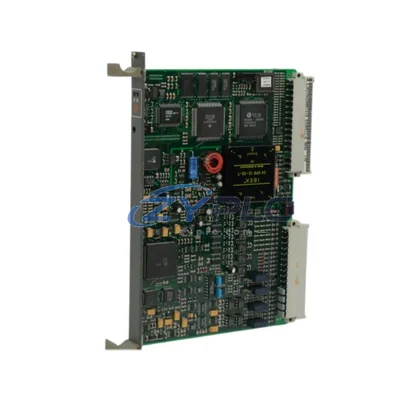
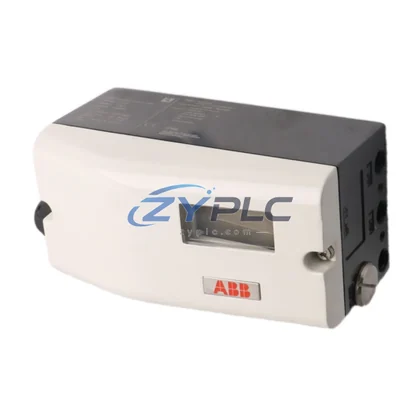
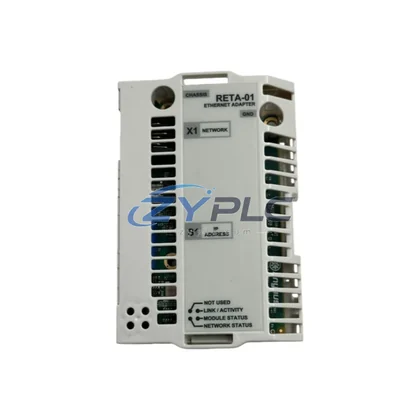
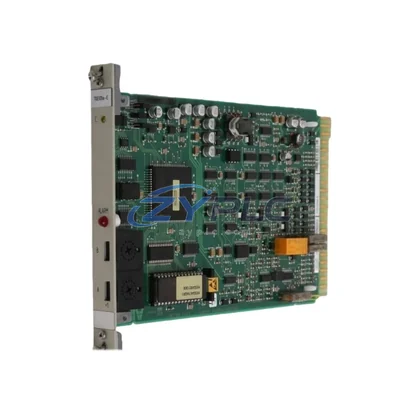
The ABB R100-30/ZS is a dedicated relay input module designed for seamless integration within the ABB Freelance distributed control system (DCS) architecture. Engineered to serve as a critical signal conditioning interface between field-level dry contact devices and the system’s digital I/O processing backbone, the R100-30/ZS ensures reliable acquisition of binary status signals from electromechanical relays, limit switches, and auxiliary contacts distributed across industrial process environments.
Within a layered automation architecture, the R100-30/ZS occupies a pivotal position at the I/O interface layer, translating discrete field signals into digitally processed data that flows upstream to the Freelance AC 900F controller for logic execution, alarm management, and coordinated process sequencing. This module’s design philosophy centers on electrical isolation, noise immunity, and deterministic signal response—qualities essential for mission-critical process applications in power generation, petrochemical refining, water treatment, and metallurgical processing facilities.
Product Specification Table
| Parameter |
Specification |
| System Role |
Relay Input Signal Conditioning Module |
| Platform Compatibility |
ABB Freelance DCS (AC 900F Controller) |
| Input Type |
Dry Contact / Relay Contact Inputs |
| Channel Configuration |
30 Relay Input Channels |
| Electrical Isolation |
Channel-to-system galvanic isolation |
| Signal Voltage |
24 VDC nominal sensing voltage |
| Communication Interface |
Freelance system bus (proprietary backplane) |
| Mounting |
DIN rail / Freelance I/O rack |
| Operating Temperature |
0°C to +55°C |
| Protection Rating |
IP20 |
| Warranty |
warranty terms confirmed during quotation |
System Compatibility Notes
The R100-30/ZS operates as an integral component within the broader ABB Freelance system architecture, where coordinated interaction between multiple hardware layers determines overall control system performance, reliability, and maintainability. At the controller level, the AC 900F processor executes continuous and sequential control logic based on digitized field data received from I/O modules including the R100-30/ZS. The controller communicates bidirectionally with engineering workstations and operator interfaces through redundant Ethernet-based communication networks.
Power integrity across the I/O subsystem is maintained by dedicated ABB SD 802F power supply modules, which deliver regulated DC voltages to both the controller and peripheral I/O cards. The R100-30/ZS shares rack space and backplane connectivity with complementary modules such as the AI 845 analog input module for 4-20mA process transmitter signals, the AO 820 analog output module for valve positioner commands, and the DI 810 digital input module for high-speed pulse counting applications. Together, these modules form a comprehensive signal acquisition and output layer capable of managing thousands of process variables within a single Freelance station.
For installations requiring system-level redundancy, the Freelance architecture supports dual-redundant AC 900F controllers operating in hot-standby configuration, ensuring bumpless transfer upon primary controller failure. The R100-30/ZS relay inputs remain accessible to both redundant controllers through the shared I/O bus, preserving signal continuity without requiring duplicate wiring at the field termination level. Communication gateway modules such as the CI 867 PROFIBUS interface and the CI 871 Modbus TCP gateway extend the Freelance system’s reach to third-party field devices, variable frequency drives, and intelligent motor control centers operating on open industrial protocols.
Terminal interface modules like the TU 811 and TU 812 provide structured field wiring connections between incoming relay contact cables and the R100-30/ZS module’s input channels. These terminal units simplify maintenance procedures by enabling module replacement without disturbing field wiring—a critical consideration for facilities operating under strict uptime requirements. The combination of standardized terminal interfaces, hot-swappable I/O modules, and centralized diagnostic reporting through the Freelance engineering environment significantly reduces mean time to repair (MTTR) across the installed base.
Human-machine interface connectivity is achieved through ABB’s DigiVis operator station software, which renders real-time process graphics, alarm summaries, and trend displays sourced from controller data including relay input states processed by the R100-30/ZS. This end-to-end data flow—from field contact through relay input module, across the system bus to the controller, and onward to operator visualization—exemplifies the architectural coherence that defines modern DCS implementations.
Industrial Application Notes
In thermal power generation facilities, the R100-30/ZS monitors auxiliary relay contacts from motor control centers, breaker status indicators, and safety interlock chains that govern turbine protection sequences. The module’s 30-channel capacity allows consolidation of multiple relay feedback signals onto a single card, reducing rack space requirements and simplifying system documentation. Combined with the Freelance system’s integrated sequence-of-events recording capability, relay state transitions captured by the R100-30/ZS provide millisecond-resolution timestamps essential for post-event analysis and regulatory compliance reporting.
Petrochemical and refining applications leverage the R100-30/ZS for monitoring safety instrumented system (SIS) voting logic outputs, emergency shutdown valve position feedback, and fire and gas detection relay contacts. The module’s galvanic isolation protects the DCS backplane from transient voltages originating in high-energy field circuits, while its deterministic scan cycle ensures that safety-critical status changes are captured within guaranteed response windows.
Water and wastewater treatment plants deploy the R100-30/ZS to monitor pump run/stop confirmation relays, level switch contacts, and filter backwash sequence indicators. The Freelance platform’s built-in batch control capabilities, combined with reliable discrete input acquisition from modules like the R100-30/ZS, enable fully automated treatment sequences that adapt to variable influent conditions while maintaining regulatory discharge compliance.
In metallurgical processing and mining operations, the R100-30/ZS captures conveyor pull-cord switch states, bin level indicators, and crusher interlock confirmations. The harsh electrical environments typical of these industries demand robust input modules with high noise immunity and wide operating temperature tolerance—characteristics engineered into the R100-30/ZS design to ensure reliable long-term operation without signal degradation or false triggering.
Product Compatibility FAQ
Q1: What system components are required to integrate the R100-30/ZS into an existing Freelance architecture?
Integration requires an available slot in a Freelance I/O rack with backplane connectivity to an AC 900F controller, a compatible terminal unit (TU 811 or TU 812) for field wiring termination, and appropriate configuration within the Freelance engineering tool. The SD 802F power supply must have sufficient capacity to support the additional module’s current draw. All components are covered under our warranty terms confirmed during quotation for assured system reliability.
Q2: Can the R100-30/ZS operate within a redundant controller configuration?
Yes. The Freelance architecture supports dual-redundant AC 900F controllers with shared I/O bus access. The R100-30/ZS remains fully operational during controller switchover events, maintaining continuous relay input monitoring without signal interruption or data loss. This redundancy capability ensures process continuity in critical applications.
Q3: What maintenance considerations apply to long-term R100-30/ZS installations?
The module supports hot-swap replacement via standardized terminal units, eliminating the need to disconnect field wiring during maintenance. Diagnostic LEDs and Freelance system-level health monitoring provide proactive fault indication. Periodic verification of relay contact wetting current and terminal torque values is recommended per ABB’s maintenance guidelines. All replacement modules supplied by ZYPLC include a warranty terms confirmed during quotation and full technical support.