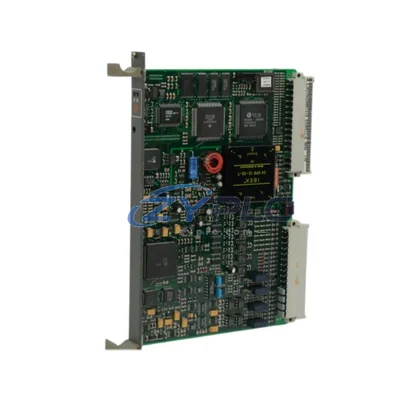
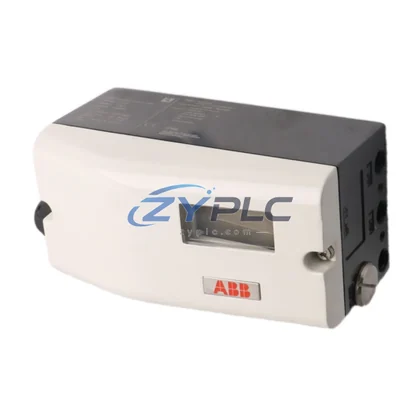
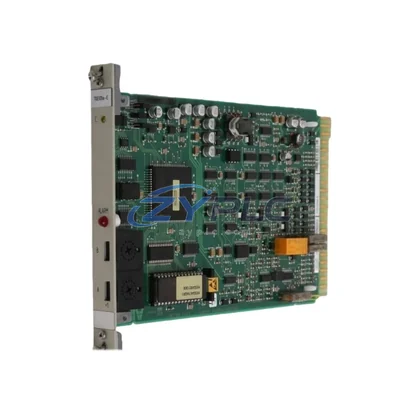
ABB RINT-5611C 68597714C Drive Interface for ACS Series
In modern industrial automation, the reliability of a drive control system depends not on any single component, but on the seamless coordination of every layer within the control architecture. The ABB RINT-5611C (part number 68597714C) is a dedicated drive interface board engineered for integration within ABB’s ACS Series variable frequency drive platform. Its role extends beyond signal conditioning — it serves as a critical bridge between the drive’s internal control logic and the broader automation system, enabling consistent communication, coordinated motion control, and long-term operational stability across multi-drive installations.
Sourced from ABB’s Finnish manufacturing facilities and backed by a warranty terms confirmed during quotation, the RINT-5611C is designed for engineers who require verified hardware with traceable provenance and guaranteed performance in demanding industrial environments.
Product Specification Table
| Parameter |
Specification |
| System Role |
Drive Interface Board — ACS Series Control Layer |
| Part Number |
RINT-5611C / 68597714C |
| Compatible Platform |
ABB ACS Series Variable Frequency Drives |
| Manufacturer |
ABB (ASEA Brown Boveri) |
| Country of Origin |
Finland |
| Board Function |
Drive control signal interface, feedback routing, I/O coordination |
| Communication Capability |
Internal drive bus; compatible with RDCO, RDNA, RETA fieldbus adapter architecture |
| Electrical Parameters |
Low-voltage logic board; powered via drive internal supply rail |
| Installation Environment |
Enclosed drive cabinet; DIN-rail or chassis mount per ACS drive frame |
| Operating Temperature |
-10°C to +55°C (standard industrial range) |
| Warranty |
warranty terms confirmed during quotation — tested, verified, ready for system deployment |
System Compatibility Notes
The RINT-5611C does not operate in isolation. Its value is realized when it is deployed as part of a fully coordinated ACS Series drive system. In a typical multi-axis or multi-drive installation, the RINT-5611C interfaces directly with the ACS800 or ACS880 drive control unit, managing the signal pathways between the drive’s main control board (such as the RMIO or RDCU module) and the external I/O and communication layers.
At the control layer, the RINT-5611C works in conjunction with the RMIO-11C main control board, which handles the core drive logic, speed reference processing, and fault management. The interface board ensures that feedback signals — including encoder pulses, analog references, and digital status outputs — are correctly routed without signal degradation or timing errors that could compromise drive synchronization.
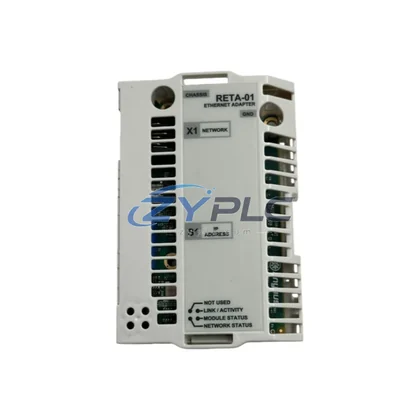
For fieldbus connectivity, the RINT-5611C supports integration with ABB’s RDCO-01/02/03 DDCS communication adapters, enabling the drive to participate in distributed control networks using DDCS or optical fiber protocols. In installations where PROFIBUS or EtherNet/IP connectivity is required, the RINT-5611C is compatible with RDNA-01 and RETA-01 fieldbus adapter modules, allowing the ACS drive to be addressed as a standard network node within a Siemens S7, Rockwell ControlLogix, or ABB AC500 PLC architecture.
At the I/O layer, the board coordinates with standard terminal modules and I/O extension cards to manage analog input/output signals for speed reference, torque feedback, and process variable monitoring. In cabinet-level designs, the RINT-5611C is typically installed alongside the APBU-44C branching unit, which distributes DDCS communication across multiple drives in a master-follower configuration — a common architecture in winder, crane, and conveyor applications.
For redundancy-critical applications, the RINT-5611C supports hot-standby drive configurations when paired with appropriate redundancy controllers and bypass contactors. In power-sensitive installations, the board operates reliably alongside ABB’s NPBU-12C or APBU-44C pulse encoder interface units, ensuring that encoder feedback remains stable even during transient load conditions. The overall system architecture — from the PLC control layer through the drive interface, I/O modules, fieldbus gateway, and HMI — benefits from the RINT-5611C’s role as a stable, well-characterized interface component with a known signal behavior profile.
Industrial Application Notes
The ABB RINT-5611C finds application across a wide range of process and discrete manufacturing environments where ACS Series drives are deployed as part of a layered automation architecture.
In power generation and utilities, ACS800 drives equipped with RINT-5611C interface boards are used to control boiler feed pumps, cooling water circulation systems, and auxiliary fan drives. The interface board’s stable signal routing ensures that the drive responds accurately to DCS speed references, maintaining process efficiency under variable load conditions.
In petrochemical and refinery applications, the RINT-5611C supports compressor and pump drive systems where precise speed control and fault-tolerant operation are mandatory. The board’s compatibility with DDCS-based redundancy architectures allows engineers to implement hot-standby drive configurations that minimize unplanned downtime.
In mining and minerals processing, conveyor and hoist drive systems built around the ACS880 platform rely on the RINT-5611C to maintain encoder feedback integrity under high-vibration, high-dust conditions. The board’s robust design and warranty terms confirmed during quotation make it a preferred choice for remote site installations where component replacement logistics are a significant operational concern.
In water and wastewater treatment, the RINT-5611C enables precise flow control in pump drive systems integrated with SCADA platforms via PROFIBUS or Modbus TCP gateways. Its system integration capability ensures that the drive’s operational data — speed, current, fault codes — is accurately reflected in the plant’s supervisory system without additional signal conditioning hardware.
In packaging and material handling, multi-axis drive systems coordinated through an ABB AC500 or Siemens S7-300 PLC use the RINT-5611C to synchronize conveyor speeds, register control, and tension management across production lines. The board’s consistent signal behavior simplifies commissioning and reduces the time required for drive parameter tuning during system startup.
Product Compatibility FAQ
Q1: Is the RINT-5611C 68597714C compatible with both ACS800 and ACS880 drive platforms?
The RINT-5611C is primarily designed for the ACS800 series drive architecture. Compatibility with ACS880 platforms depends on the specific drive frame and control board configuration. Engineers should verify the target drive’s hardware revision and control board type (RMIO vs. ZCU/BCU) before specifying the RINT-5611C as a replacement or expansion component. Our technical team can assist with cross-referencing part numbers to confirm fit within your specific system architecture.
Q2: How does the RINT-5611C support long-term maintenance in multi-drive installations?
The RINT-5611C is a standardized interface board with a well-documented signal pinout and a consistent hardware revision history. In multi-drive installations, maintaining a stock of verified RINT-5611C boards reduces mean time to repair (MTTR) significantly, as the board can be swapped without drive parameter re-entry in most configurations. The warranty terms confirmed during quotation covers functional verification, ensuring that each board shipped has been tested against ABB’s original performance specifications before dispatch.
Q3: What does the warranty terms confirmed during quotation cover, and how does system integration apply to system commissioning?
The warranty terms confirmed during quotation covers the RINT-5611C against functional failure under normal operating conditions, including signal routing faults, connector integrity issues, and component-level failures traceable to the board itself. system integration refers to the board’s verified compatibility within the broader ACS Series control architecture — meaning it has been tested not only as a standalone component but as part of a complete drive system, including its interaction with RMIO control boards, DDCS communication adapters, and external I/O modules. This system-level validation reduces integration risk and accelerates commissioning timelines for new installations and drive replacements alike.