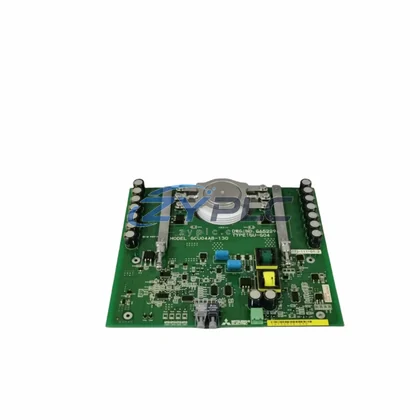
ABB SAFT315F500 Thyristor Braking Unit for ACS Series
The ABB SAFT315F500 is a high-performance thyristor braking unit engineered for seamless integration within ABB ACS-series variable frequency drive (VFD) architectures. In modern industrial automation, braking performance is not an isolated function — it is a critical node within a layered control system that spans the control layer, power layer, I/O layer, communication layer, and human-machine interface layer. The SAFT315F500 is designed to fulfill this role with precision, ensuring that deceleration events are handled safely, efficiently, and in full coordination with the surrounding drive ecosystem.
Unlike generic braking resistor assemblies, the SAFT315F500 employs thyristor-based switching technology to deliver controlled, repeatable braking torque. This makes it particularly well-suited for high-inertia loads in demanding industrial environments — including metal processing lines, mining hoists, paper machines, large centrifugal fans, and heavy-duty conveyor systems — where uncontrolled deceleration can cause mechanical stress, process disruption, or safety incidents.
From a system architecture perspective, the SAFT315F500 connects directly to the DC bus of compatible ABB ACS-series drives, absorbing regenerative energy during motor deceleration and dissipating it as heat through an external braking resistor. This architecture protects the drive’s internal capacitor bank from overvoltage conditions, extending the operational lifespan of the entire drive assembly. When paired with the ABB ACS800 or ACS880 series drives, the SAFT315F500 enables precise torque control during braking cycles, supporting both emergency stop sequences and controlled process shutdowns.
Product Specification Table
| System Role |
DC Bus Thyristor Braking Unit — Power Dissipation Layer |
| Compatible Drive Series |
ABB ACS Series (ACS800, ACS880, ACS600) |
| Braking Technology |
Thyristor (SCR) Controlled Switching |
| Rated Power |
500 kW (Frame Size F500) |
| DC Bus Voltage Range |
Nominal 540–810 VDC (compatible with 400–690 VAC input drives) |
| Braking Activation Threshold |
Configurable overvoltage trip point via drive parameter set |
| Cooling Method |
Forced air cooling (external fan recommended for continuous duty) |
| Communication Capability |
Integrated with ACS drive control board via internal DC bus connection; status feedback via drive I/O |
| Installation Environment |
IP00 (panel-mount); suitable for MCC cabinets and drive enclosures |
| Operating Temperature |
0°C to +40°C (derating above 40°C) |
| Country of Origin |
Germany |
| Warranty |
warranty terms confirmed during quotation — Tested, verified, and ready for system deployment |
System Compatibility Notes
The SAFT315F500 does not operate in isolation. Its value is fully realized when considered as part of a coordinated ABB drive and control architecture. In a typical ACS880-based multi-drive system, the SAFT315F500 is mounted within the same drive cabinet alongside the ACS880 inverter module, sharing the common DC bus. This common DC bus topology — often implemented with the ABB RDCU-02C drive control unit and ACH580 or ACS880 power modules — allows regenerative energy from one motor axis to be redistributed to other axes before the SAFT315F500 is called upon to dissipate the remainder.
At the control layer, the ABB AC500 PLC or AC800M controller manages the sequencing logic that determines when braking commands are issued. The SAFT315F500 responds to DC bus voltage thresholds rather than direct PLC commands, but its behavior is coordinated through the drive’s parameter configuration — typically managed via the ABB Drive Composer Pro engineering tool or through the ACS880 control panel (ACS-AP-I or ACS-AP-W). Operators monitoring the system through an ABB CP600 HMI panel or a SCADA interface connected via PROFIBUS-DP or PROFINET can observe braking events in real time, with fault status relayed through the drive’s digital output terminals to the control cabinet’s relay logic.
On the I/O layer, the ABB AIMA-01 I/O extension module or AINT-02 interface board may be used to expand the drive’s digital and analog I/O capacity, enabling more granular monitoring of braking resistor temperature, braking cycle frequency, and thermal load accumulation. This data feeds back into the PLC’s maintenance scheduling logic, supporting predictive maintenance strategies that reduce unplanned downtime. The SAFT315F500’s thyristor assembly is designed for long service intervals, but integration with the broader I/O and control architecture ensures that any degradation is detected early.
For power distribution, the system typically includes an ABB SACE Emax2 or Tmax XT series circuit breaker upstream of the drive cabinet, with an ABB ACS-BRK braking resistor assembly connected to the SAFT315F500’s output terminals. Proper cable sizing, fusing, and thermal management of the braking resistor are essential for system reliability — particularly in applications with frequent start-stop cycles or high-inertia loads. The warranty terms confirmed during quotation covering the SAFT315F500 provides assurance during the critical commissioning and early-operation phases of any new installation.
Industrial Application Notes
The SAFT315F500 finds application across a wide range of heavy industrial sectors where controlled motor deceleration is a process-critical requirement:
Metal Processing & Rolling Mills: In steel and aluminum rolling lines, the SAFT315F500 enables rapid, controlled deceleration of main drive motors during strip threading, gauge changes, and emergency stops. Its thyristor-based design ensures that braking torque is applied smoothly, preventing strip breakage or roll damage.
Mining & Hoisting Systems: Mine hoists and conveyor drives demand reliable braking performance under full load conditions. The SAFT315F500’s robust thyristor assembly handles the high regenerative energy levels generated during loaded descents, protecting the ACS-series drive from DC bus overvoltage faults.
Power Generation & Utilities: In power plant auxiliary systems — including induced draft fans, forced draft fans, and boiler feed pumps — the SAFT315F500 supports controlled shutdown sequences that protect both the mechanical equipment and the electrical infrastructure.
Petrochemical & Process Industries: Compressor drives and large pump systems in oil refining and chemical processing benefit from the SAFT315F500’s ability to provide consistent braking performance across varying load conditions, supporting safe process shutdowns and emergency stop compliance.
Water Treatment & Municipal Infrastructure: Large centrifugal pump and blower drives in water treatment facilities use the SAFT315F500 to manage deceleration during pump switching sequences, reducing water hammer effects and extending pump mechanical life.
Packaging & Material Handling: High-speed packaging lines and automated warehouse conveyor systems require precise, repeatable braking to maintain product positioning accuracy. The SAFT315F500’s thyristor control delivers the consistency needed for high-throughput production environments.
Product Compatibility FAQ
Q1: Is the SAFT315F500 compatible with all ABB ACS-series drives, and what parameters need to be configured for proper integration?
The SAFT315F500 is designed for use with ABB ACS-series drives that feature a compatible DC bus interface, including the ACS800 and ACS880 series in the appropriate power range. Integration requires setting the drive’s overvoltage control parameters (typically Group 30 in ACS880 parameter sets) to define the DC bus voltage threshold at which the braking unit activates. The braking resistor connected to the SAFT315F500 must be sized according to the application’s peak braking power and duty cycle. ABB Drive Composer Pro or the drive’s local control panel can be used to verify correct operation during commissioning. Our technical team can assist with parameter verification as part of the warranty terms confirmed during quotation support service.
Q2: Can the SAFT315F500 be used in a common DC bus architecture with multiple drive modules, and how does this affect braking capacity planning?
Yes. In a common DC bus system — where multiple ACS880 inverter modules share a single rectifier and DC bus — the SAFT315F500 is connected to the shared bus and handles the net regenerative energy from all connected motor axes. This requires careful capacity planning: the SAFT315F500’s rated braking power must be sufficient to handle the worst-case simultaneous regenerative load from all axes. In practice, energy recovery between axes (motoring axes absorbing braking energy from decelerating axes) reduces the net load on the SAFT315F500, but the peak braking capacity must still be verified against the application’s deceleration profile. We recommend consulting the ABB ACS880 system design guide and verifying the configuration with our engineering support team.
Q3: What does the warranty terms confirmed during quotation cover for the SAFT315F500, and what support is available for long-term maintenance?
The warranty terms confirmed during quotation covers the SAFT315F500 against manufacturing defects and component failures under normal operating conditions. Each unit is tested prior to shipment to verify thyristor switching performance and electrical integrity. For long-term maintenance, we recommend periodic inspection of the thyristor assembly, gate drive circuitry, and thermal interface materials — typically aligned with the drive system’s annual maintenance schedule. Replacement thyristor modules and gate drive boards are available from stock to minimize repair lead times. Our technical support team is available to assist with fault diagnosis, parameter verification, and system integration questions throughout the warranty period and beyond.