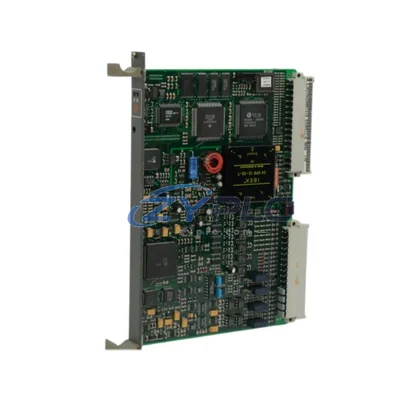
ABB SC300E PAC 031-1053-04 DCS Controller for SC300E
In modern distributed control system (DCS) architecture, every module must fulfill a precise role within a layered, interdependent control hierarchy. The ABB SC300E PAC 031-1053-04 is a process automation controller (PAC) module engineered specifically for deployment within ABB’s SC300E DCS platform — a system architecture widely adopted across power generation, petrochemical processing, water treatment, metallurgical operations, and continuous manufacturing environments. This module does not operate in isolation; it functions as the central processing and coordination node within a structured control topology that spans the control layer, I/O layer, network layer, power layer, human-machine interface layer, and field execution layer. Understanding its role within this full-stack architecture is essential for engineers responsible for system design, commissioning, and long-term maintenance.
The SC300E PAC 031-1053-04 executes real-time control logic, manages process variable acquisition, coordinates inter-module communication, and enforces system-level timing across all connected subsystems. Its integration into the SC300E backplane architecture ensures deterministic scan cycle performance, low-latency signal processing, and seamless coordination with redundant controller configurations. For facilities operating under strict uptime requirements — such as continuous process plants or critical infrastructure — this module’s ability to participate in hot-standby redundancy schemes is a defining architectural advantage.
Product Specification Table
| Parameter |
Specification |
| System Role |
Process Automation Controller (PAC) — Control Layer Node |
| Compatible Platform |
ABB SC300E Distributed Control System |
| Module Series |
SC300E PAC Series |
| Part Number |
031-1053-04 |
| Controller Type |
DCS Process Automation Controller Module |
| Backplane Compatibility |
SC300E System Backplane / Rack Architecture |
| Communication Capability |
Proprietary SC300E Inter-Module Bus; supports HART, Modbus, and fieldbus integration via gateway modules |
| Redundancy Support |
Hot-standby controller redundancy (paired with redundant PAC module) |
| Operating Temperature |
0°C to 60°C (standard industrial enclosure) |
| Power Supply Compatibility |
SC300E system power distribution rail (24VDC regulated) |
| Installation Environment |
Control cabinet / DIN rail rack; IEC 61010 compliant enclosure |
| Origin |
Sweden (ABB Industrial Automation Division) |
| Warranty |
warranty terms confirmed during quotation — covers manufacturing defects and functional failure under normal operating conditions |
| system integration |
Full system integration support — pre-validated for SC300E system architecture deployment |
System Compatibility Notes
The SC300E PAC 031-1053-04 achieves its full performance potential only when deployed within a correctly configured SC300E system architecture. At the control layer, this PAC module operates in coordination with a redundant PAC counterpart — typically a second SC300E PAC 031-1053-04 or compatible redundancy module — to maintain continuous control execution in the event of primary controller failure. The two controllers synchronize state data across the SC300E redundancy bus, ensuring bumpless transfer during switchover events.
At the I/O layer, the PAC communicates with a range of SC300E analog and digital I/O modules mounted on the same backplane or connected via remote I/O expansion racks. Modules such as the SC300E AI 8-channel analog input module and the SC300E DO 16-channel digital output module feed process variable data directly to the PAC’s execution engine, enabling closed-loop control of field instruments including control valves, variable frequency drives, and transmitters.
Network layer integration is achieved through SC300E communication gateway modules that bridge the controller’s internal bus to plant-wide networks including Modbus TCP/IP, PROFIBUS DP, and FOUNDATION Fieldbus H1. These gateways allow the SC300E PAC 031-1053-04 to exchange data with supervisory SCADA systems, historian servers, and MES platforms without disrupting real-time control execution. For facilities using ABB’s System 800xA as the supervisory layer, the SC300E platform integrates natively through the 800xA connectivity framework.
Power layer stability is maintained through dedicated SC300E power supply modules — typically dual-redundant 24VDC power supply units mounted within the same control cabinet — which provide regulated, filtered power to the PAC and all connected I/O modules. Power supply redundancy ensures that a single PSU failure does not interrupt controller operation, a critical requirement in continuous process environments.
At the human-machine interface layer, operator workstations running ABB’s control software connect to the SC300E PAC via the plant network, providing real-time process visualization, alarm management, and control command execution. Panel-mounted HMI terminals may also interface directly with the system through serial or Ethernet connections, providing local operator access at the field level.
At the execution layer, the PAC’s output signals drive field devices including motorized control valves, pneumatic actuators, relay output modules, and variable speed drives. Terminal block modules and marshalling panels serve as the physical interface between the SC300E I/O modules and field wiring, ensuring organized, maintainable signal routing throughout the control cabinet.
Industrial Application Notes
The ABB SC300E PAC 031-1053-04 is deployed across a broad range of industrial automation applications where system reliability, architectural consistency, and long-term maintainability are primary engineering requirements.
In power generation facilities — including thermal, hydroelectric, and combined-cycle plants — the SC300E PAC manages turbine control sequences, boiler feedwater regulation, and auxiliary system coordination. Its redundancy architecture ensures continuous control during planned maintenance windows and unplanned fault events, supporting the high-availability requirements of grid-connected generation assets.
In petrochemical and refinery operations, the PAC module controls distillation column temperature profiles, reactor pressure regulation, and product flow metering. Integration with HART-enabled field instruments via SC300E I/O modules allows the PAC to receive device diagnostics alongside process variables, supporting predictive maintenance programs and reducing unplanned shutdowns.
In water and wastewater treatment plants, the SC300E PAC 031-1053-04 manages pump sequencing, chemical dosing control, and filtration system automation. Its ability to operate reliably in environments with variable ambient temperatures and humidity levels — within a properly rated control enclosure — makes it well-suited for both indoor and outdoor-rated cabinet installations.
In metallurgical and mining operations, the PAC coordinates conveyor drive sequencing, crusher control, and ore processing automation. The module’s support for remote I/O expansion allows control architecture to extend across large physical plant footprints without compromising scan cycle performance or communication reliability.
In packaging and discrete manufacturing lines, the SC300E PAC integrates with servo drive systems, vision inspection modules, and reject handling mechanisms, providing the deterministic control timing required for high-speed production environments.
Product Compatibility FAQ
Q1: Is the SC300E PAC 031-1053-04 compatible with existing SC300E backplane racks, and can it be added to an operational system without full shutdown?
A1: Yes, the SC300E PAC 031-1053-04 is designed for direct installation into SC300E-compatible backplane racks. In redundant controller configurations, the standby PAC module can typically be replaced or added during system operation without interrupting the active control path, provided the system is operating in redundant mode and the active controller remains healthy. For single-controller configurations, a controlled maintenance window is required. Always verify firmware version compatibility between the replacement PAC and the existing system configuration before installation.
Q2: What communication protocols does the SC300E PAC 031-1053-04 support, and how does it integrate with third-party SCADA or MES systems?
A2: The SC300E PAC 031-1053-04 communicates natively over the SC300E internal system bus. Integration with third-party SCADA, historian, or MES platforms is achieved through SC300E communication gateway modules that support Modbus TCP/IP, PROFIBUS DP, FOUNDATION Fieldbus, and OPC DA/UA protocols. For ABB System 800xA environments, native connectivity is available through the 800xA SC300E integration layer. Third-party integration projects should include protocol gateway configuration and data mapping validation as part of the commissioning scope.
Q3: What does the warranty terms confirmed during quotation cover, and what support is available for long-term spare parts supply?
A3: The warranty terms confirmed during quotation covers manufacturing defects and functional failures occurring under normal operating conditions from the date of shipment. It includes module replacement or repair at no additional cost for covered failures. For long-term spare parts supply, ZYPLC supports RFQ sourcing for SC300E series modules to support ongoing maintenance programs, emergency replacement requirements, and planned lifecycle management strategies. Customers are encouraged to establish a spare parts inventory plan aligned with their system’s critical module list to minimize exposure to extended lead times on obsolete or end-of-life components.