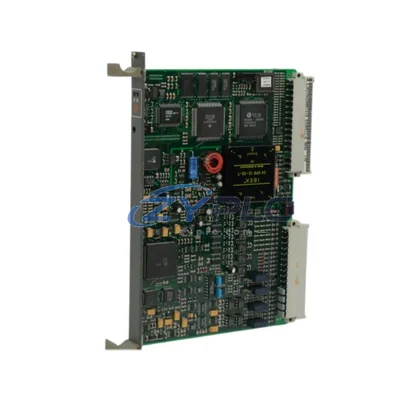
ABB SDCS-AMC-DC2 3ADT312700R0001: Industrial Data Link for DCS Series DC Drive Systems
The ABB SDCS-AMC-DC2 (Part No. 3ADT312700R0001) is a high-performance DC drive control board engineered for the ABB DCS series of DC drive systems. Designed to serve as the intelligence core of variable-speed DC motor drives, this control board enables seamless data exchange across the full automation hierarchy — from field-level sensors and actuators up through PLC controllers, SCADA platforms, and enterprise MES systems. In smart factory environments where uptime, data integrity, and real-time visibility are non-negotiable, the SDCS-AMC-DC2 delivers the communication backbone that modern industrial sites demand.
Compatibility & Integration Notes
| Parameter |
Specification |
| SKU |
SDCS-AMC-DC2 / 3ADT312700R0001 |
| Brand |
ABB |
| Series |
DCS (DC Drive Control System) |
| Product Type |
DC Drive Control Board |
| Protocol Support |
DDCS (Distributed Drive Control System), PROFIBUS-DP (via SDCS-COM-8), Modbus RTU/TCP (via adapter), DeviceNet (via SDCS-COM-5) |
| Interface Type |
Fiber optic DDCS ring, RS-485, digital I/O, analog I/O |
| Communication Speed |
Up to 4 Mbps (DDCS fiber ring) |
| Network Compatibility |
ABB Advant/AC80, PROFIBUS, Modbus, DeviceNet, Industrial Ethernet (via gateway) |
| System Application |
DC motor speed control, tension control, winding/unwinding, crane drives, paper machine drives, rolling mill automation |
| Origin |
Germany |
| Warranty |
12 Months |
| Stock Status |
Available — Global Shipping |
Connected Automation Data Flow
In a typical smart factory deployment, the SDCS-AMC-DC2 sits at the heart of the DC drive communication chain. Signal acquisition begins at the field level, where encoders, tachogenerators, and current transducers feed real-time motor feedback directly into the control board’s analog and digital I/O terminals. This raw process data — speed, torque, armature current, and field current — is processed onboard and made available to the wider automation network through the DDCS fiber optic ring, a high-speed, noise-immune communication bus native to ABB’s DCS drive architecture.
For sites running PROFIBUS-DP networks, the SDCS-COM-8 communication adapter plugs directly into the SDCS-AMC-DC2’s expansion slot, bridging the drive to Siemens S7-300/S7-400 PLCs, Schneider Modicon M340 controllers, or any PROFIBUS master without additional gateways. Where Modbus RTU or Modbus TCP connectivity is required — common in legacy SCADA systems or third-party HMI panels — the SDCS-COM-1 or SDCS-COM-3 adapters extend the board’s protocol reach, enabling direct register-level data exchange with Wonderware InTouch, Ignition SCADA, or WinCC visualization platforms.
The DDCS fiber ring architecture allows multiple DCS drives — such as the ABB DCS550, DCS800, and DCF803 — to be daisy-chained in a master-follower topology, enabling synchronized multi-drive coordination for applications like paper machine section drives, rolling mill stands, or multi-motor winding lines. Each drive node on the ring reports its status, fault codes, and process values back to the master controller in real time, giving operators full visibility from a single HMI screen.
At the supervisory level, the SDCS-AMC-DC2’s data is aggregated by industrial edge gateways or OPC-UA servers, feeding historian databases and MES platforms with timestamped production metrics. Remote I/O modules such as the ABB CI830 or third-party Wago 750-series I/O nodes can be integrated into the same network segment, expanding the site’s digital footprint without rewiring. Variable frequency drives (VFDs) on auxiliary equipment — cooling fans, hydraulic pumps, conveyor motors — can share the same PROFIBUS or Modbus segment, giving the SCADA system a unified view of all drive assets on the production floor.
Solving Data Isolation in Industrial Sites
Many industrial sites operating legacy DC drive systems face a common challenge: the drive knows what is happening at the motor, but that information never reaches the control room. Fault codes sit unread in drive memory, speed deviations go undetected until product quality suffers, and maintenance teams respond reactively rather than predictively. The SDCS-AMC-DC2 directly addresses this data isolation problem.
By supporting multiple fieldbus protocols through its plug-in communication adapter architecture, the SDCS-AMC-DC2 eliminates the need for proprietary protocol converters or custom serial bridges. A site running a mixed network — PROFIBUS on the main production line, Modbus on auxiliary equipment, and DDCS between drive groups — can integrate all three through a single SDCS-AMC-DC2-based drive system, with data flowing transparently to the SCADA layer.
For remote monitoring and diagnostics, the board’s fault logging and parameter mirroring capabilities allow SCADA operators to read drive status, reset faults, and adjust speed references from the control room without dispatching a technician to the drive cabinet. This capability is especially valuable in hazardous environments — steel mills, chemical plants, offshore platforms — where physical access to drive panels is restricted or time-consuming.
Production line transparency is further enhanced by the board’s support for real-time parameter broadcasting. Key process variables — motor speed, load current, power consumption, and thermal status — can be mapped to SCADA tags and displayed on HMI dashboards, enabling operators to detect performance drift before it becomes a fault condition. When combined with ABB’s DriveWindow or DriveAP configuration tools, the SDCS-AMC-DC2 supports full parameter backup and restore, dramatically reducing commissioning time after a board replacement.
System expansion is equally straightforward. The DDCS ring topology supports up to 12 drive nodes per ring segment, and multiple rings can be connected through ABB’s NDBU-95 branching unit, scaling the network to cover large multi-drive installations without architectural redesign. As production requirements grow, additional DCS550 or DCS800 drives can be added to the ring with minimal configuration effort, protecting the site’s investment in its existing automation infrastructure.
Industrial Connectivity FAQ
Q1: What communication protocols does the ABB SDCS-AMC-DC2 3ADT312700R0001 support, and how does it connect to a SCADA system?
The SDCS-AMC-DC2 natively supports ABB’s DDCS fiber optic protocol for drive-to-drive and drive-to-controller communication. For SCADA integration, protocol adapters such as the SDCS-COM-8 (PROFIBUS-DP), SDCS-COM-1 (Modbus RTU), or SDCS-COM-3 (Modbus TCP) can be installed in the board’s expansion slot, enabling direct connection to most industrial SCADA and DCS platforms without additional hardware gateways.
Q2: How does the SDCS-AMC-DC2 ensure network stability in high-interference industrial environments?
The board uses fiber optic DDCS communication for its primary drive network, which provides complete galvanic isolation and immunity to electromagnetic interference — critical in environments with large motors, welding equipment, or variable frequency drives generating significant electrical noise. For fieldbus connections, the communication adapters include hardware filtering and comply with EN 61800-3 EMC standards for industrial drive systems.
Q3: Can the SDCS-AMC-DC2 be used to expand an existing DCS drive network, and what is the maximum network size?
Yes. The DDCS ring topology supports up to 12 drive nodes per ring, and rings can be interconnected using the ABB NDBU-95 branching unit to build larger networks. This makes the SDCS-AMC-DC2 suitable for both standalone drive replacements and large multi-drive system expansions, with no changes required to the existing network architecture.
Q4: What does the warranty terms confirmed during quotation cover, and has the board been tested before shipment?
Every SDCS-AMC-DC2 3ADT312700R0001 unit supplied by ZYPLC undergoes pre-shipment functional testing to verify communication interfaces, I/O channels, and power supply integrity. The warranty terms confirmed during quotation covers manufacturing defects and component failures under normal operating conditions. Our technical team provides remote diagnostic support to assist with installation, commissioning, and fault resolution throughout the warranty period.