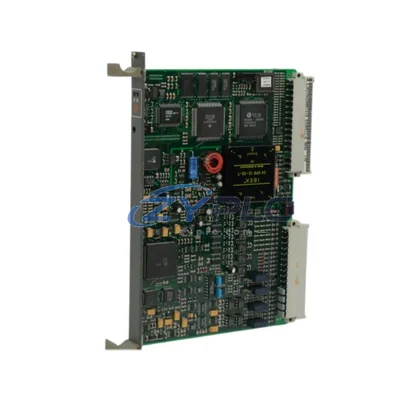
ABB SDCS-POW-1C Industrial Power Supply Board: Backbone of DCS800 Data Link Integrity
The ABB SDCS-POW-1C is a precision-engineered internal power supply board purpose-built for the ABB DCS800 Series DC drive platform — one of the most widely deployed variable-speed DC drive systems across heavy industry, metals processing, paper mills, and large-scale manufacturing automation. As the foundational power conditioning component within the DCS800 drive cabinet, the SDCS-POW-1C delivers stable, regulated voltage to the drive’s control electronics, communication interfaces, and I/O subsystems, making it an indispensable element in any connected industrial automation architecture.
In modern smart factory environments, the reliability of a DC drive’s internal power supply directly determines the integrity of the entire data chain — from field-level signal acquisition through to SCADA dashboards and MES reporting layers. A failing or degraded power supply board introduces noise, communication dropouts, and unpredictable drive behavior that can cascade across an entire production line. The SDCS-POW-1C eliminates this risk by delivering clean, stable power to every logic and communication circuit within the DCS800 drive, ensuring uninterrupted data flow across the full automation stack.
Compatibility & Integration Notes
| Attribute |
Specification |
| Part Number / SKU |
SDCS-POW-1C |
| Compatible Platform |
ABB DCS800 Series DC Drives |
| Board Function |
Internal Power Supply for Drive Control Electronics & Communication Interfaces |
| Supported Communication Protocols |
DDCS (Distributed Drive Control System), PROFIBUS-DP (via SDCS-COM-8), DeviceNet (via SDCS-COM-9), Modbus RTU, CANopen, EtherNet/IP (via adapter modules) |
| Interface Compatibility |
SDCS-CON-4 Control Board, SDCS-COM-8 PROFIBUS Adapter, SDCS-IOB-3 I/O Extension Board |
| Network Architecture Support |
Fieldbus, Industrial Ethernet, SCADA Integration, PLC Master Control, DDCS Fiber Ring |
| System Application |
DC Motor Speed Control, Tension Control, Winding/Unwinding, Crane & Hoist, Rolling Mill Drives |
| Transmission Reliability |
Stable DC power to all control and communication circuits; eliminates signal noise at source |
| Network Compatibility |
ABB AC500 PLC, ABB Ability System 800xA SCADA, Siemens S7 via gateway, Rockwell ControlLogix via EtherNet/IP adapter |
| Warranty and support terms confirmed before quote |
Yes — Fully Tested Before Dispatch |
| Origin |
Germany (ABB Manufacturing) |
| Availability |
Confirmed via RFQ before quotation |
Connected Automation Data Flow
To understand the role of the SDCS-POW-1C in a connected factory, consider the complete data flow of a DCS800-based DC drive system. At the field level, process sensors — including speed encoders, current transducers, and temperature probes — feed real-time signals into the SDCS-IOB-3 I/O Extension Board, which aggregates analog and digital inputs for the drive’s control logic. These signals are processed by the SDCS-CON-4 Control Board, the computational core of the DCS800 drive, which executes speed regulation algorithms, torque control loops, and protection logic in real time.
The SDCS-POW-1C supplies the regulated internal voltages that keep both the SDCS-CON-4 and the communication adapter modules operating within specification. Without stable power at this level, the SDCS-COM-8 PROFIBUS-DP Adapter — which connects the DCS800 drive to a Siemens S7-300 or S7-400 PLC master, or to an ABB AC500 PLC — cannot maintain reliable cyclic data exchange. Any voltage ripple or dropout at the power supply board level translates directly into communication timeouts, drive faults, and unplanned production stops.
Upstream from the drive, the PROFIBUS or DeviceNet network carries real-time process data — motor speed, armature current, drive status words, and fault codes — to the plant’s SCADA system, such as ABB Ability System 800xA, Wonderware InTouch, or Ignition by Inductive Automation. Operators at HMI terminals monitor drive performance, set reference values, and acknowledge alarms through this data pathway. The SDCS-POW-1C, by maintaining power integrity at the drive level, ensures that this entire data chain — from encoder pulse to SCADA trend display — remains unbroken and latency-free.
In multi-drive installations, such as a rolling mill with coordinated master-follower DC drives, the DDCS (Distributed Drive Control System) fiber-optic link connects multiple DCS800 drives to an ABB NDBU-95 Branching Unit, enabling synchronized speed and torque control across the drive line. The power supply board in each drive must perform identically to prevent timing skew in the DDCS communication cycle. For remote monitoring and predictive maintenance, edge gateways — such as the ABB Edge Controller or third-party IIoT gateways running OPC-UA or Modbus TCP — collect drive diagnostic data and forward it to cloud analytics platforms, enabling condition-based maintenance scheduling without requiring on-site intervention. Protocol conversion gateways such as the Moxa MGate MB3000 Series further extend DCS800 connectivity to modern Ethernet-based SCADA and MES environments.
Solving Data Isolation in Industrial Sites
One of the most persistent challenges in legacy industrial environments is the fragmentation of drive systems from plant-wide data networks. Older DC drive installations — including many DCS800 deployments — may have been commissioned before the widespread adoption of Industrial Ethernet, leaving them isolated from modern SCADA, MES, and ERP systems. A failed or degraded SDCS-POW-1C accelerates this isolation: when the drive’s internal power supply degrades, communication adapters lose their operating voltage, fieldbus nodes drop off the network, and the drive becomes invisible to the control system — creating a critical data island on the production floor.
Replacing the SDCS-POW-1C restores the drive’s full communication capability, allowing it to rejoin the plant network and resume real-time data exchange. This is the first and most cost-effective step in eliminating data silos. Once the drive is back online, protocol conversion gateways can bridge the DCS800’s PROFIBUS interface to an EtherNet/IP or Modbus TCP backbone, making drive data accessible to modern SCADA and cloud platforms without replacing the entire drive system. For production line transparency, integrating DCS800 drive data into a unified SCADA view allows plant managers to track motor load trends, identify energy inefficiencies, and schedule preventive maintenance based on actual operating hours and thermal history — rather than fixed calendar intervals.
Remote diagnostics via the DDCS or fieldbus interface allow drive specialists to read fault logs, adjust parameters, and perform test runs without traveling to the site, reducing mean time to repair (MTTR) and minimizing production losses. System expansion is equally straightforward: additional DCS800 drives can be added to the DDCS fiber ring or PROFIBUS segment without disrupting existing nodes, provided each drive’s SDCS-POW-1C is in good condition and supplying stable power to its communication interfaces. This scalability makes the DCS800 platform — and the SDCS-POW-1C that underpins it — a long-term investment for industrial sites planning phased automation upgrades.
Industrial Connectivity FAQ
Q1: Will a degraded SDCS-POW-1C cause PROFIBUS communication errors on the DCS800?
Yes. The SDCS-POW-1C supplies operating voltage to the SDCS-COM-8 PROFIBUS adapter and the SDCS-CON-4 control board. If the power supply board delivers out-of-specification voltages — due to aging capacitors, failed regulators, or thermal damage — the PROFIBUS node will experience intermittent dropouts, increased communication latency, and eventually a complete loss of network presence. Replacing the SDCS-POW-1C with a tested unit is the most reliable corrective action and restores full fieldbus participation immediately.
Q2: Is the SDCS-POW-1C compatible with all DCS800 drive variants, including the DCS800-S and DCS800-EP?
The SDCS-POW-1C is designed for the standard DCS800 drive family. Compatibility with specific sub-variants — including the DCS800-S regenerative drives and DCS800-EP extended power range — depends on the drive’s hardware revision and firmware version. We recommend providing your drive’s full nameplate data, including the type code and hardware revision, when submitting an RFQ so our technical team can confirm exact compatibility before dispatch.
Q3: How is the SDCS-POW-1C tested before shipment, and what does the warranty and support terms confirmed before quote cover?
Every SDCS-POW-1C unit supplied by ZYPLC undergoes functional testing prior to dispatch, including output voltage verification under load, insulation resistance checks, and visual inspection for component damage. The warranty and support terms confirmed before quote covers manufacturing defects and functional failures under normal operating conditions. It does not cover damage resulting from incorrect installation, overvoltage events, or operation outside the specified environmental parameters. Warranty claims are supported by our technical team at plc.sales@zyplc.com.
Q4: Can the DCS800 drive system be expanded to support Industrial Ethernet or OPC-UA after replacing the SDCS-POW-1C?
Yes. Once the SDCS-POW-1C is replaced and the drive’s communication interfaces are restored to full operation, the DCS800 can be connected to Industrial Ethernet networks using the SDCS-COM-8 (PROFIBUS) or SDCS-COM-9 (DeviceNet) adapters in combination with a protocol gateway. For OPC-UA integration, an edge gateway — such as the ABB Edge Controller or a Kepware OPC server — can bridge the fieldbus data to an OPC-UA server, making drive data accessible to cloud SCADA platforms, MES systems, and IIoT analytics tools without modifying the drive’s internal hardware.
Contact: +86 19859288691 | plc.sales@zyplc.com