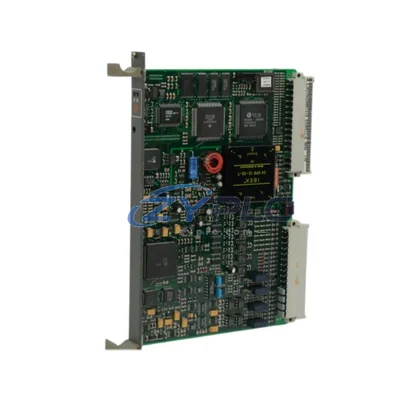
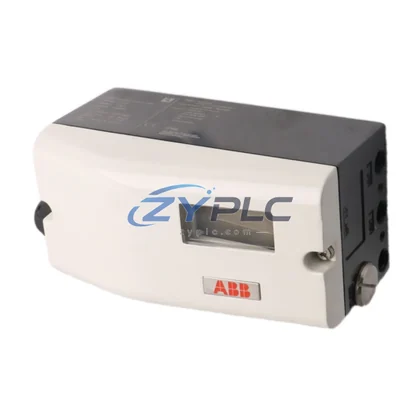
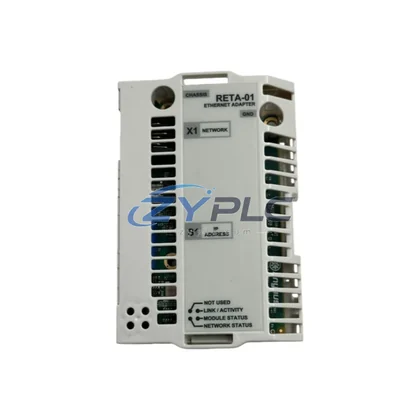
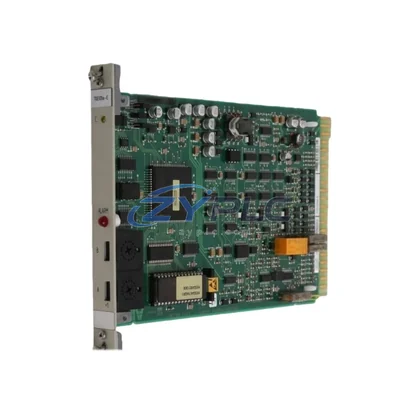
ABB YPK112A Communication Board for AC Drive
In modern industrial automation, the reliability of a control system depends not on any single component, but on the seamless coordination of every layer — from the controller and I/O modules down to the drive-level communication interfaces. The ABB YPK112A Communication Board occupies a critical position in this architecture: it serves as the dedicated fieldbus interface card for ABB AC drive systems, enabling deterministic, high-speed data exchange between the drive unit and the upper-level control network. Whether deployed in a distributed control system (DCS), a PLC-based machine controller, or a SCADA-integrated process line, the YPK112A ensures that the drive is not an isolated actuator but a fully integrated node within the control hierarchy.
The YPK112A is engineered for installation into compatible ABB drive platforms, including the ACS880 industrial drive series and the ACS580 general-purpose drive family. It slots directly into the option slot of the drive’s control unit, establishing a physical and logical bridge between the drive’s internal control logic and the plant-wide communication backbone. This plug-in architecture eliminates the need for external gateways or protocol converters, reducing wiring complexity, minimizing signal latency, and improving overall system diagnostics capability.
Product Specification Table
| Parameter |
Specification |
| System Role |
Drive-Level Fieldbus Communication Interface Card |
| Compatible Platforms |
ABB ACS880, ACS580, ACS355 AC Drive Series |
| Installation Method |
Direct plug-in to drive option slot (no external gateway required) |
| Communication Protocol |
Fieldbus (protocol-specific per variant; supports PROFIBUS-DP, DeviceNet, CANopen, Modbus RTU) |
| Data Exchange |
Cyclic process data + acyclic parameter access |
| Electrical Interface |
Powered via drive option slot backplane (no external power supply required) |
| Operating Temperature |
-10°C to +55°C (storage: -40°C to +70°C) |
| Humidity |
5–95% RH, non-condensing |
| Enclosure / Form Factor |
PCB option card, IP20 when installed in drive enclosure |
| Country of Origin |
Germany (DE) |
| Warranty |
warranty terms confirmed during quotation — covers manufacturing defects and functional failure under normal operating conditions |
System Compatibility Notes
The true value of the ABB YPK112A is realized when it is evaluated within the context of a complete, layered control system rather than as a standalone component. In a typical automation architecture, the YPK112A acts as the communication bridge between the drive’s power electronics and the supervisory control layer, enabling the following system-level integrations:
Controller Layer: The YPK112A connects the ACS880 or ACS580 drive to a PLC or DCS controller — such as an ABB AC500 PLC or an ABB System 800xA DCS — via a standardized fieldbus. The controller issues speed references, torque commands, and start/stop signals through the fieldbus network, while the YPK112A relays real-time drive status, fault codes, and process feedback back upstream. This bidirectional data flow enables closed-loop control without analog signal degradation.
I/O and Signal Layer: In systems where the drive must respond to discrete or analog field signals — such as pressure transmitters, flow sensors, or limit switches — the YPK112A works in conjunction with the drive’s onboard I/O terminals and any extended I/O modules. The RDNA-01 DeviceNet adapter or RINT-5611C DDCS fiber interface may be used in parallel architectures where redundant communication paths are required, ensuring that a single communication failure does not interrupt drive operation.
Network and Gateway Layer: For plants running mixed-protocol environments, the YPK112A can coexist with protocol gateways such as the FENA-21 Ethernet adapter or the FPBA-01 PROFIBUS adapter installed in adjacent drive option slots. This allows a single drive to participate in multiple network segments simultaneously — for example, reporting energy data to an Ethernet-based SCADA system while receiving motion commands from a PROFIBUS-DP PLC network.
Power and Redundancy Layer: In high-availability applications, the YPK112A-equipped drive is typically paired with a redundant power supply module and an uninterruptible power system (UPS) at the control cabinet level. The CDP312R control panel provides local parameter access and fault acknowledgment without interrupting fieldbus communication, ensuring that maintenance personnel can interact with the drive without taking the network node offline.
HMI and Supervision Layer: Operator workstations running ABB’s Mint or System 800xA visualization software receive real-time drive data — including output frequency, motor current, DC bus voltage, and active fault history — via the fieldbus path established by the YPK112A. This eliminates the need for dedicated analog instrumentation loops for drive monitoring, reducing panel wiring and improving data accuracy.
Execution and Actuator Layer: At the field level, the ACS880 or ACS580 drive controlled through the YPK112A directly governs motors, pumps, fans, compressors, and conveyors. The communication board ensures that speed ramps, torque limits, and maintenance planning parameters set at the controller level are faithfully executed at the motor shaft, maintaining process consistency across the entire production line.
Industrial Application Notes
The ABB YPK112A Communication Board is deployed across a wide range of industrial sectors where AC drive integration into a networked control architecture is essential:
Manufacturing and Assembly Lines: In automotive body shops and electronics assembly facilities, the YPK112A enables precise speed synchronization between multiple ACS880 drives controlling conveyor sections, robotic positioners, and material handling systems. The fieldbus connection allows the line PLC to coordinate drive acceleration profiles in real time, eliminating mechanical shock and reducing product defect rates.
Power Generation and Utilities: In thermal power plants and hydroelectric stations, the YPK112A integrates boiler feed pump drives and cooling water pump drives into the plant DCS. Operators can remotely adjust pump speed setpoints and monitor motor load from the control room, reducing the need for field personnel intervention during load-following operations.
Petrochemical and Refinery Applications: In hazardous area installations, the YPK112A-equipped drive is mounted in pressurized or purged control cabinets, with the fieldbus cable routed through certified conduit to the safe-area PLC room. The communication board’s ability to transmit detailed diagnostic data — including insulation resistance trends and bearing temperature estimates — supports predictive maintenance programs that reduce unplanned shutdowns.
Water and Wastewater Treatment: Municipal water treatment plants use the YPK112A to integrate variable-speed pump drives into SCADA systems, enabling automatic flow control based on tank level sensors and demand forecasts. The warranty terms confirmed during quotation and proven reliability of the ABB drive platform reduce the total cost of ownership for utilities operating on tight maintenance budgets.
Mining and Mineral Processing: In ore crushing and conveyor systems, the YPK112A connects high-power ACS880 drives to the mine’s distributed control network, allowing remote start/stop, speed adjustment, and fault logging from the surface control room. The robust communication architecture supports the long cable runs and electrically noisy environments typical of underground mining installations.
Packaging and Food Processing: In hygienic packaging lines, the YPK112A enables the line controller to coordinate filling, sealing, and labeling drives with sub-millisecond synchronization, ensuring consistent package quality at high throughput rates. The plug-in form factor simplifies drive replacement during scheduled maintenance windows, minimizing production downtime.
Product Compatibility FAQ
Q1: Is the ABB YPK112A compatible with both ACS880 and ACS580 drive platforms, and can it be used in a mixed-drive architecture?
A: The YPK112A is designed for installation in ABB AC drive option slots and is compatible with the ACS880 and ACS580 series, as well as select ACS355 variants. In a mixed-drive architecture where different drive models are networked on the same fieldbus segment, each drive requires its own YPK112A (or equivalent communication adapter), and all adapters must be configured with unique node addresses. The upper-level PLC or DCS treats each drive as an independent fieldbus node, so mixed-model installations are fully supported provided the fieldbus master (e.g., the AC500 PLC’s communication module) is configured with the correct GSD or EDS files for each drive type.
Q2: How does the YPK112A support long-term maintenance and spare parts management in a multi-drive system?
A: The YPK112A’s plug-in design means that a single spare card can serve as a replacement for any drive in the system that uses the same option slot format, simplifying spare parts inventory. The warranty terms confirmed during quotation covers manufacturing defects and functional failures under normal operating conditions, providing a defined support window for commissioning and early-life operation. For long-term maintenance, it is recommended to maintain at least one spare YPK112A per five drives in the system, and to document the fieldbus node address and parameter configuration for each installed card so that replacement can be completed without re-commissioning the entire drive from scratch.
Q3: What steps are required to commission the YPK112A in a PROFIBUS-DP network, and how is system integration with the PLC achieved?
A: Commissioning the YPK112A in a PROFIBUS-DP network involves three main steps: (1) Install the card in the drive’s option slot and power up the drive to allow automatic detection of the communication board. (2) Set the PROFIBUS node address using the drive’s CDP312R control panel or the DriveStudio PC tool, ensuring the address matches the configuration in the PLC’s hardware manager. (3) Import the drive’s GSD file into the PLC engineering software (e.g., ABB Automation Builder or Siemens TIA Portal) and configure the cyclic data telegram to map drive speed reference, control word, status word, and actual speed to the PLC’s process image. system integration — the ability of the drive to participate in the broader control context, including interlocks, safety functions, and maintenance planning — is achieved by mapping additional acyclic parameters (such as motor temperature, energy consumption, and fault history) to the PLC’s data blocks, enabling the controller to make informed decisions based on real-time drive state rather than simple on/off feedback.