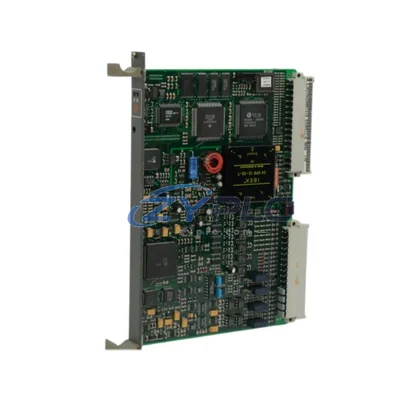
ABB YPT111A I/O Board for Advant OCS
The ABB YPT111A is a dedicated I/O board engineered for seamless integration within the ABB Advant OCS (Open Control System) and Advant Master distributed control system (DCS) architecture. Rather than functioning as a standalone component, the YPT111A is designed to operate as a precision node within a layered automation hierarchy — connecting field-level signals to the controller backbone with deterministic reliability. In complex industrial environments where signal integrity, system uptime, and long-term maintainability are non-negotiable, the YPT111A delivers the structural consistency that modern control engineers demand.
Understanding the YPT111A requires viewing it through the lens of the complete Advant OCS control architecture. From the controller layer down through I/O distribution, network communication, power conditioning, and human-machine interface, every module in the system must operate in coordinated harmony. The YPT111A occupies a critical position in this hierarchy — serving as the signal acquisition and distribution interface between physical process instrumentation and the central processing units that execute control logic.
Product Specification Table
| Parameter |
Specification |
| System Role |
I/O Signal Interface Board — Advant OCS/Master DCS |
| Compatible Platform |
ABB Advant OCS, Advant Master Series |
| Module Type |
DCS I/O Board (Analog/Digital Signal Processing) |
| Mounting |
Rack-mounted, compatible with Advant OCS subrack/backplane |
| Signal Interface |
Process I/O — field instrument signal termination |
| Communication |
Internal Advant bus / MasterBus 300 compatible architecture |
| Power Supply |
Supplied via Advant OCS rack power distribution (24 VDC nominal) |
| Operating Temperature |
0°C to +55°C (standard industrial environment) |
| Humidity |
5% to 95% RH, non-condensing |
| Country of Origin |
Sweden |
| Warranty |
warranty terms confirmed during quotation — covers manufacturing defects and functional failure |
| Condition |
Tested, inspected, and verified prior to shipment |
System Compatibility Notes
The YPT111A does not operate in isolation. Its value is fully realized when it is deployed as part of a coherent Advant OCS system architecture. In a typical Advant OCS installation, the YPT111A interfaces directly with the DSPC110 or DSPC172 processor modules, which handle the execution of control algorithms and manage the real-time data exchange across the system bus. The processor modules rely on I/O boards like the YPT111A to deliver accurate, time-stamped field data that feeds into PID loops, sequence logic, and alarm management routines.
At the power layer, the DSPU110 or DSTD110 power supply units provide the regulated 24 VDC rail that energizes the subrack and all installed I/O boards. Stable power distribution is essential for maintaining signal accuracy across the YPT111A’s input channels — any voltage fluctuation at the rack level can introduce measurement drift that compromises process control quality. Pairing the YPT111A with a properly rated Advant power supply ensures that the I/O board operates within its specified electrical envelope throughout the system lifecycle.
For network communication and data routing, the DSSB110 or DSCS110 communication modules serve as the bridge between the Advant OCS subrack and higher-level SCADA systems or engineering workstations. These modules implement the MasterBus 300 or PROFIBUS DP protocol stack, enabling the YPT111A’s field data to be transmitted upstream for operator visualization, historian logging, and remote diagnostics. The YPT111A’s role in this communication chain is to ensure that field signals are correctly conditioned and formatted before they enter the network layer.
At the human-machine interface layer, ABB Advant Station 500 series operator workstations or compatible HMI terminals consume the process data originating from the YPT111A. Operators monitoring flow rates, temperatures, pressures, or discrete equipment states are ultimately viewing data that has passed through the YPT111A’s signal conditioning circuitry. The accuracy and reliability of the YPT111A therefore directly impacts the quality of operator decision-making in real-time process environments.
For I/O expansion and signal termination, the YPT111A is typically used alongside DSTD150 or DSTD190 termination units and DSAI130 or DSDI110 analog and digital input modules. These companion modules extend the I/O capacity of the Advant OCS subrack, allowing engineers to scale the control system to match the complexity of the process without redesigning the controller architecture. The YPT111A’s backplane compatibility ensures that it can be inserted into existing Advant racks alongside these expansion modules without requiring additional hardware modifications.
Redundancy is a core design principle in high-availability Advant OCS installations. When deployed in redundant configurations, the YPT111A works in conjunction with DSMB175 or DSMC110 redundancy modules that manage automatic switchover between primary and backup I/O paths. This architecture ensures that a single board failure does not interrupt process control — the redundancy module detects the fault condition and transfers signal processing responsibility to the standby I/O board within milliseconds, maintaining system continuity without operator intervention.
Industrial Application Notes
The ABB YPT111A finds application across a broad spectrum of industrial sectors where the Advant OCS platform has been deployed as the primary control infrastructure.
In power generation and electrical utilities, the YPT111A is used to interface turbine control signals, generator excitation feedback, and switchgear status inputs with the Advant OCS controller. The board’s ability to handle multiple signal types within a single rack position makes it particularly valuable in power plant control rooms where panel space is constrained and signal density is high.
In petrochemical and refinery applications, the YPT111A supports the acquisition of temperature, pressure, and flow signals from field transmitters installed throughout distillation columns, heat exchangers, and reactor vessels. The board’s industrial-grade design tolerates the electromagnetic interference common in heavy process environments, ensuring that signal integrity is maintained even in electrically noisy installations.
In pulp and paper manufacturing, where ABB Advant OCS systems have historically been widely deployed, the YPT111A manages the I/O requirements of continuous process lines including stock preparation, paper machine wet end control, and dryer section management. The board’s compatibility with the existing Advant subrack infrastructure allows paper mills to extend the operational life of their control systems without undertaking costly platform migrations.
In water and wastewater treatment facilities, the YPT111A interfaces with level sensors, pump status contacts, and chemical dosing feedback signals. Its reliable signal processing supports the regulatory compliance requirements of water treatment operations, where accurate measurement and control are mandated by environmental standards.
In mining and minerals processing, the YPT111A is deployed in crusher control systems, conveyor management applications, and flotation cell control loops. The board’s robust construction and compatibility with the Advant OCS redundancy architecture make it suitable for the demanding operating conditions typical of mineral processing plants.
Product Compatibility FAQ
Q1: Is the ABB YPT111A compatible with both Advant OCS and Advant Master DCS platforms, and can it be installed in existing racks without hardware modification?
The YPT111A is designed for the ABB Advant OCS and Advant Master DCS subrack architecture. It is backplane-compatible with standard Advant rack configurations and can be installed alongside existing I/O modules, processor boards, and communication modules without requiring rack modifications. Engineers should verify the specific subrack model and slot assignment against the Advant OCS hardware configuration documentation to confirm compatibility with their installed base before deployment.
Q2: How does the YPT111A support long-term system maintainability, and what does the warranty terms confirmed during quotation cover?
The YPT111A is supplied as a tested and inspected unit, verified for functional performance prior to shipment. The warranty terms confirmed during quotation covers manufacturing defects and functional failures under normal operating conditions, providing engineering teams with the assurance needed for planned maintenance cycles and spare parts inventory management. For aging Advant OCS installations where original ABB support has been discontinued, sourcing tested YPT111A boards with warranty coverage is a cost-effective strategy for extending system operational life without platform migration.
Q3: What is the recommended approach for integrating the YPT111A into a redundant Advant OCS architecture during commissioning?
During commissioning of a redundant Advant OCS configuration, the YPT111A should be installed in the designated I/O slot as specified in the system hardware layout drawing. Engineers should verify that the redundancy module (such as the DSMB175) is correctly configured to recognize the YPT111A as a managed I/O node. Signal loop checks should be performed with the redundancy module active to confirm that automatic switchover functions correctly under simulated fault conditions. All channel assignments should be documented in the Advant OCS engineering database to support future maintenance and troubleshooting activities.