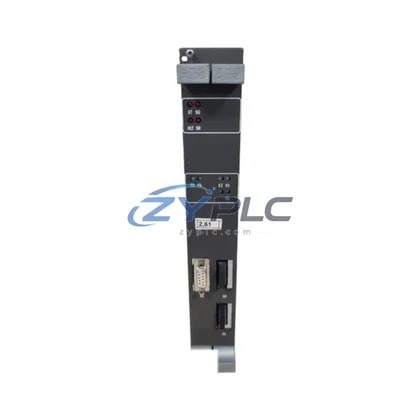
Allen-Bradley 1757-FFLD2 Fieldbus Module: Precision Control for Optimized Automation
The Allen-Bradley 1757-FFLD2 is a high-performance FOUNDATION Fieldbus Linking Device designed to bridge H1 fieldbus segments with a high-speed Ethernet backbone in process automation environments. As industrial facilities face mounting pressure to reduce operating load, minimize unplanned downtime, and maximize equipment utilization, the 1757-FFLD2 delivers the communication infrastructure needed to achieve measurable efficiency gains across the entire production line.
Unlike conventional I/O architectures that rely on point-to-point wiring and centralized polling, the 1757-FFLD2 enables distributed intelligence at the field level. Each connected field device — whether a smart valve positioner, flow transmitter, or pressure sensor — can execute control functions locally, reducing the computational burden on the host PLC and cutting unnecessary data traffic. This architecture directly translates into lower energy overhead per control loop and faster response times that tighten production line cycle rates.
At ZYPLC, every 1757-FFLD2 unit is sourced from verified supply channels, subjected to outgoing shipment testing, and backed by a warranty terms confirmed during quotation. Inventory is maintained availability confirmed by RFQ for prompt dispatch, supporting both urgent replacement needs and planned system expansions.
Product Specification Table
| Parameter |
Specification / Value |
| Model / SKU |
Allen-Bradley 1757-FFLD2 |
| Product Category |
Fieldbus Linking Module / FOUNDATION Fieldbus H1 Linking Device |
| Series |
Allen-Bradley 1757 Series |
| Power Consumption |
Low-power design; optimized for continuous 24/7 industrial operation |
| Operating Efficiency |
Supports up to 4 H1 fieldbus segments; up to 16 devices per segment |
| Compatible Systems |
ControlLogix, PlantPAx DCS, FOUNDATION Fieldbus H1/HSE networks |
| Application Environment |
Process industries: oil & gas, chemical, water treatment, power generation |
| Value |
Distributed control reduces host CPU load; minimizes redundant polling cycles |
| Communication Protocol |
FOUNDATION Fieldbus H1 + High-Speed Ethernet (HSE) |
| Origin |
USA |
| Warranty |
warranty terms confirmed during quotation — tested before shipment |
System Compatibility and Application
The 1757-FFLD2 is most effective when deployed as part of a cohesive, industrial automation system. In a typical PlantPAx distributed control system, the module connects to a ControlLogix L7x or L8x controller via the backplane, acting as the gateway between the high-speed controller network and the slower but highly capable H1 fieldbus segments running to field instruments.
On the fieldbus segments themselves, devices such as the Rosemount 3051 differential pressure transmitter and Fisher DVC6200 digital valve controller execute PID control loops autonomously. This means the 1757-FFLD2 does not simply pass data — it enables field devices to act on control decisions without waiting for a round-trip to the host controller, dramatically reducing latency and the energy cost of unnecessary communication cycles.
For power quality monitoring upstream of the control system, integrating a PowerMonitor 5000 unit into the same ControlLogix chassis provides real-time visibility into operating load at the panel level. When combined with the 1757-FFLD2’s fieldbus data, engineers gain a complete picture from field instrument to power distribution — enabling targeted energy reduction strategies rather than blanket load shedding.
Variable frequency drives such as the PowerFlex 755 or PowerFlex 525 are commonly deployed alongside the 1757-FFLD2 in motor-driven process applications. The fieldbus module communicates setpoints and feedback from flow or pressure transmitters directly to the drive control loop, enabling precise motor speed regulation that eliminates the unplanned downtime of throttling valves or running motors at fixed speed against variable loads. In pump and compressor applications, this integration alone can help restore stable operation when a compatible replacement is required.
On the I/O side, POINT I/O 1734 modules and Flex I/O 1794 adapters complement the 1757-FFLD2 by handling discrete and analog signals from equipment that does not support fieldbus protocols. Together, they form a unified data collection layer that feeds the ControlLogix controller with the process data needed for energy-optimized control strategies. For human-machine interface, a PanelView Plus 7 terminal provides operators with real-time energy dashboards, alarm management, and trend visualization — enabling faster response to inefficiency events before they escalate into costly downtime.
Where long-distance communication is required between plant areas, the 1756-EN2T EtherNet/IP communication module extends the ControlLogix backplane to remote I/O drops and other controllers, maintaining the low-latency data exchange that energy-efficient control depends on. In redundant configurations, a 1757-FFLD2 pair with a 1756-RM2 redundancy module ensures that a single device failure does not interrupt the fieldbus segments — protecting both production continuity and the operational stability achieved through optimized control.
Maintenance and Replacement Notes
In a chemical processing plant running continuous batch operations, the 1757-FFLD2 enables a control strategy where flow, temperature, and pressure loops are closed at the field device level. Rather than the host controller issuing setpoint commands every scan cycle, the fieldbus devices maintain their own control execution. The result is a measurable reduction in controller CPU utilization — freeing processing capacity for higher-level optimization tasks such as energy scheduling and predictive maintenance routines.
In water and wastewater treatment facilities, where pump stations run around the clock, the 1757-FFLD2 supports integration with smart transmitters that report not just process values but also device health diagnostics. Predictive maintenance alerts — such as valve signature degradation or transmitter drift — are surfaced through the fieldbus before they cause process upsets. Avoiding unplanned shutdowns eliminates the energy-intensive restart sequences that consume disproportionate power during motor acceleration and system re-pressurization.
For oil and gas upstream applications, the 1757-FFLD2’s ability to support intrinsically safe fieldbus segments (with appropriate barriers) means it can be deployed in hazardous areas without sacrificing the energy efficiency benefits of distributed control. Field devices in wellhead control panels and separator skids communicate process data back to the control room with minimal wiring infrastructure, reducing both installation cost and the ongoing energy overhead of maintaining legacy analog signal conditioning equipment.
Across all these applications, the 1757-FFLD2 contributes to a measurable improvement in Overall Equipment Effectiveness (OEE) by reducing the three primary OEE losses: unplanned downtime (through predictive diagnostics), speed losses (through tighter control loop performance), and quality losses (through more accurate process measurement and control). Each percentage point of OEE improvement in a continuous process plant typically translates directly into reduced operating load per unit of output.
Product Sourcing FAQ
Q1: How does the 1757-FFLD2 contribute to operational stability compared to conventional analog I/O?
The 1757-FFLD2 enables FOUNDATION Fieldbus, which allows field devices to execute control functions locally rather than relying on continuous polling from the host controller. This reduces unnecessary communication cycles, lowers controller CPU load, and enables tighter, faster control loops — all of which contribute to reduced operating load per unit of process output. When paired with variable frequency drives like the PowerFlex 755, the operational stability from precise motor speed control are particularly significant.
Q2: Is the 1757-FFLD2 compatible with existing ControlLogix and PlantPAx systems?
Yes. The 1757-FFLD2 is designed for integration into ControlLogix chassis and is fully supported within the PlantPAx distributed control system architecture. It communicates with the controller via the 1756 backplane and is configured through Rockwell Automation’s RSLogix 5000 / Studio 5000 software environment. Existing EtherNet/IP infrastructure, including 1756-EN2T modules, can be used to extend connectivity across plant networks.
Q3: What is the recommended replacement or upgrade path if the 1757-FFLD2 is end-of-life?
For systems requiring continued FOUNDATION Fieldbus support, the 1757-FFLD2 remains a viable solution where the existing infrastructure is in place. For new installations or major upgrades, Rockwell Automation’s current PlantPAx architecture may offer alternative fieldbus or EtherNet/IP-based field device integration options. ZYPLC maintains availability subject to RFQ confirmation of the 1757-FFLD2 for replacement and spare parts purposes, with each unit tested prior to shipment.
Q4: What testing and warranty coverage does ZYPLC provide for the 1757-FFLD2?
Every 1757-FFLD2 unit supplied by ZYPLC undergoes outgoing shipment testing to verify functional integrity before dispatch. All units are covered by a warranty terms confirmed during quotation from the date of shipment. In the event of a warranty claim, ZYPLC’s technical team provides support to diagnose the issue and arrange replacement or repair as appropriate. For urgent replacement requirements, availability confirmed by RFQ units are available for fast dispatch.