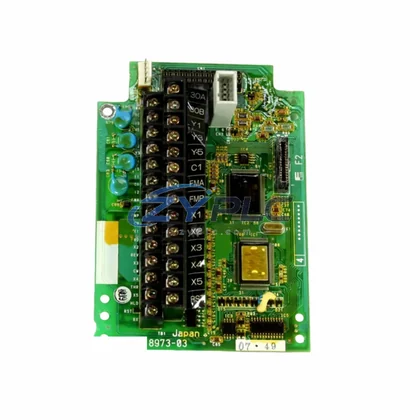
Berger Lahr TLC411F Stepper Motor Drive for TLC Series Automation
The Berger Lahr TLC411F is a high-performance stepper motor drive engineered for industrial environments where energy efficiency, precision motion control, and reliable throughput are non-negotiable. As part of the renowned TLC series from Berger Lahr (a Schneider Electric motion brand), the TLC411F delivers finely tuned current regulation and intelligent power staging that directly reduces wasted energy during partial-load and idle cycles. For factories seeking to lower electricity costs while maintaining or improving production line speed, the TLC411F represents a critical node in any industrial automation system.
In modern manufacturing, maintenance planning extends to every axis of motion, every indexing table, and every packaging station. The TLC411F addresses this by providing micro-stepping capability with adaptive current reduction. When the motor is holding position or decelerating, the drive automatically scales back power draw, eliminating the thermal losses and unnecessary consumption that plague older open-loop stepper systems. This translates directly into measurable kWh savings across 24/7 production shifts.
Product Specification Table
| Parameter |
Specification |
| Model |
TLC411F |
| Brand |
Berger Lahr (Schneider Electric) |
| Series |
TLC |
| Drive Type |
Stepper Motor Drive |
| Phase Output |
Bipolar, 2-phase |
| Max Output Current |
4.0 A/phase |
| Supply Voltage |
24–48 VDC |
| Micro-stepping Resolution |
Up to 1/64 step |
| Idle Power Reduction |
Automatic current cutback (up to 50%) |
| Operating Temperature |
0–45 °C |
| Compatible Systems |
PLC-based motion, CNC indexers, packaging lines |
| Communication |
Pulse/Direction, RS-485 optional |
| Energy Efficiency Feature |
Adaptive current regulation, thermal management |
| Application Environment |
Packaging, labeling, pick-and-place, conveyor indexing |
| Warranty |
warranty terms confirmed during quotation |
System Compatibility and Application
Deploying the TLC411F within a broader energy-optimized control system amplifies its savings potential. In a typical production cell, the TLC411F works alongside a Schneider Electric Modicon M340 PLC that orchestrates motion sequences, ensuring that stepper axes only energize during active production windows. The PLC communicates via industrial Ethernet to a Schneider Magelis HMI panel, giving operators real-time visibility into per-axis power consumption and cycle efficiency metrics.
For applications requiring coordinated multi-axis motion—such as cartoning machines or rotary filling stations—the TLC411F pairs naturally with the Berger Lahr TLC532F (a higher-current variant for heavier loads) and the Berger Lahr IFE71 stepper motor, which is specifically designed for the TLC drive family and features low-loss lamination stacks that further reduce heat generation. When the production line includes servo-driven axes for high-speed segments, the Schneider Lexium 32 servo drive handles those demands while sharing the same DC bus architecture, enabling regenerative braking energy to be redistributed rather than dissipated.
Power monitoring at the cabinet level is accomplished through a Schneider PM5110 power meter, which logs real-time operating load per circuit. This data feeds into predictive maintenance algorithms running on the PLC or an edge gateway, correlating increased power draw with mechanical wear—such as bearing degradation in stepper motors—before a failure occurs. The TeSys GV2 motor protection circuit breaker provides overcurrent and short-circuit protection for each drive channel, ensuring that a fault on one axis does not cascade into broader system downtime.
Signal distribution from the PLC to multiple TLC drives is handled through a Schneider TM3DQ16T digital output module, which provides pulse train outputs with the timing precision required for accurate micro-stepping. For installations where RS-485 communication is preferred over pulse/direction wiring, the Berger Lahr TLC5 RS-485 communication module enables parameter configuration and real-time status monitoring from the PLC without additional wiring complexity. The entire system is powered by a Schneider ABL8RPS24100 regulated power supply (24 VDC, 10 A), which features high conversion efficiency greater than 91% and contributes to the overall energy budget by minimizing losses at the power conversion stage.
Maintenance and Replacement Notes
Consider a pharmaceutical blister packaging line running three shifts. Each indexing station uses a stepper motor to advance film by precise increments. With legacy drives, motors remain fully energized between index cycles, generating heat and consuming power even when stationary. Replacing these with TLC411F drives introduces automatic current reduction during dwell periods. Across twelve indexing stations operating 8,000 hours per year, the cumulative operational stability reach hundreds of operating-hours annually—a direct reduction in operating cost with zero impact on throughput.
In a food-grade conveyor system, the TLC411F controls diverter gates and lane-sorting mechanisms. Because these actuators spend 60–70% of their cycle in a holding state, the adaptive current feature of the TLC411F is particularly effective. Maintenance teams also benefit: lower operating temperatures extend motor insulation life and reduce the frequency of thermal-related failures. When combined with vibration monitoring on critical bearings, the system enables condition-based maintenance scheduling rather than fixed-interval replacement, further reducing both cost and unplanned downtime.
For electronics assembly, where pick-and-place machines demand rapid acceleration followed by precise positioning, the TLC411F’s micro-stepping capability ensures smooth motion profiles that reduce mechanical stress on linear guides and ball screws. Less mechanical stress means less friction loss, less lubricant degradation, and longer intervals between maintenance events. The result is a compounding efficiency gain: electrical savings at the drive, mechanical savings at the actuator, and operational savings through extended maintenance intervals. Every TLC411F unit shipped from our facility undergoes functional testing under load conditions, verifying current regulation accuracy, thermal performance, and communication integrity. We maintain ready stock to support urgent replacement scenarios, minimizing the risk of extended downtime when a drive failure occurs on a critical production line.
Product Sourcing FAQ
Q: How much energy can the TLC411F save compared to conventional stepper drives?
A: The TLC411F’s automatic current reduction feature can decrease idle-state power consumption by up to 50%. In applications where motors spend significant time in holding position—such as indexing, sorting, and packaging—annual operational stability of Actual operating results depend on the installed system, load profile, and commissioning parameters.
Q: Is the TLC411F compatible with existing PLC systems and motion controllers?
A: Yes. The TLC411F accepts standard pulse/direction signals compatible with virtually all PLC brands including Siemens, Mitsubishi, Allen-Bradley, and Schneider Electric platforms. Optional RS-485 communication allows integration with Modbus-based supervisory systems for parameter tuning and diagnostics without hardware changes.
Q: Can I replace an older Berger Lahr drive with the TLC411F without rewiring?
A: The TLC411F maintains backward-compatible connector pinouts with earlier TLC series drives such as the TLC412F and TLC421F. In most cases, replacement is a direct swap requiring only parameter reconfiguration via DIP switches or software. Our technical team can provide migration guidance for specific legacy models.
Q: What warranty and testing does ZYPLC provide?
A: Every TLC411F is covered by a warranty terms confirmed during quotation from the date of shipment. Units are functionally tested before dispatch, including current output verification, thermal cycling, and signal response validation. We confirm availability by RFQ and arrange shipment after confirmation to support downtime-sensitive replacement needs.