Fuji Electric EP-3364B-CA-Z2: Industrial Data Link and Smart Factory Connectivity for FRENIC Drive Systems
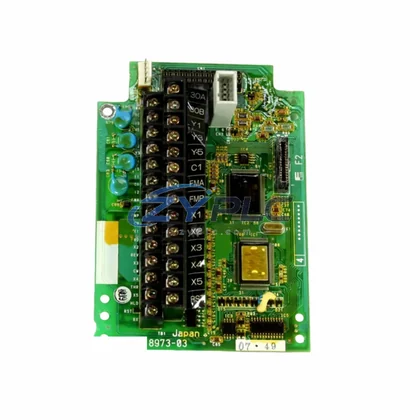
The Fuji Electric EP-3364B-CA-Z2 is a high-performance inverter control board engineered for seamless integration within FRENIC series variable frequency drive platforms. Designed to serve as the central communication backbone between field-level devices and supervisory control systems, this module enables reliable data exchange across complex industrial networks. Whether deployed in process manufacturing, material handling, water treatment, or discrete automation environments, the EP-3364B-CA-Z2 ensures that drive parameters, diagnostic feedback, and operational commands flow without interruption between PLCs, HMIs, SCADA platforms, and edge computing gateways.
In modern smart factory architectures, the ability to connect inverters and drives to higher-level control and monitoring systems is essential. The EP-3364B-CA-Z2 bridges the gap between the FRENIC drive’s internal logic and external industrial networks, supporting protocols such as RS-485 and Modbus RTU for robust serial communication. This enables plant engineers to monitor motor speed, torque output, fault codes, operating load, and thermal status in real time from centralized control rooms or remote diagnostic terminals.
Compatibility & Integration Notes
| Parameter |
Specification |
| Model / SKU |
EP-3364B-CA-Z2 |
| Brand |
Fuji Electric |
| Series |
FRENIC |
| Product Type |
Inverter Control Board / Communication Interface PCB |
| Supported Protocols |
RS-485, Modbus RTU |
| Interface Type |
Serial Communication Port (Terminal Block) |
| Transmission Speed |
Up to 38.4 kbps (configurable) |
| Network Compatibility |
Modbus RTU Master/Slave, Multi-drop RS-485 Network |
| System Application |
VFD Control, SCADA Integration, PLC Communication, HMI Monitoring |
| Operating Temperature |
-10°C to +50°C |
| Origin |
Japan |
| Warranty |
warranty terms confirmed during quotation |
Connected Automation Data Flow
In a typical FRENIC-based drive system, the EP-3364B-CA-Z2 serves as the communication gateway between the inverter’s CPU and the plant-wide industrial network. At the field level, analog and digital sensors feed process variables such as pressure, flow rate, and temperature into remote I/O modules like the Fuji Electric PXR series temperature controllers or NR1 remote terminal units. These signals are conditioned and transmitted to the FRENIC drive, where the EP-3364B-CA-Z2 converts internal drive data into Modbus RTU frames for upstream communication.
The PLC — commonly a Fuji Electric MICREX-SX SPH series programmable controller — polls the EP-3364B-CA-Z2 over an RS-485 multi-drop network, retrieving real-time motor parameters including output frequency, current draw, DC bus voltage, and cumulative run hours. This data is then relayed to an HMI panel such as the Fuji Electric MONITOUCH V9 series, where operators can visualize drive status, adjust speed setpoints, and acknowledge fault alarms without approaching the drive cabinet.
For plant-wide visibility, the communication chain extends from the PLC to a SCADA server through an Ethernet gateway module such as the Fuji Electric OPC-E1-DEF fieldbus option card or a third-party Modbus TCP/IP converter. The SCADA system aggregates data from multiple FRENIC drives equipped with EP-3364B-CA-Z2 boards, enabling trend analysis, maintenance planning, and predictive maintenance across the entire production line. In facilities where edge computing is deployed, an industrial edge gateway collects drive telemetry and pushes it to cloud-based analytics platforms for long-term performance benchmarking.
When multiple drives operate in coordinated motion or load-sharing configurations, the EP-3364B-CA-Z2 enables synchronized communication between FRENIC-Ace, FRENIC-MEGA, and FRENIC-Multi units on the same RS-485 bus. This allows synchronized speed ramping, torque balancing, and fault propagation across drive groups without requiring additional master controllers. Complementary components such as the Fuji Electric DCS-DG1-04 braking resistor unit and the OPC-G1-RY relay output option card further extend the system’s capability by providing regenerative braking feedback and discrete alarm outputs to the network.
Solving Data Isolation in Industrial Sites
One of the most persistent challenges in brownfield industrial environments is data isolation — the inability of legacy drives, sensors, and controllers to share information across a unified network. Many older FRENIC installations rely on hardwired analog control signals (4–20 mA or 0–10 V) that provide no diagnostic visibility and cannot be monitored remotely. By retrofitting these systems with the EP-3364B-CA-Z2, plant engineers can digitize drive communication and bring previously isolated equipment onto a standardized Modbus RTU network.
This transformation eliminates the need for manual parameter readings at the drive panel, reduces unplanned downtime through real-time fault notification, and enables centralized configuration of drive parameters across multiple units from a single engineering workstation. The EP-3364B-CA-Z2 supports multi-drop addressing, allowing up to 31 devices on a single RS-485 segment, which simplifies wiring and reduces infrastructure costs compared to point-to-point analog connections.
For facilities transitioning to Industry 4.0 architectures, the EP-3364B-CA-Z2 provides the foundational communication layer that connects FRENIC drives to MES (Manufacturing Execution Systems) and ERP platforms. Drive-level data such as operating load per production cycle, cumulative fault history, and thermal trend data can be extracted and correlated with production KPIs, enabling data-driven decisions about maintenance scheduling, energy procurement, and capacity planning. System expansion is straightforward: additional FRENIC drives equipped with EP-3364B-CA-Z2 boards can be added to the RS-485 network by assigning unique station addresses and updating the PLC polling table — no changes to the physical network topology are required, making it ideal for phased automation upgrades in food processing, textile manufacturing, HVAC systems, and water treatment plants.
Industrial Connectivity FAQ
Q1: What is the typical communication latency when using the EP-3364B-CA-Z2 with Modbus RTU?
At 38.4 kbps baud rate, the round-trip response time for a single register read is typically under 10 milliseconds on a lightly loaded RS-485 network. For networks with 20+ nodes, scan cycle times remain under 100 ms when polling intervals are optimized in the PLC program.
Q2: Is the EP-3364B-CA-Z2 compatible with third-party PLCs and SCADA systems?
Yes. The board communicates using standard Modbus RTU protocol, which is supported by virtually all industrial PLCs (Siemens, Allen-Bradley, Mitsubishi, Omron) and SCADA platforms (Ignition, WinCC, iFIX, Wonderware). A Modbus register map is available for integration configuration.
Q3: How does ZYPLC ensure product quality before shipping?
Every EP-3364B-CA-Z2 unit undergoes functional testing and visual inspection before dispatch. We verify communication port integrity, component condition, and board-level continuity to ensure the module is ready for immediate installation upon arrival.
Q4: What warranty and after-sales support does ZYPLC provide?
All units sold through ZYPLC carry a warranty terms confirmed during quotation covering manufacturing defects and functional failures under normal operating conditions. Our technical support team is available to assist with protocol configuration, wiring guidance, and system integration questions throughout the warranty period.