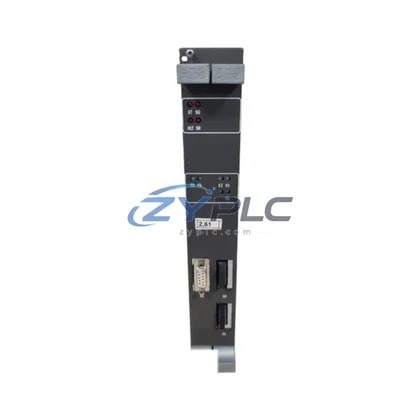
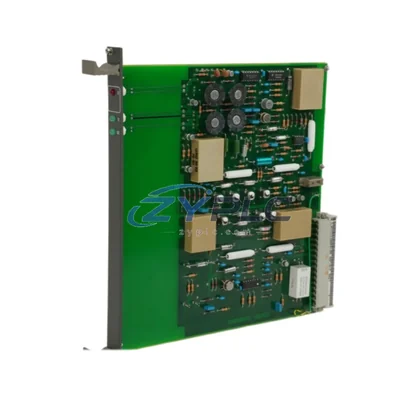
The Emerson MMS6110 is a dual-channel shaft vibration monitoring module from the MMS6000 Series, engineered for continuous, real-time protection of rotating machinery in energy-intensive industrial environments. As manufacturing facilities face mounting pressure to reduce unplanned downtime, minimize unplanned downtime, and optimize equipment utilization rates, the MMS6110 delivers the measurement accuracy and system integration depth required to make predictive maintenance a practical, cost-effective reality on the production floor.
Unlike passive monitoring solutions, the MMS6110 actively contributes to maintenance planning by providing the vibration data that drives smarter motor control decisions. When shaft displacement or velocity readings trend toward alarm thresholds, the system enables operators and control platforms to intervene before a fault escalates — reducing the energy penalty of emergency shutdowns, unscheduled restarts, and extended idle periods that consume power without producing output.
Product Specification Table
| Parameter |
Specification / Value |
| Model / SKU |
Emerson MMS6110 |
| Series |
MMS6000 |
| Monitoring Channels |
Dual-channel shaft vibration (displacement / velocity) |
| Sensor Compatibility |
Eddy-current proximity probes (standard MMS6000 series) |
| Power Consumption |
Low-power module design; optimized for continuous 24/7 operation |
| Operating Efficiency |
Continuous real-time signal processing with minimal CPU overhead |
| Compatible Systems |
Emerson Ovation DCS, DeltaV, AMS Device Manager, Modbus/TCP, PROFIBUS |
| Application Environment |
Turbines, compressors, pumps, fans, motors — heavy industrial rotating equipment |
| Value |
Reduces unplanned downtime unplanned downtime; enables load-optimized motor scheduling |
| Origin |
United States |
| Warranty |
warranty terms confirmed during quotation — tested and verified before shipment |
System Compatibility and Application
The MMS6110 does not operate in isolation — its value is realized within a layered automation architecture where vibration data flows upward into control and maintenance planning systems. In a typical energy-optimized plant configuration, the MMS6110 sits at the sensing layer, feeding shaft displacement and velocity signals into the Emerson MMS6120 (velocity monitor) and MMS6823 (temperature and speed monitor) modules within the same MMS6000 rack, creating a comprehensive machine health dataset without redundant hardware.
At the control execution layer, this data integrates with the Emerson Ovation Distributed Control System (DCS) or DeltaV process automation platform, where PID loops and advanced process control algorithms use vibration trends to adjust motor load setpoints in real time. When the MMS6110 detects early-stage bearing wear on a centrifugal pump, the DCS can automatically reduce the pump’s duty cycle, shifting load to a standby unit — avoiding both mechanical failure and the energy spike associated with emergency restarts.
For drive-level energy regulation, the vibration data from the MMS6110 pairs effectively with Emerson Control Techniques variable frequency drives (VFDs), enabling speed modulation based on actual machine health rather than fixed schedules. A compressor running at 85% speed under healthy vibration conditions consumes significantly less energy than one running at full speed with degraded bearings — the MMS6110 provides the measurement confidence to make that speed reduction safely.
At the I/O and communication layer, the MMS6000 rack interfaces with Emerson CHARM I/O modules and supports Modbus/TCP and PROFIBUS DP protocols, enabling seamless data exchange with third-party SCADA platforms and maintenance planning systems (EMS). This interoperability means the MMS6110’s vibration readings can be incorporated into plant-wide power consumption dashboards alongside data from Emerson power quality meters and AMS Device Manager asset health software — giving energy managers a unified view of where mechanical inefficiency is translating into electrical waste.
For facilities using Emerson AMS Machinery Manager, the MMS6110 data stream enables trend analysis across entire fleets of rotating equipment, identifying which machines are operating outside their efficiency envelope and scheduling maintenance during planned low-production windows — minimizing both unplanned downtime and production line disruption.
Maintenance and Replacement Notes
In petrochemical and power generation facilities, rotating equipment — turbines, compressors, boiler feed pumps — accounts for 60–80% of total electrical consumption. A single large centrifugal compressor running with misaligned shafts or worn bearings can consume 8–15% more energy than a properly maintained unit. The MMS6110 addresses this directly by providing continuous, high-resolution shaft vibration data that makes the difference between reactive maintenance (fix it after it fails) and predictive maintenance (fix it before it costs you energy and production).
On automotive and discrete manufacturing lines, the MMS6110 contributes to production rhythm (takt time) optimization. When a conveyor drive motor begins exhibiting sub-synchronous vibration — an early indicator of bearing fatigue — the MMS6110 triggers an alert that allows maintenance to schedule a bearing replacement during a planned shift change rather than an unplanned line stop. A single avoided line stop on a high-volume assembly line can recover hours of production time and eliminate the energy cost of restarting cold equipment.
For facilities managing multiple production lines, the MMS6110’s integration with centralized DCS and EMS platforms enables load balancing across equipment assets. Lines with healthy vibration signatures can be run at optimized speeds; lines showing early degradation can be throttled back — reducing operating load while extending equipment service life. This approach directly improves Overall Equipment Effectiveness (OEE) by reducing both unplanned downtime (availability losses) and speed losses caused by running degraded equipment at reduced capacity.
Every MMS6110 unit supplied by ZYPLC is subject to pre-shipment functional testing, verifying channel accuracy, alarm relay operation, and communication output integrity. Stock is maintained for prompt dispatch, and all units are covered by a warranty terms confirmed during quotation from the date of shipment — providing procurement teams with the supply reliability and risk coverage required for critical infrastructure projects.
Product Sourcing FAQ
Q1: How does the MMS6110 contribute to measurable operational stability on the production floor?
The MMS6110 enables predictive maintenance by detecting shaft vibration anomalies before they cause mechanical failure. By identifying degraded bearings, misalignment, or imbalance early, facilities can schedule corrective action during planned downtime — avoiding the energy-intensive cycle of emergency shutdowns, cold restarts, and extended idle periods. Additionally, vibration data integrated with VFD control loops allows motor speeds to be optimized based on actual machine health, reducing unplanned downtime risk.
Q2: Is the MMS6110 compatible with existing DCS and SCADA systems?
Yes. The MMS6110 operates within the Emerson MMS6000 rack architecture and supports integration with Emerson Ovation DCS, DeltaV, and AMS Device Manager natively. For third-party systems, Modbus/TCP and PROFIBUS DP communication protocols are supported, enabling data exchange with most industrial SCADA, EMS, and historian platforms without additional gateways.
Q3: Can the MMS6110 replace an existing vibration monitoring module in a legacy MMS6000 rack?
In most cases, yes. The MMS6110 is designed for direct installation into standard MMS6000 series racks and is backward-compatible with existing proximity probe wiring and rack power infrastructure. Before replacement, verify the rack firmware version and confirm channel configuration parameters match your existing alarm setpoints. ZYPLC recommends consulting the Emerson MMS6000 system documentation or contacting our technical team for site-specific compatibility confirmation.
Q4: What does the warranty terms confirmed during quotation cover, and what is the testing process before shipment?
All MMS6110 units supplied by ZYPLC undergo pre-shipment functional testing covering dual-channel signal accuracy, alarm relay operation, power supply integrity, and communication output verification. The warranty terms confirmed during quotation covers manufacturing defects and functional failures under normal operating conditions from the date of shipment. Warranty claims are supported by ZYPLC’s technical team — contact plc.sales@zyplc.com or +86 19859288691 for RMA and support procedures.