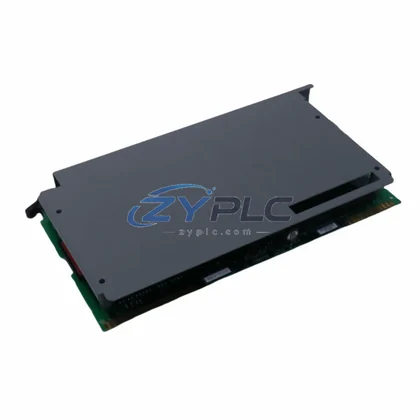
FANUC AOR16G A03B-0819-C161: Analog Output for Series 16/18/21 Control Systems
The FANUC AOR16G A03B-0819-C161 is a precision analog output module engineered for seamless integration within FANUC Series 16, Series 18, and Series 21 CNC control architectures. Rather than functioning as a standalone component, this module occupies a critical position in the layered automation hierarchy — bridging the digital command layer of the CNC controller with the analog-driven actuators, drives, and process instruments that execute real-world motion and process control. Understanding its role within the full system architecture is essential for engineers designing, commissioning, or maintaining high-availability CNC environments.
In a complete FANUC CNC system, the control architecture is organized across multiple functional layers: the CPU and main control board layer, the I/O and signal conditioning layer, the servo and spindle drive layer, the communication and network layer, the power supply layer, and the human-machine interface layer. The AOR16G A03B-0819-C161 operates at the I/O signal layer, converting digital process values generated by the CNC CPU into precise analog voltage or current signals that downstream devices — such as variable frequency drives, proportional valves, or analog-input instrumentation — can directly interpret and act upon.
This module is designed to mount within the FANUC I/O unit backplane, sharing the same rack infrastructure as other I/O modules such as digital input modules, digital output modules, and analog input modules. Its physical and electrical compatibility with the Series 16/18/21 backplane ensures that system architects can expand analog output capacity without redesigning the control cabinet or introducing third-party signal converters. The result is a cleaner, more maintainable system with reduced wiring complexity and improved signal integrity across the entire control loop.
From a system consistency standpoint, using OEM FANUC modules like the AOR16G A03B-0819-C161 rather than aftermarket alternatives ensures that firmware compatibility, diagnostic transparency, and parameter mapping remain fully aligned with the CNC controller’s native software environment. Maintenance engineers benefit from standardized fault codes, predictable module behavior during power cycling, and direct support from FANUC’s diagnostic toolchain. This consistency is particularly valuable in multi-machine production environments where cross-machine troubleshooting efficiency directly impacts overall equipment effectiveness (OEE).
The module’s analog output channels provide stable, low-noise signal output suitable for driving servo amplifiers, spindle inverters, and process control valves in demanding industrial environments. In applications where the CNC system must coordinate with external process equipment — such as coolant flow control, hydraulic pressure regulation, or tension control in material handling — the AOR16G A03B-0819-C161 provides the analog interface that makes closed-loop process integration possible without external signal conditioning hardware.
In redundant or high-availability system designs, the AOR16G A03B-0819-C161 can be deployed as part of a hot-standby or warm-standby I/O architecture, where duplicate I/O racks are maintained in parallel to ensure uninterrupted analog output in the event of a module failure. This approach is common in critical manufacturing lines, power generation auxiliary systems, and continuous process plants where unplanned downtime carries significant financial or safety consequences. The module’s compact form factor and standardized connector interface simplify the physical implementation of such redundant configurations.
Long-term maintenance planning for FANUC Series 16/18/21 systems should account for the lifecycle of all I/O modules, including analog output modules. Stocking a spare AOR16G A03B-0819-C161 as part of a critical spares inventory strategy reduces mean time to repair (MTTR) in the event of module failure. Given the age profile of many Series 16/18/21 installations, sourcing verified, tested modules from a reliable supplier with documented quality assurance processes is essential. All units supplied by ZYPLC are covered by a warranty terms confirmed during quotation, providing documented assurance of module functionality and supporting the spare parts management programs of maintenance teams worldwide.
Product Specification Table
| Parameter |
Specification |
| Module Designation |
AOR16G |
| Part Number |
A03B-0819-C161 |
| Brand |
FANUC |
| Compatible Series |
Series 16, Series 18, Series 21 |
| Module Type |
Analog Output Module |
| System Role |
I/O Layer — Analog Signal Output |
| Output Channels |
16 Channels (Analog Output) |
| Signal Type |
Voltage / Current Analog Output |
| Communication Interface |
FANUC I/O Link (Backplane Bus) |
| Mounting |
FANUC I/O Unit Backplane / Rack |
| Operating Environment |
Industrial CNC Control Cabinet |
| Country of Origin |
Japan |
| Warranty |
warranty terms confirmed during quotation (ZYPLC) |
System Compatibility Notes
The AOR16G A03B-0819-C161 achieves its full value when considered within the context of the complete FANUC Series 16/18/21 control system. At the controller level, the FANUC Series 16-MB or Series 18-MB main CPU board generates the digital process commands that the AOR16G translates into analog output signals. The CPU board communicates with I/O modules via the FANUC I/O Link, a high-speed serial bus that connects the controller to distributed I/O units across the control cabinet and machine body.
Power to the I/O rack and its modules, including the AOR16G, is supplied by the FANUC A13B-0154 or equivalent I/O unit power supply module, which provides regulated DC power to the backplane. Ensuring power supply stability is a prerequisite for reliable analog output performance, as voltage fluctuations at the power supply level can introduce noise or offset errors in analog output signals.
On the output side, the analog signals generated by the AOR16G A03B-0819-C161 are typically routed to FANUC Alpha Series or Beta Series servo amplifiers for axis feed override or spindle speed reference, or to third-party variable frequency drives and proportional valve controllers in process integration applications. In multi-axis systems, the AOR16G works in coordination with FANUC digital I/O modules such as the DI/DO modules in the A03B-0819 series, which handle discrete signal management for limit switches, solenoids, and safety interlocks.
For human-machine interface integration, the FANUC Series 16i/18i-compatible MDI/CRT unit or iHMI panel provides the operator interface through which process parameters — including analog output setpoints — are configured and monitored. The HMI layer communicates with the CPU, which in turn updates the analog output values written to the AOR16G in real time.
In systems requiring communication with supervisory control or SCADA platforms, a FANUC Ethernet board or PROFIBUS communication module installed in the controller provides the network gateway function, allowing higher-level systems to read and write analog output parameters through standardized industrial protocols. The AOR16G’s outputs remain under deterministic CNC control regardless of network communication state, ensuring that analog output integrity is maintained even during network interruptions.
Terminal modules and wiring duct components within the control cabinet — such as FANUC-compatible terminal blocks and shielded analog signal cables — complete the signal path from the AOR16G’s output connectors to the field devices. Proper shielding and grounding of analog signal wiring is essential to achieving the signal-to-noise performance that the AOR16G is designed to deliver.
Industrial Application Notes
The FANUC AOR16G A03B-0819-C161 finds application across a wide range of industrial sectors where FANUC Series 16, 18, or 21 CNC systems are deployed as the primary machine control platform.
In precision machining and manufacturing environments, the module provides analog speed reference signals to spindle drives and feed override signals to servo systems, enabling smooth, programmable control of cutting parameters. Multi-spindle machining centers and transfer lines benefit from the module’s 16-channel capacity, which allows simultaneous analog output to multiple drives without requiring additional I/O racks.
In power generation and energy infrastructure applications, FANUC CNC systems are sometimes deployed in turbine blade machining and generator component manufacturing. The AOR16G supports the precise analog control required for tight-tolerance machining of critical components, where dimensional accuracy directly affects equipment efficiency and safety.
In petrochemical and process industries, CNC-controlled machining of valve bodies, pump housings, and pressure vessel components relies on stable analog output for feed rate and spindle speed control. The AOR16G’s compatibility with the Series 16/18/21 architecture ensures that these systems can be maintained and expanded without platform migration.
In mining and metallurgical applications, heavy-duty CNC machining of wear parts, drill bits, and structural components operates in environments with elevated vibration and temperature. The AOR16G’s industrial-grade design supports reliable analog output in these demanding conditions, contributing to consistent part quality and reduced scrap rates.
In packaging and material handling automation, FANUC CNC systems integrated with analog-controlled tension regulators, web guides, and flow control valves rely on the AOR16G to provide the analog interface between the CNC controller and process instrumentation. This integration enables coordinated control of both machining and material handling functions within a unified control architecture.
Product Compatibility FAQ
Q1: Is the FANUC AOR16G A03B-0819-C161 compatible with both Series 16 and Series 18 CNC controllers?
Yes. The AOR16G A03B-0819-C161 is designed for use within the FANUC Series 16, Series 18, and Series 21 CNC control architectures. It interfaces with the controller via the FANUC I/O Link backplane bus, which is common across these series. Before installation, verify that the I/O unit slot configuration and I/O Link address assignments in your specific controller version are compatible with the module’s channel mapping. Consulting the FANUC Series 16/18/21 I/O unit connection manual is recommended for system architects integrating this module into an existing or new control cabinet design.
Q2: Can multiple AOR16G modules be installed in the same I/O rack to expand analog output capacity?
Yes, multiple analog output modules can typically be installed within the same FANUC I/O unit rack, subject to the rack’s slot capacity and the controller’s I/O Link address space. Each module occupies a defined number of I/O Link slots and consumes a corresponding portion of the controller’s I/O address map. System architects should verify the total I/O Link load and address allocation against the controller’s maximum I/O capacity before adding modules. Power supply capacity for the I/O rack should also be reviewed to ensure that the combined current draw of all installed modules remains within the power supply module’s rated output.
Q3: What warranty terms are confirmed during quotation, and how does it support long-term maintenance planning?
All FANUC AOR16G A03B-0819-C161 modules supplied by ZYPLC are covered by a warranty terms confirmed during quotation from the date of shipment. This warranty covers module functionality and provides assurance that the unit has been tested and verified prior to dispatch. For maintenance teams managing critical spare parts inventories, the warranty terms confirmed during quotation provides a documented quality baseline that supports spare parts qualification processes and reduces the risk associated with sourcing replacement modules for aging FANUC Series 16/18/21 systems. For warranty claims or technical support, contact ZYPLC directly at plc.sales@zyplc.com or +86 19859288691.