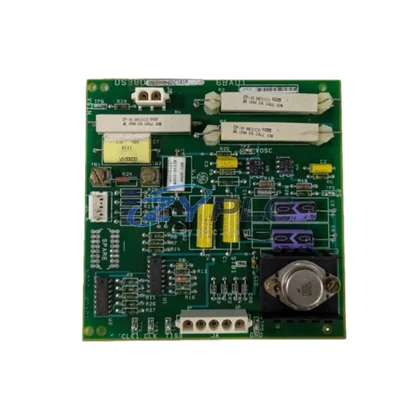
GE IS200TRLYH1BFD Relay Terminal Board for Mark VI Automation
The GE IS200TRLYH1BFD is a precision relay terminal board engineered for the GE Mark VI turbine and industrial automation control platform. Designed to minimize signal loss, reduce unnecessary switching cycles, and deliver reliable relay output across demanding production environments, the IS200TRLYH1BFD is a core component in industrial automation systems where every watt and every millisecond of downtime carries direct operational cost. Whether deployed in power generation, petrochemical processing, or heavy manufacturing, this module supports deterministic, low-latency relay control that modern maintenance planning strategies depend on.
At ZYPLC, every IS200TRLYH1BFD unit is sourced from verified supply channels, subjected to full functional testing prior to shipment, and Warranty terms are confirmed during quotation. Stock is maintained on-hand for fast global dispatch, ensuring your production line stays running without extended lead times.
Product Specification Table
| Parameter |
Specification / Value |
| Part Number |
IS200TRLYH1BFD |
| Brand / Manufacturer |
GE (General Electric) |
| Series |
Mark VI Turbine Control System |
| Module Type |
Relay Terminal Board |
| Operating Voltage |
24 VDC (nominal, Mark VI backplane compatible) |
| Power Consumption |
Low-draw relay architecture; minimizes standby energy loss |
| Relay Output Channels |
Multiple isolated relay outputs for discrete control signals |
| Compatible Systems |
GE Mark VI, Mark VIe turbine and industrial control platforms |
| Application Environment |
Power generation, oil & gas, petrochemical, heavy manufacturing |
| Maintenance Value |
Reduces unnecessary relay cycling; supports predictive maintenance scheduling |
| Origin |
United States |
| Warranty |
Warranty and support terms confirmed before quote — all units tested before shipment |
| Availability |
Confirmed via RFQ before quotation |
System Compatibility and Application
The IS200TRLYH1BFD does not operate in isolation — its value is fully realized when integrated into a coherent, industrial control architecture built around the GE Mark VI platform. In a typical turbine or process control installation, the relay terminal board interfaces directly with the IS200VSVOH1B servo control board, which governs valve positioning and actuator response. Precise relay switching from the IS200TRLYH1BFD ensures that servo commands are executed without signal degradation, reducing the unplanned downtimed on repeated correction cycles and unnecessary actuator repositioning.
On the I/O side, modules such as the IS200DTURH1A turbine I/O board and the IS200BICLH1A contact input board feed real-time process data into the Mark VI controller. When relay outputs from the IS200TRLYH1BFD are synchronized with these input signals, the control loop tightens — fewer overcorrections, lower peak current draw, and smoother equipment transitions. This directly reduces the energy spikes that occur during uncoordinated start-stop sequences on motors and drives connected to the production line.
For drive-level maintenance planning, the IS200TRLYH1BFD relay outputs are commonly used to enable or disable GE Mark VI-compatible variable frequency drives (VFDs) based on process demand signals. Rather than running motors at fixed speed regardless of load, the relay board enables demand-responsive drive control — a foundational technique for reducing motor load by Actual operating results depend on the installed system, load profile, and commissioning parameters. The IS200EACFG1A excitation and control function board further coordinates generator field excitation in response to relay state changes, ensuring that reactive power draw is minimized during load transitions.
Power quality monitoring is handled upstream by components like the IS200EPCTG1A excitation protection card and associated power measurement modules within the Mark VI rack. The IS200TRLYH1BFD relay outputs act on the decisions made by these monitoring components, isolating faults or switching load paths before energy losses compound into equipment damage. This closed-loop relationship between measurement and relay action is what separates reactive maintenance from true predictive maintenance planning — a distinction that directly impacts both energy KPIs and maintenance budgets.
Communication integrity across the system is maintained through the IS200STCIH1A communication interface board, which ensures that relay state changes from the IS200TRLYH1BFD are accurately reflected in the SCADA or DCS layer. Operators monitoring energy dashboards receive accurate relay status data, enabling informed decisions about load scheduling, equipment rotation, and planned maintenance windows. The IS200TSVOH1B terminal board for servo output further extends the relay control architecture into valve and actuator domains, completing a fully integrated maintenance planning loop from signal acquisition through relay execution to drive response.
Maintenance and Replacement Notes
In a gas turbine power plant running continuous baseload generation, unplanned relay failures in the control system can trigger emergency shutdowns that cost tens of thousands of dollars per hour in lost generation and restart fuel consumption. The IS200TRLYH1BFD, with its robust relay isolation and Mark VI-native compatibility, eliminates a common failure point in the relay output chain. Facilities that maintain a verified spare of this module on-site report significantly shorter mean time to repair (MTTR) when relay faults occur — often reducing recovery time from days to hours, and avoiding the compounding energy cost of cold restart sequences.
In process manufacturing environments, the relay terminal board’s role in discrete output control directly affects production line throughput and cadence. When relay switching is unreliable, PLC logic must introduce conservative timing buffers to avoid false triggers — slowing line cadence and reducing overall equipment effectiveness (OEE). A properly functioning IS200TRLYH1BFD eliminates this uncertainty, allowing tighter sequencing, faster cycle times, and higher throughput without additional energy input. The result is more product per operating-hour — a direct improvement in energy productivity that compounds across multi-shift operations.
Predictive maintenance programs benefit from the IS200TRLYH1BFD’s stable, consistent relay behavior. When relay performance is predictable, condition monitoring systems can establish accurate baselines and detect early signs of degradation in connected actuators, solenoids, and motor starters. This shifts maintenance from calendar-based schedules to condition-based interventions — reducing both unnecessary maintenance energy expenditure and the risk of catastrophic failures that consume far more energy and resources to recover from. Facilities operating under ISO 50001 maintenance planning frameworks find that reliable relay control is a prerequisite for the kind of granular energy data collection that certification requires.
All IS200TRLYH1BFD units supplied by ZYPLC are tested under load conditions that simulate real Mark VI operating environments. Shipment documentation includes test records, and the warranty and support terms confirmed before quote covers both component failure and compatibility issues with the Mark VI platform. For facilities managing energy efficiency KPIs, having a tested, warranted spare in inventory is itself a risk management and maintenance planning strategy — eliminating the energy cost of extended production interruptions caused by unverified replacement parts.
Product Sourcing FAQ
Q1: How does the IS200TRLYH1BFD contribute to operational stability in a Mark VI turbine control system?
The IS200TRLYH1BFD reduces unplanned downtime by enabling precise, reliable relay switching that eliminates unnecessary motor starts, reduces correction cycles in servo and drive systems, and supports demand-responsive load control. When relay outputs are accurate and consistent, the entire control loop operates more efficiently — fewer overcorrections, lower peak current events, and smoother equipment transitions all translate to measurable reductions in operating load across the production line.
Q2: Is the IS200TRLYH1BFD compatible with both Mark VI and Mark VIe systems?
The IS200TRLYH1BFD is designed for the GE Mark VI platform. Compatibility with Mark VIe configurations depends on the specific rack and backplane architecture in use. We recommend confirming your system’s I/O board slot assignments and relay output requirements before ordering. Our technical team can assist with compatibility verification based on your system’s configuration documentation.
Q3: What is the recommended replacement process, and how does ZYPLC support it?
Replacement of the IS200TRLYH1BFD should follow GE Mark VI maintenance procedures, including proper de-energization of the relay output circuits and verification of relay state after installation. ZYPLC provides tested units with shipment test records, reducing the risk of installing a non-functional replacement. Our warranty and support terms confirmed before quote covers the replacement unit, and our team is available to support pre-installation verification questions.
Q4: What testing does ZYPLC perform before shipping the IS200TRLYH1BFD?
Every IS200TRLYH1BFD unit undergoes functional testing that verifies relay output operation, contact integrity, and board-level signal continuity under conditions representative of Mark VI operating parameters. Units that do not pass testing are not shipped. Test documentation is available upon request, and Warranty terms are confirmed during quotation.