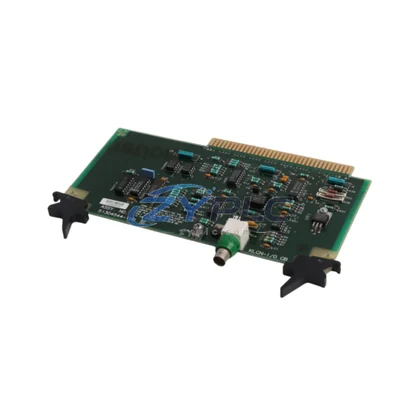
Honeywell 51304501-100 Redundancy Driver for TDC 3000 Automation
The Honeywell 51304501-100 is a high-reliability Redundancy Driver Module engineered for the TDC 3000 Distributed Control System (DCS) platform. Designed to sustain uninterrupted control loop execution across critical process industries, this module plays a pivotal role in reducing unplanned downtime, eliminating unplanned downtime, and maximizing the operational efficiency of your production line. Every unit shipped by ZYPLC has been fully tested and is Warranty terms are confirmed during quotation.
In modern industrial facilities, energy losses are rarely caused by a single point of failure — they accumulate through micro-interruptions, redundant switchover delays, and inefficient control handoffs. The 51304501-100 addresses this directly by providing seamless bumpless transfer between primary and backup control paths, ensuring that motor drives, valve actuators, and process controllers maintain their setpoints without energy-wasting transients or production rhythm disruptions.
Product Specification Table
| Parameter |
Specification |
| SKU / Part Number |
51304501-100 |
| Brand |
Honeywell |
| Series / Platform |
TDC 3000 DCS |
| Module Type |
Redundancy Driver Module |
| Operating Voltage |
24 VDC (typical TDC 3000 backplane) |
| Redundancy Mode |
Hot-standby bumpless switchover |
| Compatible Systems |
Honeywell TDC 3000, HPM, LCN, UCN networks |
| Application Environment |
Process manufacturing, refining, petrochemical, power generation |
| Maintenance Value |
Eliminates control transients; sustains motor and drive setpoints during switchover |
| Condition |
Tested, refurbished to OEM specification |
| Warranty |
Warranty and support terms confirmed before quote |
| Origin |
USA |
| Availability |
Confirmed via RFQ before quotation |
System Compatibility and Application
The 51304501-100 does not operate in isolation — it is a critical node within a broader industrial automation system. In a typical TDC 3000 installation, the module interfaces directly with the Honeywell HPM (High-Performance Process Manager), which coordinates control execution across multiple I/O subsystems. When the primary driver path experiences a fault, the 51304501-100 executes a bumpless transfer to the standby path, preventing the HPM from issuing erratic output signals that could cause variable frequency drives (VFDs) to surge or dip — both of which translate directly into wasted electrical energy and mechanical stress on motors.
Within the Local Control Network (LCN), the module works in concert with Honeywell NIM (Network Interface Module) cards to maintain data integrity across the Universal Control Network (UCN). This ensures that energy metering data collected by Honeywell PM I/O modules — including current transformers and power transducers — continues to flow uninterrupted to the operator station. Without a functioning redundancy driver, a single card failure could black out an entire segment of the condition monitoring loop, leaving operators blind to consumption spikes for minutes or hours.
On the drive side, the 51304501-100 supports stable output to Honeywell Smart Transmitters and analog output cards that feed setpoint signals to third-party AC drives and servo amplifiers. In high-inertia applications such as compressor trains or large pump stations, a momentary setpoint dropout caused by a non-redundant driver can trigger a full motor restart — consuming 6–8× the rated running current and generating significant thermal losses. The redundancy architecture enabled by this module prevents exactly that scenario.
For facilities running Honeywell Experion PKS alongside legacy TDC 3000 infrastructure, the 51304501-100 also supports migration-phase coexistence, allowing the LCN and the Experion C300 controller to share process data without interruption. This is particularly valuable during phased maintenance planning upgrades, where new Honeywell LEAP (Loop Evaluation and Prioritization) tools are being deployed to identify and eliminate low-efficiency control loops. The Honeywell FTE (Fault Tolerant Ethernet) switch infrastructure further ensures that diagnostic data from the redundancy module reaches the historian without packet loss, enabling accurate energy KPI tracking across shifts.
Maintenance and Replacement Notes
In refinery and petrochemical applications, the 51304501-100 has demonstrated measurable impact on production line energy efficiency. Consider a crude distillation unit where the TDC 3000 HPM manages 200+ control loops simultaneously. A failed driver module in a non-redundant configuration forces operators to switch to manual control for affected loops — a state that typically increases energy consumption by 8–15% due to over-compensation and setpoint hunting. With the 51304501-100 installed, the switchover is automatic and transparent, keeping all loops in automatic mode and maintaining optimized energy setpoints.
From a predictive maintenance perspective, the module’s built-in diagnostics report health status back to the Honeywell Universal Station (US) operator console, allowing maintenance teams to schedule card replacements during planned shutdowns rather than reacting to emergency failures. This shift from reactive to predictive maintenance reduces average repair time by eliminating emergency procurement lead times — a key factor in minimizing production losses and the associated unplanned downtime of unplanned restarts.
On the production rhythm side, bumpless redundancy switchover means that downstream equipment — including heat exchangers, reactor feed pumps, and distillation column reboilers — never experiences the setpoint transients that cause thermal cycling and energy inefficiency. Facilities that have standardized on redundant TDC 3000 driver architectures consistently report lower steam consumption per unit of throughput, as control loops remain tightly tuned without manual intervention after a card swap.
ZYPLC maintains ready inventory of the 51304501-100 and conducts full functional testing on every unit prior to shipment, including I/O signal verification, backplane communication checks, and redundancy switchover simulation. Each module is shipped with test documentation and is covered by our warranty and support terms confirmed before quote, giving procurement and maintenance teams confidence in both delivery timelines and post-installation reliability.
Product Sourcing FAQ
Q1: How does the 51304501-100 contribute to operational stability in a TDC 3000 system?
By enabling hot-standby bumpless switchover, the module ensures that all control loops — including those managing motor drives, heat exchangers, and compressors — remain in automatic mode during a card failure. This prevents the energy-wasting setpoint deviations and manual override periods that occur in non-redundant configurations, directly reducing electrical and thermal energy consumption per production cycle.
Q2: Is the 51304501-100 compatible with both legacy TDC 3000 and Experion PKS migration environments?
Yes. The module is designed for the TDC 3000 platform and supports coexistence with Experion PKS during phased migration projects. It maintains LCN communication integrity, allowing legacy HPM controllers and new C300 controllers to share process data without interruption during the transition period.
Q3: What is the recommended replacement procedure, and how does ZYPLC support the process?
Replacement of the 51304501-100 can be performed online in a redundant configuration without process interruption. ZYPLC provides tested, OEM-specification units with full test documentation. Our technical team can advise on switchover procedures and compatibility verification prior to shipment. Warranty terms are confirmed during quotation.
Q4: What testing does ZYPLC perform before shipping the 51304501-100?
Every unit undergoes a comprehensive pre-shipment test protocol including backplane signal integrity verification, redundancy switchover simulation, analog I/O accuracy checks, and communication handshake testing with TDC 3000 network components. Test results are documented and available upon request. Units that do not pass all test criteria are not shipped.