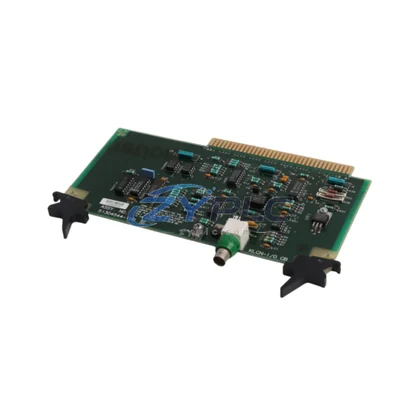
The Honeywell 51307186-175 is a high-efficiency power supply module engineered for the TDC 3000 Distributed Control System (DCS) platform — one of Honeywell’s most enduring and widely deployed process automation architectures. In energy-intensive manufacturing environments, the power supply is not merely a utility component; it is the foundation upon which stable, low-loss control system operation depends. The 51307186-175 delivers regulated, conditioned DC power to critical control nodes, ensuring that every downstream module — from I/O cards to communication processors — operates within its optimal energy envelope.
For facilities running continuous process operations such as refining, chemical production, power generation, or advanced discrete manufacturing, unregulated or aging power supplies introduce hidden energy losses, voltage ripple, and thermal inefficiency that compound across the system. Replacing or upgrading to the 51307186-175 directly addresses these inefficiencies, reducing unnecessary power draw and extending the operational lifespan of connected control hardware.
Product Specification Table
| Parameter |
Specification / Value |
| Part Number / SKU |
51307186-175 |
| Brand |
Honeywell |
| Series / Platform |
TDC 3000 DCS |
| Module Type |
Power Supply Module |
| Output Voltage |
Regulated DC (per TDC 3000 backplane specification) |
| Efficiency Class |
High-Efficiency Industrial Grade |
| Compatible Systems |
Honeywell TDC 3000, HPM, LCN, UCN subsystems |
| Application Environment |
Process automation, DCS control cabinets, industrial panels |
| Energy Saving Value |
Reduces voltage ripple losses; stabilizes downstream module power draw |
| Operating Temperature |
Industrial range (0°C to 60°C typical) |
| Origin |
United States |
| Inventory Status |
RFQ Available — shipment arranged after confirmation |
| Pre-shipment Testing |
Full functional and load test performed before dispatch |
| Warranty |
warranty terms confirmed during quotation |
System Compatibility and Application
The 51307186-175 does not operate in isolation — it is the energy backbone of a tightly integrated control architecture. In a typical TDC 3000 installation, the power supply module feeds regulated voltage to the High-Performance Process Manager (HPM) controller cards, which execute real-time PID loops and advanced regulatory control. Alongside the HPM, Local Control Network (LCN) nodes rely on stable power delivery to maintain deterministic communication latency across the plant network.
On the field side, Field Control Processors (FCP) and Advanced Process Manager (APM) modules draw from the same power bus, making supply quality directly relevant to loop stability and scan cycle consistency. Any voltage sag or ripple introduced by a degraded power supply propagates into control output jitter — which in motor-driven applications translates to unnecessary variable frequency drive (VFD) corrections, increased wear on actuators, and elevated energy consumption at the drive level.
In facilities where Honeywell Universal Control Network (UCN) segments connect remote I/O clusters, the power supply’s ability to maintain clean rail voltage under varying load conditions is critical. Fluctuating supply voltage forces UCN interface modules to compensate, increasing retry cycles and communication overhead — all of which consume additional processing energy and reduce effective network throughput.
For condition monitoring integration, the 51307186-175 is commonly deployed alongside Honeywell Power Monitor modules and third-party power quality analyzers connected via Modbus RTU or HART protocol gateways. These instruments capture real-time power factor, harmonic distortion, and load current data — feeding the DCS historian for energy KPI trending. When the power supply operates within specification, these monitoring systems report stable baselines, making anomaly detection faster and more reliable.
In servo and drive-intensive lines, the TDC 3000 platform interfaces with Honeywell SmartLine transmitters and analog output modules that generate 4–20 mA signals to variable speed drives controlling pumps, compressors, and conveyor motors. A stable power supply ensures that these analog signals are free from noise-induced offset errors — preventing the drive from hunting around the setpoint and wasting energy through unnecessary speed corrections.
Maintenance and Replacement Notes
In continuous process plants, the cost of an unstable or inefficient power supply is rarely visible on a single line item — it accumulates across dozens of control loops, hundreds of I/O points, and thousands of operating hours. The Honeywell 51307186-175 addresses this by providing a clean, regulated power rail that eliminates the micro-interruptions and voltage excursions that force downstream modules into protective states or error recovery routines.
Consider a refinery crude distillation unit where the TDC 3000 manages over 400 control loops. A degraded power supply introduces 50–100 mV of ripple onto the backplane bus. Each affected analog input card interprets this as signal noise, triggering increased filtering delays in the scan cycle. The result: slower loop response, wider process variability, and — in energy terms — less precise control of fired heater fuel valves. A properly functioning 51307186-175 eliminates this ripple source, tightening loop performance and reducing fuel consumption at the heater by maintaining tighter temperature control.
In batch chemical manufacturing, where production line rhythm (takt time) is governed by the DCS sequencer, power supply stability directly affects batch cycle repeatability. Voltage instability can cause sequencer step timeouts, forcing operators to manually intervene and restart sequences — adding unplanned idle time to reactors and agitators that continue drawing energy without productive output. The 51307186-175 supports consistent sequencer execution, keeping batch cycles on schedule and minimizing unplanned downtime from extended idle states.
From a predictive maintenance perspective, the power supply module is a leading indicator of system health. Monitoring its output voltage and thermal signature over time — through the DCS historian or an integrated asset management system (AMS) — allows maintenance teams to identify degradation trends before they cause unplanned shutdowns. Proactive replacement of the 51307186-175 based on performance data, rather than reactive replacement after failure, eliminates the energy and production losses associated with emergency shutdowns and cold restarts of large process units.
All units supplied by ZYPLC undergo full functional testing under load conditions prior to shipment, verifying output voltage regulation, ripple performance, and thermal stability. This pre-shipment test protocol ensures that the module arrives ready for immediate installation — reducing commissioning time and the associated energy costs of extended startup procedures.
Product Sourcing FAQ
Q1: How does replacing the 51307186-175 contribute to measurable operational stability?
A degraded power supply introduces resistive losses and forces downstream modules to draw compensatory current, increasing total system power consumption. Replacing a failing 51307186-175 with a tested unit restores designed efficiency levels, reduces thermal output from the control cabinet, and improves the signal integrity of analog control outputs — leading to tighter process control and reduced unplanned downtime at the actuator and drive level.
Q2: Is the 51307186-175 compatible with all TDC 3000 subsystem configurations?
The 51307186-175 is designed for the Honeywell TDC 3000 platform and is compatible with standard backplane configurations supporting HPM, APM, and LCN-connected subsystems. For specific rack configurations or mixed-generation TDC 3000 installations, we recommend verifying the backplane slot assignment and power budget against your system’s engineering documentation before installation.
Q3: What is the recommended replacement and testing procedure?
For live DCS environments, replacement should be performed during a planned maintenance window. The module should be installed into the designated power supply slot, and output voltage verified under partial and full load before returning the system to automatic control. ZYPLC supplies each 51307186-175 with a pre-shipment test report confirming output regulation and ripple performance, which can be used as a baseline reference during site commissioning.
Q4: What warranty coverage is provided, and what does it include?
All 51307186-175 modules supplied by ZYPLC are covered by a warranty terms confirmed during quotation from the date of shipment. This warranty covers defects in materials and workmanship under normal operating conditions. Units that fail within the warranty period are eligible for replacement or repair at no additional cost. Our technical team is available to support troubleshooting and warranty claims throughout the coverage period.