KUKA 00-197-799 1FK7105-5AY81-1SH3-Z Servo Motor for KR C4: Control System and Upstream–Downstream Coordination
The KUKA 00-197-799, cross-referenced as the Siemens 1FK7105-5AY81-1SH3-Z S11 servo motor at 8.3 kW, is a high-performance rotary servo drive unit engineered to operate as a tightly integrated axis component within the KUKA KR C4 robotic control architecture. Rather than functioning as a standalone actuator, this motor is designed from the ground up to participate in a layered automation hierarchy — from the controller layer down through the drive layer, I/O layer, power supply layer, and into the mechanical execution layer — delivering the motion precision, thermal stability, and communication fidelity that modern industrial robotic cells demand.
In a fully realized KR C4 system, the 00-197-799 servo motor does not operate in isolation. It is energized and regulated by the KUKA KPP 600-20 Servo Pack power unit, which conditions DC bus voltage and distributes drive power across multiple axes simultaneously. The KSP 600-3×40 axis controller module governs torque, velocity, and position loops in real time, communicating with the motor’s integrated resolver or encoder feedback system to close the servo loop at microsecond intervals. This tight coupling between the KSP axis module and the 1FK7105 motor body ensures that position accuracy, repeatability, and dynamic response remain consistent across the full duty cycle — whether the robot is performing high-speed pick-and-place, precision arc welding, or heavy-payload palletizing.
At the network and communication layer, the KR C4 cabinet integrates EtherCAT and PROFINET fieldbus protocols through the KUKA CCU (Cabinet Control Unit), which synchronizes motion commands from the KRC4 controller CPU to each servo axis. The 00-197-799 motor’s drive interface is fully compatible with this communication architecture, ensuring that motion interpolation, safety monitoring, and diagnostic feedback are all handled within the same deterministic network frame. This eliminates latency-induced positioning errors that can arise when mixing incompatible drive and controller platforms.
From a power architecture perspective, the KUKA KPS 600-20 primary power supply module feeds the DC bus shared by all axis drives in the cabinet. The 00-197-799 motor, rated at 8.3 kW continuous output, draws from this shared bus in a manner that is fully coordinated with the cabinet’s maintenance planning logic — including regenerative braking energy recovery, which feeds kinetic energy back into the bus during deceleration phases. This reduces net energy consumption and thermal load on the cabinet cooling system, extending the service life of adjacent components such as the KEB frequency inverter and the KUKA smartPAD teach pendant interface electronics.
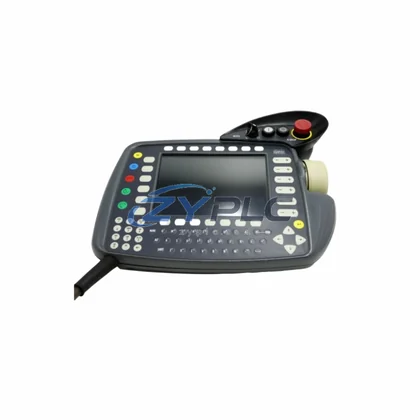
At the human-machine interface layer, the KUKA smartPAD or KCP2 pendant provides the operator with real-time axis status, motor temperature readings, encoder fault codes, and torque utilization data — all sourced directly from the 00-197-799 motor’s embedded diagnostics. This transparency allows maintenance engineers to identify bearing wear, winding insulation degradation, or resolver drift before they escalate into unplanned downtime events. Combined with KUKA WorkVisual software for offline programming and axis configuration, the system supports rapid commissioning and parameter backup — critical for multi-robot production lines where configuration consistency across cells is a maintenance priority.
For system integrators managing spare parts inventory across multiple KR C4 installations, the 00-197-799 is a strategically important stocking unit. Its compatibility with the KR 60, KR 120, KR 150, and KR 210 robot families means that a single motor variant can serve as a cross-platform replacement across a broad installed base. This reduces the number of unique SKUs that must be held in the maintenance store, simplifies procurement workflows, and shortens mean time to repair (MTTR) when axis failures occur during production shifts.
All units supplied by ZYPLC are tested for encoder signal integrity, winding resistance balance, and insulation resistance prior to dispatch. Each motor ships with a warranty terms confirmed during quotation covering manufacturing defects and functional failures under normal operating conditions, providing procurement teams and plant engineers with the assurance needed to approve the purchase of refurbished or surplus industrial servo components for critical production environments.
Product Specification Table
| Parameter |
Specification |
| KUKA Part Number |
00-197-799 |
| Cross-Reference SKU |
1FK7105-5AY81-1SH3-Z S11 |
| Brand |
KUKA / Siemens OEM |
| Series |
KR C4 Architecture |
| Rated Power Output |
8.3 kW |
| Motor Type |
Synchronous AC Servo Motor |
| Feedback System |
Resolver / Incremental Encoder |
| System Role |
Axis Drive Unit — KR C4 Robotic Cell |
| Compatible Controllers |
KRC4, KRC4 compact, KRC4 smallsize |
| Communication Interface |
EtherCAT / PROFINET (via KSP axis module) |
| Mounting Configuration |
Flange-mount, IEC standard shaft |
| Protection Rating |
IP65 (standard) |
| Cooling Method |
Natural convection / forced air (application-dependent) |
| Operating Temperature |
0°C to +40°C ambient |
| Country of Origin |
Germany |
| Warranty |
warranty terms confirmed during quotation (ZYPLC) |
| system integration |
Full KR C4 cabinet and axis module compatibility |
System Compatibility Notes
The 00-197-799 servo motor achieves its full performance potential only when deployed within a correctly specified KR C4 system architecture. The following components represent the primary coordination partners in a typical installation:
- KUKA KPP 600-20 — Servo Pack power unit providing DC bus voltage to all axis drives in the cabinet.
- KUKA KSP 600-3×40 — Axis controller module managing torque and velocity loops for the 00-197-799 motor axis.
- KUKA KPS 600-20 — Primary power supply module feeding the shared DC bus with regenerative recovery capability.
- KUKA CCU (Cabinet Control Unit) — Central communication hub synchronizing EtherCAT motion commands across all servo axes.
- KUKA KRC4 Controller CPU — Master motion planner executing robot programs and interpolating axis trajectories in real time.
- KUKA smartPAD / KCP2 Teach Pendant — HMI device providing axis diagnostics, motor status, and manual jogging capability.
- Siemens 1FK7 Series Motors (adjacent axes) — Sibling motor units sharing the same DC bus and axis module platform for multi-axis coordination.
- KUKA KEB Frequency Inverter — Auxiliary drive component managing peripheral actuators within the same control cabinet.
- KUKA RDC (Resolver Digital Converter) — Signal conditioning board converting resolver feedback from the 00-197-799 into digital position data for the KSP module.
- KUKA MFC3 / DSE-IBS Communication Board — Fieldbus interface card enabling PROFIBUS or PROFINET connectivity between the KRC4 and plant-level SCADA or DCS systems.
This coordinated architecture ensures that the 00-197-799 motor operates within a fully deterministic control loop, with no signal latency, no protocol mismatch, and no power quality degradation that could compromise axis repeatability or robot path accuracy.
Industrial Application Notes
The KUKA 00-197-799 servo motor finds application across a wide range of industrial sectors where the KR C4 platform is the preferred robotic control standard:
Automotive Manufacturing: In body-in-white welding lines and assembly stations, the 00-197-799 drives articulated robot axes performing spot welding, sealing, and component handling at cycle times below 5 seconds. Its high torque density and thermal stability allow sustained operation across multi-shift production schedules without axis drift or positional error accumulation.
Electronics and Semiconductor Assembly: In precision pick-and-place and PCB handling applications, the motor’s low cogging torque and high encoder resolution support sub-millimeter positioning accuracy, enabling reliable component placement on densely populated circuit boards.
Petrochemical and Process Industries: In hazardous area robotic inspection and valve actuation systems, the IP65-rated motor body and sealed connector interface allow deployment in environments with airborne particulates, moisture ingress, and chemical vapor exposure — provided the overall system is rated for the zone classification.
Metal Fabrication and Laser Cutting: In robotic laser cutting and plasma welding cells, the 8.3 kW power rating supports the high-inertia load profiles generated by heavy cutting head assemblies, maintaining path accuracy at elevated feed rates.
Food and Beverage Packaging: In high-speed case packing and palletizing lines, the motor’s dynamic response and regenerative braking capability reduce cycle time and energy consumption simultaneously, supporting sustainability targets without sacrificing throughput.
Mining and Mineral Processing: In remote robotic sampling and material handling systems, the motor’s robust mechanical construction and wide operating temperature range support reliable operation in dusty, vibration-intensive environments where maintenance access is infrequent.
Product Compatibility FAQ
Q1: Is the KUKA 00-197-799 directly compatible with all KR C4 cabinet variants, including the KRC4 compact and KRC4 smallsize?
A: Yes. The 00-197-799 / 1FK7105-5AY81-1SH3-Z motor is compatible with the full KR C4 controller family, including the standard KRC4, KRC4 compact, and KRC4 smallsize variants, provided the corresponding KSP axis module is correctly rated for the motor’s power and current requirements. System integrators should verify the KSP module firmware version against the KUKA compatibility matrix prior to installation to ensure full system integration between the motor and the axis controller.
Q2: Can this motor be installed as a direct replacement on an existing KR C4 robot without re-parameterization of the axis controller?
A: In most cases, yes — provided the replacement motor carries the same KUKA part number (00-197-799) and the same Siemens cross-reference (1FK7105-5AY81-1SH3-Z S11). The KRC4 controller stores axis motor data in the machine data file (MDI), and if the motor parameters are identical, the controller will recognize the replacement unit without requiring a full re-commissioning cycle. However, KUKA recommends performing a mastering (zero-point calibration) procedure after any motor replacement to restore absolute position accuracy. ZYPLC’s technical team can provide commissioning guidance as part of the warranty terms confirmed during quotation support package.
Q3: What is covered under the warranty terms confirmed during quotation, and how does ZYPLC handle warranty claims for this motor?
A: The warranty terms confirmed during quotation covers all manufacturing defects, winding failures, encoder or resolver malfunctions, and bearing failures that occur under normal operating conditions within 12 months of the dispatch date. It does not cover damage resulting from incorrect installation, overvoltage events, mechanical overload beyond the motor’s rated torque, or unauthorized disassembly. To initiate a warranty claim, customers contact ZYPLC at plc.sales@zyplc.com or +86 19859288691 with the order reference and a description of the fault. ZYPLC will arrange return logistics and either repair or replace the unit within an agreed lead time, minimizing production downtime for the customer.