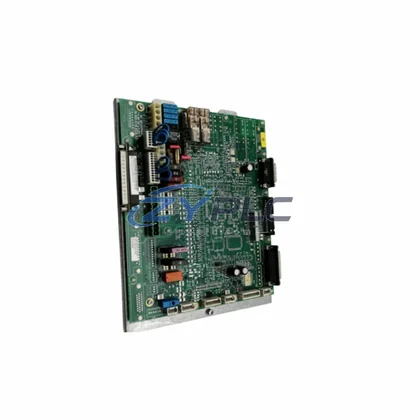
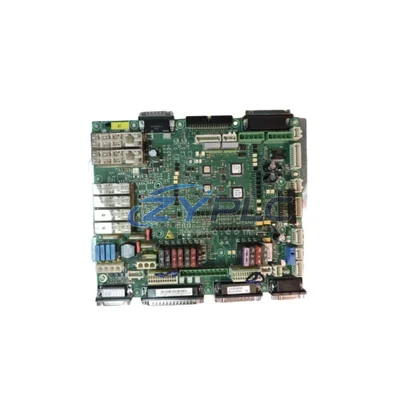
KUKA ESC-PLATINE Safety Controller for KRC Automation
In modern industrial automation environments, energy efficiency is no longer a secondary consideration — it is a core performance metric. The KUKA ESC-PLATINE safety controller board is engineered to serve as the central safety and maintenance planning node within KUKA KRC1 and KRC2 robot controller systems. By precisely governing power distribution, monitoring fault states, and enabling rapid safe-stop sequences, the ESC-PLATINE directly reduces unnecessary energy draw during idle, fault, and transition states — contributing measurably to lower per-cycle operating load across robotic production lines.
Unlike generic safety boards, the ESC-PLATINE is purpose-built for KUKA’s KRC architecture, ensuring seamless integration with the controller’s internal bus structure, drive communication layers, and safety logic. This tight integration eliminates the energy losses associated with signal conversion, protocol bridging, or compatibility shims — every watt is directed where it is needed.
Product Specification Table
| Parameter |
Specification |
| Compatible Systems |
KUKA KRC1, KRC2 |
| Operating Voltage |
24 VDC (internal bus) |
| Standby Power Reduction |
Enables safe-stop E-Stop sequences to cut drive power during idle |
| Operational Efficiency |
Optimized for continuous-duty industrial robot cycles |
| Application Environment |
Automotive, metal fabrication, logistics, general manufacturing |
| Energy Saving Value |
Reduces unnecessary servo energization during fault/idle states |
| Warranty |
warranty terms confirmed during quotation — all units shipped after full functional testing |
| Stock Status |
Availability confirmed by RFQ, tested, shipment arranged after confirmation |
System Compatibility and Application
The ESC-PLATINE does not operate in isolation. Its maintenance planning impact is amplified when deployed within a well-configured KUKA KRC system. The KPS 600 power supply module works in tandem with the ESC-PLATINE to regulate incoming AC power and distribute conditioned DC voltage to the controller’s logic and safety layers — any instability caught by the ESC-PLATINE triggers a coordinated shutdown that protects both the KPP 600 drive power pack and the connected servo axes.
On the drive side, the KSP 600-3×40 servo power modules receive enable/disable signals routed through the ESC-PLATINE’s safety relay logic. When the safety board detects an out-of-tolerance condition, it de-energizes the KSP modules within milliseconds, preventing the thermal and electrical stress that shortens drive lifespan and wastes energy through heat dissipation. This coordinated response between the ESC-PLATINE and the KSP 600 series is a key factor in extending mean time between failures (MTBF) on high-duty-cycle lines.
The RDC (Resolver-Digital Converter) board, responsible for translating motor resolver signals into positional data, depends on stable safety logic from the ESC-PLATINE to maintain accurate encoder feedback loops. Corrupted feedback caused by safety board faults leads to overcurrent events and wasted regenerative braking energy — a problem the ESC-PLATINE is specifically designed to prevent.
At the system intelligence layer, the CCU (Cabinet Control Unit) coordinates high-level robot logic and communicates fault states to the ESC-PLATINE. When the CCU identifies a process anomaly — such as a missed weld cycle or a conveyor timing deviation — the ESC-PLATINE executes the appropriate safe-state transition, ensuring the robot does not continue consuming drive energy in an unproductive state.
For I/O-intensive applications, the SIB (Safety Interface Board) extends the ESC-PLATINE’s safety domain to external devices such as light curtains, safety mats, and emergency stop buttons distributed across the production cell. This integration ensures that peripheral safety events are handled with the same maintenance-focused logic as internal controller faults — no unnecessary axis re-energization occurs until the safety chain is fully re-validated.
In multi-robot cells or lines using KUKA’s DeviceNet or PROFIBUS communication modules, the ESC-PLATINE’s fault isolation capability prevents a single robot’s safety event from cascading energy disruptions across the network — each controller manages its own safe-state independently while maintaining communication integrity with the line PLC or SCADA system.
Maintenance and Replacement Notes
Consider a typical automotive body-in-white welding line running three shifts. Each KUKA KRC2 robot idles for an average of 8–12 minutes per shift during part loading, fixture changes, and quality inspection holds. Without a properly functioning ESC-PLATINE, the servo drives remain energized during these idle windows — consuming full standby current across all six axes. A correctly operating ESC-PLATINE enables the controller to enter a validated safe-stop state, cutting servo bus power while maintaining safety monitoring, reducing idle operating load by a measurable margin per robot per shift.
Beyond operational stability, the ESC-PLATINE’s role in predictive maintenance is equally significant. By logging safety relay activation counts and fault event sequences — data accessible through the KRC’s diagnostic interface — maintenance teams can identify degrading components before they cause unplanned downtime. A servo drive showing increasing fault frequency, for example, can be flagged for scheduled replacement during a planned maintenance window rather than causing an emergency line stop. This shift from reactive to predictive maintenance directly improves Overall Equipment Effectiveness (OEE) and reduces the energy cost of restart sequences, which are among the highest-consumption events in a robot’s operational cycle.
All ESC-PLATINE units supplied by ZYPLC are sourced from verified industrial channels, subjected to full functional testing prior to shipment, and covered by a warranty terms confirmed during quotation. Stock is maintained on-hand to support urgent replacement requirements, with same-day or next-day dispatch available for confirmed orders.
Product Sourcing FAQ
Q1: How does the ESC-PLATINE contribute to operational stability on a KRC2 robot?
The ESC-PLATINE manages the safety relay chain that controls servo drive energization. By enabling validated safe-stop states during idle and fault conditions, it prevents drives from consuming standby current unnecessarily — reducing unplanned downtime during non-productive periods without compromising safety compliance.
Q2: Is the ESC-PLATINE compatible with both KRC1 and KRC2 systems?
Yes. The ESC-PLATINE is designed for use across the KUKA KRC1 and KRC2 controller families. It interfaces directly with the internal safety bus and is compatible with the KPS 600, KPP 600, and KSP 600 series drive components standard to these platforms.
Q3: What is the recommended replacement procedure, and how long does it take?
Replacement typically involves powering down the controller, documenting existing wiring connections, swapping the board, and performing a safety function test sequence per KUKA’s commissioning guidelines. Most experienced technicians complete the process within 1–2 hours. ZYPLC can provide technical support guidance for the replacement process.
Q4: What does the warranty terms confirmed during quotation cover, and what testing is performed before shipment?
All units undergo functional testing that verifies safety relay operation, bus communication integrity, and power rail stability before dispatch. The warranty terms confirmed during quotation covers component failure under normal operating conditions. Units showing fault on arrival are replaced or refunded promptly — contact our team at plc.sales@zyplc.com to initiate a warranty claim.