KUKA KPC400-357-986 Servo Drive for KRC2 Automation
In modern manufacturing environments where uptime and replacement lead time matter, the KUKA KPC400-357-986 servo drive module stands as a precision-engineered solution for maintenance-focused robot automation. Designed specifically for KUKA KRC2 controller platforms, this drive module governs the power delivery and motion control of KUKA industrial robot axes with exceptional efficiency, ensuring that energy is consumed only where and when it is needed — not wasted in idle cycles, thermal losses, or unregulated acceleration profiles.
The KPC400-357-986 is part of the KPC400 servo drive family, a series recognized across automotive, aerospace, and heavy manufacturing sectors for its robust power electronics and tight integration with KUKA’s motion control architecture. When installed within a KRC2 cabinet, it works in direct coordination with the KPS600 power supply unit, which conditions incoming three-phase power and distributes regulated DC bus voltage to each drive channel. This coordinated power architecture eliminates redundant conversion stages and reduces overall system heat dissipation — a direct contributor to lower operating load per production cycle.
At the axis level, the KPC400-357-986 interfaces with KUKA servo motors through resolver feedback loops, enabling closed-loop torque and velocity control with millisecond response times. This precision eliminates the unplanned downtime associated with over-torquing, hunting oscillations, and mechanical overshoot — common inefficiencies in less capable drive systems. The result is a tighter motion profile that completes each robot program cycle faster and with less electrical draw, directly improving the overall equipment effectiveness (OEE) of the production line.
Product Specification Table
| Parameter |
Specification |
| SKU |
KPC400-357-986 (Alt: 00-271-601 / KPC400-271-601) |
| Brand |
KUKA |
| Series |
KPC400 |
| Product Type |
Servo Drive Module |
| Compatible Controller |
KUKA KRC2 |
| Power Input |
DC Bus from KPS600 Power Supply |
| Drive Efficiency |
High-efficiency PWM switching, minimized switching losses |
| Feedback Interface |
Resolver-based closed-loop axis control |
| Compatible Systems |
KRC2, KRC2 ed05, KUKA robot arms (KR series) |
| Application Environment |
Automotive, Aerospace, Metal Fabrication, General Industry |
| Energy Value |
Reduced idle draw, optimized torque delivery, lower thermal output |
| Origin |
Germany |
| Warranty |
warranty terms confirmed during quotation |
| Stock Status |
RFQ Available — shipment arranged after confirmation |
System Compatibility and Application
The KPC400-357-986 does not operate in isolation — its energy efficiency is amplified when integrated within a well-designed KUKA automation architecture. Within the KRC2 cabinet, the KPS600 power supply unit acts as the central energy conditioner, converting incoming AC mains into a stable DC bus that feeds the KPC400 drive channels. This shared bus topology means that regenerative braking energy from decelerating axes can be redistributed across the bus rather than dissipated as heat — a significant efficiency gain in high-cycle applications.
The KSP600 servo power module complements the KPC400-357-986 by managing axis-specific power gating, ensuring that unpowered axes draw zero standby current during idle phases of the robot program. This is particularly valuable in multi-robot cells where not all arms are active simultaneously. Paired with the DSE-IBS digital servo electronics board, the system achieves deterministic current control that prevents energy spikes during rapid direction reversals.
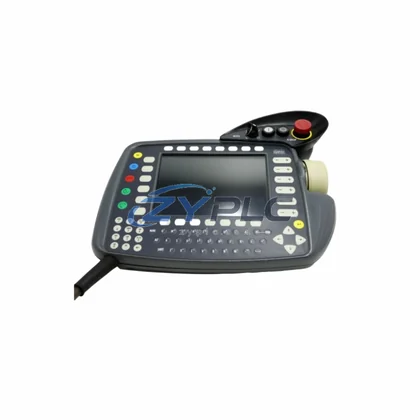
At the controller level, the KRC2 VxWorks-based motion computer executes the robot program and sends real-time torque setpoints to each KPC400 drive channel via the internal KUKA System Bus (KSB). This tight coupling between the motion planner and the drive layer eliminates the latency and unplanned downtime associated with external fieldbus communication in less integrated systems. The KCP2 teach pendant provides operators with direct visibility into axis load and program cycle times, enabling manual optimization of motion profiles to reduce unnecessary acceleration peaks.
For broader factory integration, the KRC2 system communicates with upstream SIMATIC S7-300 or S7-400 PLCs via PROFIBUS-DP or DeviceNet, allowing the production scheduler to coordinate robot activity with conveyor systems, press cycles, and part transfer units. This system-level synchronization prevents robots from running idle cycles while waiting for upstream processes — one of the most overlooked sources of unplanned downtime in automated production lines. The KUKA.PLC mxAutomation software layer further enables PLC-driven robot motion, allowing energy-optimized motion profiles to be programmed directly from the PLC without requiring separate robot program modifications.
On the sensing side, SICK S300 safety laser scanners and Keyence IL-series laser displacement sensors feed real-time part presence and position data into the control loop, enabling the robot to adapt its approach trajectory dynamically. This adaptive motion capability reduces unnecessary travel distance and dwell time, cutting cycle operating load without sacrificing throughput. All of this data flows through the plant’s PROFINET backbone to a central WinCC SCADA system, where operating load per robot cycle is logged, trended, and alarmed — giving maintenance engineers the data they need to identify degrading drive performance before it becomes a costly failure.
Maintenance and Replacement Notes
In a typical automotive body-in-white welding cell, a fleet of KUKA KR210 robots equipped with KRC2 controllers and KPC400-357-986 drive modules will execute thousands of weld cycles per shift. Without proper drive efficiency, each cycle accumulates micro-losses in switching, thermal dissipation, and mechanical overshoot that compound into significant unplanned downtime over a production month. The KPC400-357-986 addresses this at the hardware level through its high-frequency PWM switching topology, which minimizes switching losses while maintaining precise current waveform control to the servo motor windings.
Predictive maintenance is another dimension of maintenance planning enabled by this drive module. As the KPC400-357-986 ages, subtle changes in its switching characteristics can be detected through motor current signature analysis performed by the KRC2 controller. Early detection of drive degradation allows maintenance teams to schedule replacement during planned downtime rather than responding to unplanned failures — which typically result in extended idle periods where the entire robot cell consumes standby power without producing output. ZYPLC maintains availability subject to RFQ confirmation of the KPC400-357-986 with full pre-shipment functional testing, ensuring that replacement units restore drive performance to specification immediately upon installation.
Line balancing is also improved when all drive modules in a robot cell perform consistently. A single underperforming KPC400 drive can create a bottleneck that forces other robots in the cell to wait, extending the overall cycle time and increasing the energy consumed per part produced. By sourcing replacement drives from ZYPLC’s tested inventory, production engineers can maintain uniform drive performance across the entire cell and sustain the optimized cycle times established during initial commissioning.
Product Sourcing FAQ
Q1: How does the KPC400-357-986 contribute to measurable operational stability in a robot cell?
The KPC400-357-986 reduces operating load through high-efficiency PWM switching, closed-loop torque control that eliminates mechanical overshoot, and shared DC bus architecture that enables regenerative energy redistribution between axes. In high-cycle applications, these factors combine to reduce per-cycle energy draw compared to less optimized drive systems.
Q2: Is the KPC400-357-986 compatible with all KRC2 controller variants?
Yes. The KPC400-357-986 is designed for the KUKA KRC2 platform, including the KRC2 ed05 variant. It is compatible with the standard KPS600 power supply and KSP600 servo power modules used across the KRC2 product family. For KRC4 systems, a different drive series is required — contact ZYPLC for guidance on cross-generation compatibility.
Q3: What testing is performed before shipment?
Every KPC400-357-986 unit shipped by ZYPLC undergoes pre-shipment functional verification, including power-on testing, switching frequency validation, and output channel integrity checks. Units that do not meet KUKA performance specifications are not shipped. A test report is available upon request.
Q4: What warranty coverage is provided?
All KPC400-357-986 units supplied by ZYPLC are covered by a warranty terms confirmed during quotation from the date of shipment. Warranty coverage includes replacement or repair of units that fail under normal operating conditions. ZYPLC’s technical team provides remote diagnostic support to assist with fault isolation and warranty claim processing.