Mitsubishi MR-JE-70C: Industrial Data Link for MELSERVO-JE Smart Factory Systems
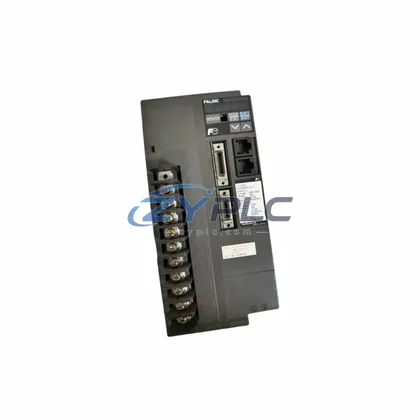
The Mitsubishi MR-JE-70C is a high-performance SSCNET III/H servo amplifier from the MELSERVO-JE series, engineered to serve as a precision industrial network interface between motion controllers, field devices, and upper-level automation systems. With its optical high-speed serial communication backbone, the MR-JE-70C eliminates the latency and noise vulnerabilities of conventional wiring, delivering deterministic real-time data exchange across the entire drive chain — from encoder feedback to PLC command execution.
In modern smart factory environments, servo amplifiers are no longer isolated motion devices. The MR-JE-70C functions as an active node in the industrial data flow, receiving position, speed, and torque commands from Mitsubishi MELSEC iQ-R and iQ-F series PLCs via SSCNET III/H, while simultaneously feeding back real-time status, alarm codes, and diagnostic data to SCADA platforms and HMI terminals. This bidirectional data transparency is the foundation of connected automation.
Compatibility & Integration Notes
| Parameter |
Specification |
| Communication Protocol |
SSCNET III/H (High-Speed Optical Serial) |
| Interface Type |
Optical Fiber (CN1A / CN1B) |
| Transmission Speed |
150 Mbps |
| Network Compatibility |
Mitsubishi MELSEC iQ-R, iQ-F, Q-Series Motion Controllers |
| System Application |
Multi-axis servo control, SCADA integration, HMI monitoring, smart factory automation |
| Rated Output |
750W (0.75 kW) |
| Input Voltage |
Single-phase / Three-phase 200–240V AC |
| Control Mode |
Position, Speed, Torque |
| Encoder Interface |
22-bit high-resolution encoder |
| Warranty |
Warranty and support terms confirmed before quote — Tested before shipment |
Connected Automation Data Flow
The MR-JE-70C sits at the intersection of motion control and industrial networking. In a typical smart factory deployment, a Mitsubishi MELSEC iQ-R series motion controller (such as the RD77MS4 or RD77MS16) acts as the SSCNET III/H master, issuing synchronized position commands to multiple MR-JE-70C amplifiers across a daisy-chained optical network. Each amplifier responds with encoder position data, current load ratio, and fault status — all within a single 0.444 ms communication cycle.
At the field level, the MR-JE-70C drives Mitsubishi HG-KN series servo motors, with 22-bit encoder resolution ensuring sub-micron positioning accuracy for precision assembly, CNC, and packaging applications. The amplifier’s real-time feedback loop integrates seamlessly with Mitsubishi GOT2000 series HMI terminals, where operators can monitor axis position, speed trend, and alarm history without interrupting production cycles.
For broader plant-level visibility, the MELSEC iQ-R PLC aggregates servo data from all MR-JE-70C nodes and forwards it upstream via CC-Link IE Field Network or Ethernet/IP to SCADA systems such as Mitsubishi MAPS4 or third-party platforms like Wonderware and Ignition. This architecture enables real-time OEE dashboards, predictive maintenance alerts, and remote diagnostics — all driven by the live data stream originating at the MR-JE-70C level.
In distributed I/O architectures, Mitsubishi MELSEC NZ2GF remote I/O modules share the same CC-Link IE backbone, allowing sensor signals — from proximity switches, photoelectric sensors, and pressure transducers — to be correlated with servo motion data in real time. When a torque overload is detected on the MR-JE-70C, the PLC can instantly cross-reference upstream sensor states to isolate the root cause before triggering an alarm on the GOT2000 HMI.
For applications requiring protocol bridging between SSCNET III/H motion networks and Modbus TCP or PROFINET-based SCADA layers, Mitsubishi MR-J4-GF series gateway amplifiers or third-party industrial protocol converters can be inserted at the network boundary, ensuring that MR-JE-70C drive data reaches every level of the automation pyramid — from field bus to cloud historian.
Variable frequency drives such as the Mitsubishi FR-E800 series inverters often operate in parallel with MR-JE-70C servo systems on the same production line, with both device types reporting to the same MELSEC iQ-R controller. This unified control architecture simplifies commissioning, reduces wiring complexity, and enables coordinated motion-speed profiles across servo and induction motor axes.
Solving Data Isolation in Industrial Sites
One of the most persistent challenges in industrial automation is data isolation — servo drives, PLCs, HMIs, and SCADA systems that cannot communicate effectively, leaving operators blind to real-time machine status and engineers unable to perform remote diagnostics. The MR-JE-70C directly addresses this problem through its SSCNET III/H optical communication architecture.
Unlike conventional analog or pulse-train servo interfaces, SSCNET III/H is a fully digital, deterministic protocol that carries not only motion commands but also rich diagnostic data — including alarm codes, load ratio, regenerative load, and encoder multi-turn data — across a single optical fiber link. This eliminates the need for separate diagnostic wiring and enables full drive transparency from the PLC level upward.
For sites transitioning from legacy servo systems with RS-232 or analog interfaces, the MR-JE-70C’s integration with Mitsubishi’s iQ-Works engineering environment allows engineers to configure, tune, and monitor all axes from a single software platform — dramatically reducing commissioning time and eliminating protocol translation errors. Parameter backup and restoration are performed over the network, removing the need for physical access to each drive cabinet.
Remote monitoring via SCADA becomes straightforward when MR-JE-70C data is aggregated at the MELSEC iQ-R level and published to OPC-UA or Ethernet/IP endpoints. Plant managers can track production throughput, servo health trends, and energy consumption from any networked terminal — enabling proactive maintenance scheduling and reducing unplanned downtime. For multi-site operations, edge gateways can forward anonymized drive telemetry to cloud analytics platforms, supporting factory-wide KPI benchmarking.
System expansion is equally seamless: the SSCNET III/H daisy-chain topology allows additional MR-JE-70C amplifiers to be added to an existing network without rewiring the controller, simply by extending the optical fiber chain and updating the axis count in the motion controller configuration. This scalability makes the MR-JE-70C an ideal foundation for phased smart factory upgrades.
Industrial Connectivity FAQ
Q1: What is the communication cycle time of the MR-JE-70C on SSCNET III/H?
The MR-JE-70C supports SSCNET III/H communication cycles as short as 0.444 ms, ensuring deterministic real-time motion control with minimal latency. This is critical for high-speed multi-axis synchronization in CNC, robotics, and precision assembly applications.
Q2: Is the MR-JE-70C compatible with third-party SCADA and HMI systems?
Yes. While the MR-JE-70C communicates natively via SSCNET III/H to Mitsubishi motion controllers, the upstream MELSEC iQ-R PLC can bridge drive data to Ethernet/IP, Modbus TCP, OPC-UA, and CC-Link IE Field Network — making it accessible to SCADA platforms such as Ignition, Wonderware, and Citect, as well as any OPC-UA compliant HMI.
Q3: How does the MR-JE-70C handle network faults and alarm recovery?
The MR-JE-70C features built-in alarm history logging and real-time fault broadcasting over SSCNET III/H. When a fault occurs, the amplifier immediately transmits an alarm code to the motion controller, which can trigger automated safety responses, operator alerts on the GOT2000 HMI, and SCADA alarm notifications — all without manual intervention. Remote parameter reset is supported via the iQ-Works software environment.
Q4: What warranty and pre-shipment testing does the MR-JE-70C come with?
Every MR-JE-70C supplied by ZYPLC carries a warranty and support terms confirmed before quote and undergoes functional testing prior to shipment, including communication link verification, encoder interface check, and power stage validation. Availability and shipment timing are confirmed by RFQ, with full traceability documentation provided upon request.