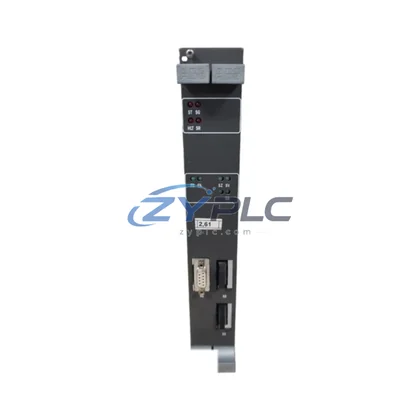
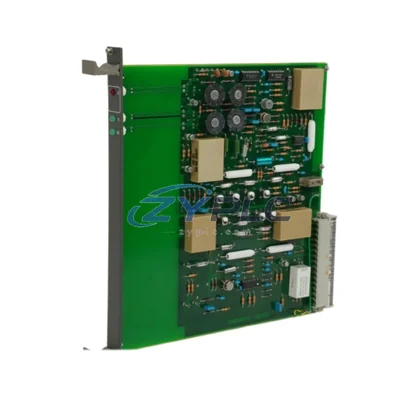
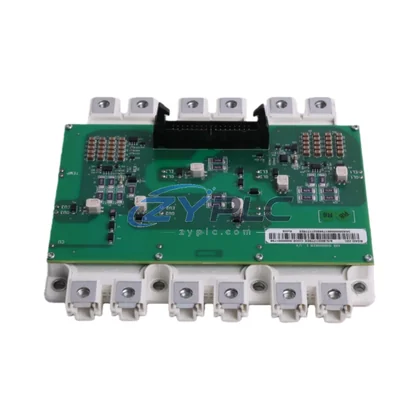
Mitsubishi RD77MS16 SSCNETIII/H Motion Module: Industrial Data Link for iQ-R Smart Factory Systems
The Mitsubishi RD77MS16 is a high-performance 16-axis Simple Motion Module engineered for the MELSEC iQ-R Series platform. Leveraging the SSCNETIII/H (Servo System Controller Network III/H) optical fiber communication protocol, this module delivers deterministic, high-speed motion data across the factory floor — from servo drives and encoder feedback signals all the way up to SCADA supervisory systems and MES data layers. In smart manufacturing environments where microsecond-level synchronization between axes determines product quality, the RD77MS16 serves as the critical communication backbone that unifies motion control, real-time diagnostics, and network transparency into a single, scalable architecture.
Designed to integrate seamlessly within Mitsubishi Electric’s iQ-R platform, the RD77MS16 mounts directly onto the iQ-R Series main base unit alongside CPU modules such as the R04CPU or R08CPU, sharing the high-speed backplane bus for zero-latency inter-module communication. This tight integration eliminates the protocol conversion overhead that typically introduces jitter in multi-axis coordinated motion, making the RD77MS16 ideal for applications in semiconductor handling, precision assembly, packaging lines, and CNC-adjacent automation cells.
Compatibility & Integration Notes
| Parameter |
Specification |
| Communication Protocol |
SSCNETIII/H (Optical Fiber, Full Duplex) |
| Interface Type |
Optical Fiber Connector (MR-J3BUS□M compatible) |
| Number of Controlled Axes |
Up to 16 axes per module |
| Communication Cycle |
0.222 ms / 0.444 ms / 0.888 ms (selectable) |
| Transmission Speed |
150 Mbps (SSCNETIII/H) |
| Network Compatibility |
MELSEC iQ-R Series, CC-Link IE Field, SSCNETIII/H servo network |
| System Application |
SCADA, MES, HMI, Multi-axis Servo Control, PLC Motion Programs |
| Positioning Methods |
Linear, Circular, Speed-Position, Position-Speed switching |
| Compatible Servo Amplifiers |
MR-J4 Series, MR-J5 Series (SSCNETIII/H compatible) |
| Warranty |
warranty terms confirmed during quotation — Tested & availability subject to RFQ confirmation |
Connected Automation Data Flow
In a fully connected iQ-R automation architecture, the RD77MS16 sits at the intersection of the motion layer and the network communication layer. Signal acquisition begins at the field device level: MR-J4-□A servo amplifiers connected via SSCNETIII/H optical fiber transmit real-time position, velocity, torque, and alarm data back to the RD77MS16 at sub-millisecond intervals. This data is immediately available to the iQ-R CPU module — for example, an R16CPU running motion SFC programs — which can execute interpolation calculations, cam profile switching, and synchronous control across all 16 axes simultaneously without any external gateway delay.
Moving up the data chain, the iQ-R CPU communicates with the plant network via CC-Link IE Field Network or CC-Link IE TSN modules such as the RJ71GF11-T2, enabling remote I/O nodes, distributed sensor clusters, and intelligent field devices to share process data with the motion controller in real time. This network layer feeds into GOT2000 Series HMI panels (e.g., GT2715-XTBA) where operators monitor axis positions, cycle counts, alarm histories, and production KPIs on high-resolution touchscreens. Simultaneously, the MR Configurator2 software running on an engineering workstation connects through the CPU’s USB or Ethernet port to perform servo gain tuning, vibration suppression setup, and drive diagnostics without interrupting production.
At the SCADA and MES integration level, the iQ-R platform’s built-in OPC UA server function (available via the RD81OPC96 OPC UA module) exposes RD77MS16 motion data — including axis status, positioning error, and program step — as standardized data objects accessible to Wonderware, Ignition, or GENESIS64 SCADA platforms. Edge computing nodes running MELIPC MI5122-VW industrial PCs can subscribe to this data stream for AI-based predictive maintenance, cycle time optimization, and digital twin synchronization. The result is a seamless, low-latency data pipeline from servo encoder to enterprise dashboard, with the RD77MS16 as the foundational motion communication node.
Solving Data Isolation in Industrial Sites
Many industrial facilities operate with legacy motion controllers, proprietary servo networks, and siloed SCADA systems that cannot exchange data without custom middleware. The RD77MS16, as part of the MELSEC iQ-R ecosystem, directly addresses these integration challenges through its multi-protocol architecture and open network compatibility.
Protocol Unification: By standardizing all servo communication on SSCNETIII/H optical fiber, the RD77MS16 eliminates the mixed-protocol environments where pulse-train, analog ±10V, and MECHATROLINK drives coexist on the same machine — each requiring separate tuning tools and diagnostic software. A single RD77MS16 module replaces multiple standalone motion controllers, reducing cabinet footprint and wiring complexity while providing a unified engineering environment through GX Works3.
Breaking Data Silos: Through CC-Link IE Field Network integration, the RD77MS16 connects motion data to remote I/O stations, vision systems, barcode readers, and weighing modules distributed across the production line. Data that was previously trapped inside individual machine controllers is now accessible plant-wide, enabling cross-machine synchronization, OEE calculation, and real-time production reporting without manual data collection.
Remote Monitoring and Diagnostics: The iQ-R platform’s built-in remote maintenance functions allow engineers to monitor RD77MS16 axis status, error codes, and program execution state from off-site locations via secure VPN connections. Alarm notifications can be routed through the CPU’s email send function or integrated with plant-wide alarm management systems, reducing mean time to repair (MTTR) and enabling predictive maintenance scheduling based on servo load trend data.
Production Line Transparency: With GOT2000 HMI panels displaying real-time motion data and GX Works3 providing online monitoring of motion programs, production supervisors gain full visibility into axis performance, positioning accuracy, and cycle time distribution — enabling data-driven decisions for line balancing, quality improvement, and capacity planning.
System Scalability: The modular iQ-R architecture allows additional RD77MS16 modules to be added to the same base unit as production requirements grow, scaling from 16 to 32 or more controlled axes without changing the CPU or network infrastructure. This investment protection makes the RD77MS16 a long-term platform choice for facilities planning phased automation expansion.
Industrial Connectivity FAQ
Q1: What is the communication latency of the RD77MS16 over SSCNETIII/H, and does it affect multi-axis synchronization?
The SSCNETIII/H protocol operates at 150 Mbps with a minimum communication cycle of 0.222 ms, providing deterministic, jitter-free data exchange between the RD77MS16 and connected MR-J4/MR-J5 servo amplifiers. This ultra-low latency ensures that all 16 axes receive position commands and return feedback data within the same communication cycle, guaranteeing microsecond-level synchronization for interpolated and electronic cam motion profiles.
Q2: Is the RD77MS16 compatible with existing SSCNETIII (non-H) servo amplifiers and networks?
The RD77MS16 supports SSCNETIII/H as its primary protocol. Backward compatibility with legacy SSCNETIII devices depends on the specific servo amplifier firmware version. In mixed environments, Mitsubishi Electric recommends using SSCNETIII/H-compatible amplifiers (MR-J4 Series and above) to take full advantage of the module’s 150 Mbps communication speed and advanced diagnostic functions. Consult the RD77MS16 user manual for detailed compatibility matrices.
Q3: How does the RD77MS16 integrate with SCADA and HMI systems for real-time monitoring?
The RD77MS16 exposes all motion data — axis positions, velocities, error codes, and program states — through the iQ-R CPU’s shared memory, which is accessible via CC-Link IE Field Network, Ethernet (SLMP protocol), and OPC UA interfaces. GOT2000 HMI panels connect directly to the CPU via GT Designer3-configured Ethernet or USB links, while SCADA platforms such as Ignition or Wonderware access motion data through the OPC UA server or SLMP Ethernet driver without requiring additional gateway hardware.
Q4: What does the warranty terms confirmed during quotation cover, and how is the RD77MS16 tested before shipment?
Every RD77MS16 unit supplied by ZYPLC undergoes pre-shipment functional verification including power-on self-test, communication interface check, and firmware version confirmation. The warranty terms confirmed during quotation covers hardware defects and communication failures under normal operating conditions. Units are shipped in anti-static packaging with inspection documentation. For warranty claims or technical support, contact our team directly at plc.sales@zyplc.com or +86 19859288691.