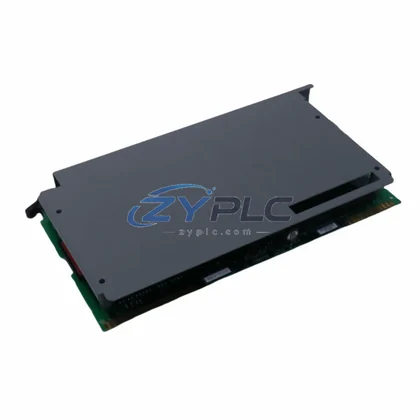
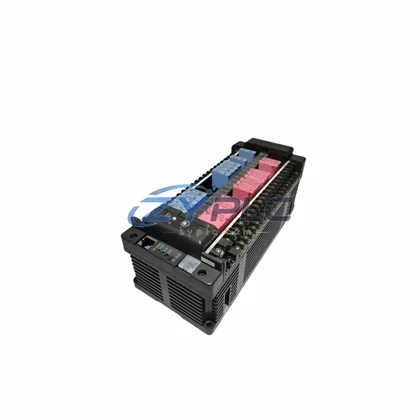
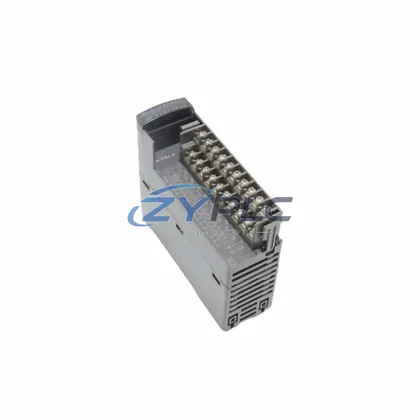
In modern industrial automation, the reliability of a control system is determined not by any single component, but by the coherence of every layer working in concert. The OMRON SRT2-ID16T-1 is a 16-point NPN transistor digital input module engineered specifically for the SRT2 CompoBus/S Remote I/O platform — a distributed I/O architecture that bridges field-level signal acquisition with upper-level PLC processing. Understanding where this module sits within a complete control system architecture is essential for engineers designing scalable, maintainable, and redundancy-capable automation solutions.
The SRT2-ID16T-1 operates at the I/O layer of a layered automation hierarchy. It collects discrete 24 VDC NPN signals from field devices — proximity sensors, limit switches, push buttons, and photoelectric sensors — and transmits that data upstream via the CompoBus/S serial communication bus to a master unit connected to the PLC CPU. This architecture eliminates the need for point-to-point wiring between the control cabinet and field devices, dramatically reducing installation complexity and long-term maintenance overhead.
Product Specification Table
| Parameter |
Specification |
| System Role |
CompoBus/S Remote I/O Slave — Digital Input |
| Input Points |
16 points (NPN transistor input) |
| Input Voltage |
24 VDC (20.4–26.4 VDC) |
| Input Current |
Approx. 6 mA per point |
| Communication Protocol |
CompoBus/S (High-speed mode: 750 kbps; Long-distance mode: 93.75 kbps) |
| Node Address Setting |
Rotary switch, 0–15 |
| Occupied Words |
1 input word (16 bits) |
| Power Supply |
Supplied from SRT2 bus connector |
| Installation |
DIN rail or direct panel mount |
| Operating Temperature |
0 to 55°C |
| Protection Rating |
IP20 |
| Dimensions (W×H×D) |
Approx. 31 × 90 × 65 mm |
| system integration |
Compatible with SRT2 master units on CS1, CJ1, and CJ2 PLC platforms |
| Warranty |
warranty terms confirmed during quotation — all units shipped by ZYPLC |
System Compatibility Notes
The SRT2-ID16T-1 does not function in isolation — its value is realized when it is deployed as part of a coherent, multi-layer control architecture. A typical SRT2-based distributed I/O system begins at the CPU layer, where a CJ1M-CPU13 or CJ2M-CPU31 serves as the central processing unit, executing ladder logic and managing I/O refresh cycles. The CPU communicates with the CompoBus/S master unit — such as the SRT2-series master — which coordinates all slave nodes on the bus, including the SRT2-ID16T-1.
On the output side, the SRT2-OD16T-1 (16-point NPN transistor output module) is the natural counterpart to the SRT2-ID16T-1, forming a complete I/O node pair for bidirectional field control. For applications requiring both input and output at a single node location, the SRT2-MD16T-1 mixed I/O module provides an efficient alternative, reducing the total node count and simplifying cabinet layout.
Power integrity is foundational to CompoBus/S reliability. The CJ1W-PA202 power supply unit provides stable 5 VDC and 24 VDC rails to the CPU backplane, while dedicated field power supplies feed the 24 VDC input circuits of the SRT2-ID16T-1. In larger systems, the CJ1W-ID211 and CJ1W-OD211 local I/O modules handle high-density signal processing at the main rack, while the SRT2 slaves manage distributed field points — a division of labor that optimizes both scan time and cable routing.
Network-layer integration is handled by communication modules such as the CJ1W-SCU21-V1 serial communication unit or the CJ1W-CLK21-V1 Controller Link unit, enabling the PLC to exchange data with SCADA systems, historian servers, or peer PLCs in a supervisory network. At the human-machine interface layer, an NS8-TV00-V2 or NS12-TS01B-V2 HMI panel provides operators with real-time visibility into the status of all 16 input channels monitored by the SRT2-ID16T-1, supporting alarm management and process diagnostics.
For applications requiring output-side relay isolation, the SRT2-ROC16 relay output module can be paired within the same CompoBus/S segment, providing dry-contact outputs for motor starters, solenoid valves, and safety interlocks. This combination of input, output, and relay modules within a single CompoBus/S network creates a fully coordinated field I/O layer that is both scalable and maintainable.
Industrial Application Notes
The SRT2-ID16T-1 is deployed across a wide range of industrial sectors where distributed signal acquisition is critical to process integrity.
In discrete manufacturing and packaging lines, the module collects position feedback from pneumatic cylinders, part-present sensors, and conveyor limit switches, feeding real-time data to the PLC for sequence control and fault detection. Its compact form factor and DIN rail mounting make it ideal for distributed junction boxes along production lines.
In power distribution and electrical substation automation, the SRT2-ID16T-1 monitors breaker status, relay trip signals, and interlock conditions. The CompoBus/S protocol’s deterministic communication timing ensures that critical status changes are captured within the PLC scan cycle without latency ambiguity.
In water treatment and municipal utilities, the module interfaces with level switches, flow switches, and pump run-feedback contacts distributed across pump stations and filtration banks. The ability to extend CompoBus/S up to 200 meters in long-distance mode allows a single master to serve multiple field panels without repeaters.
In petrochemical and process industries, the SRT2-ID16T-1 is used in conjunction with safety relay modules and emergency stop circuits, providing the PLC with discrete status inputs from pressure switches, temperature switches, and valve position indicators. Its NPN input compatibility aligns with the sourcing output convention common in Asian industrial sensor ecosystems.
In mining and metallurgy, where environmental conditions are demanding, the module’s wide operating temperature range and robust terminal block connections support reliable operation in dusty, vibration-prone environments when installed in appropriately rated enclosures.
Product Compatibility FAQ
Q1: How many SRT2-ID16T-1 modules can be connected to a single CompoBus/S master, and what is the maximum system I/O capacity?
A CompoBus/S master supports up to 16 slave nodes in standard configuration, with each node occupying one input or output word. A system using exclusively SRT2-ID16T-1 modules can therefore monitor up to 256 discrete input points (16 nodes × 16 points) from a single master unit. For larger systems, multiple CompoBus/S masters can be installed in the same CJ1 or CJ2 PLC rack, each managing an independent bus segment, effectively multiplying total I/O capacity while maintaining deterministic communication performance.
Q2: Is the SRT2-ID16T-1 compatible with both CS1 and CJ1/CJ2 PLC platforms, and are there any firmware or master unit version requirements?
Yes, the SRT2-ID16T-1 is compatible with CompoBus/S master units designed for both the CS1 and CJ1/CJ2 platforms. The key requirement is that the master unit supports the SRT2 slave series — confirmed by checking the master unit’s compatible slave list in the OMRON CompoBus/S system manual. No firmware update is typically required for the slave module itself, as the SRT2-ID16T-1 operates as a passive node whose behavior is governed by the master’s configuration. Node address assignment via the rotary switch must be unique within each bus segment to avoid address conflicts.
Q3: What does the warranty terms confirmed during quotation cover, and how does ZYPLC support long-term maintenance and spare parts availability?
All SRT2-ID16T-1 units shipped by ZYPLC are covered by a warranty terms confirmed during quotation against manufacturing defects and functional failures under normal operating conditions. The warranty covers module replacement or repair at no additional cost within the warranty period. For long-term maintenance planning, ZYPLC supports RFQ sourcing for SRT2-series modules to support ongoing spare parts requirements, minimizing the risk of extended downtime due to component unavailability. Engineers are encouraged to contact ZYPLC at plc.sales@zyplc.com or +86 19859288691 to discuss volume procurement, lead times, and system-level sourcing strategies for complete SRT2 architecture builds.