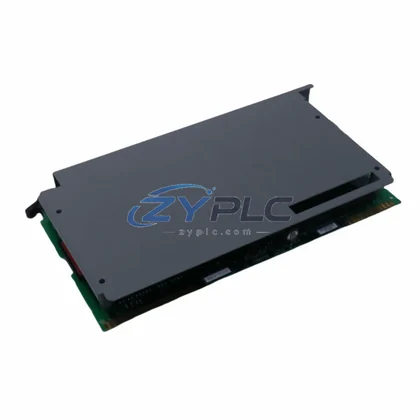
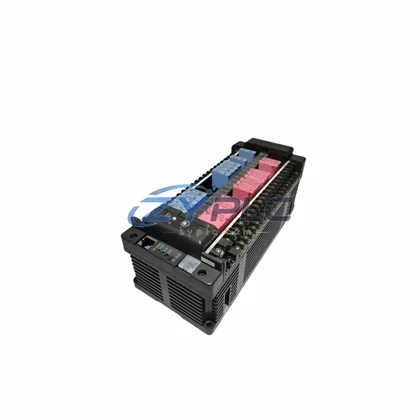
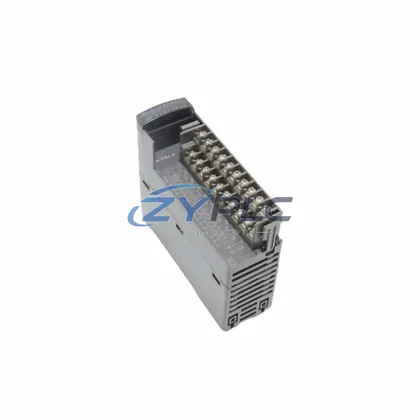
Omron SRT2-MD16T-1 Mixed I/O Module for SRT2
In modern industrial automation, the reliability and scalability of a control system depend not on any single component, but on the coherent integration of every layer — from the CPU and power supply down to the field-level I/O terminals. The Omron SRT2-MD16T-1 is a 16-point mixed digital I/O module designed specifically for the SRT2 series of CompoBus/S remote terminal systems. With 8 digital inputs and 8 transistor outputs (NPN sink type) consolidated into a single compact unit, this module plays a critical role in distributed I/O architectures where panel space, wiring efficiency, and communication determinism are all engineering priorities.
The SRT2-MD16T-1 connects to the CompoBus/S network — Omron’s high-speed serial bus protocol — enabling the host PLC to scan field signals at cycle times as low as 0.5 ms per node. This level of responsiveness is essential in applications such as packaging lines, conveyor sorting systems, and process control panels where input latency directly affects throughput and product quality. By consolidating both input and output functions into a single node, the SRT2-MD16T-1 reduces the total node count on the CompoBus/S segment, simplifying network topology and lowering the risk of communication bottlenecks.
Product Specification Table
| Parameter |
Specification |
| System Role |
CompoBus/S Remote Mixed I/O Terminal |
| Total I/O Points |
16 (8 Inputs + 8 Transistor Outputs) |
| Output Type |
NPN Open Collector (Sink) |
| Input Voltage |
24 VDC (±10%) |
| Output Current |
0.5 A per point, 2.0 A total |
| Communication Protocol |
CompoBus/S (High-Speed Mode) |
| Node Address Setting |
Rotary Switch (0–15) |
| Baud Rate |
750 kbps (High-Speed Mode) |
| Transmission Distance |
Up to 100 m (High-Speed), 500 m (Long-Distance) |
| Mounting |
DIN Rail or Direct Panel Mount |
| Operating Temperature |
0°C to 55°C |
| Protection Rating |
IP20 |
| Country of Origin |
Japan |
| Warranty |
warranty terms confirmed during quotation |
System Compatibility Notes
The SRT2-MD16T-1 does not operate in isolation — its value is realized within a fully coordinated control architecture. At the controller level, Omron CPUs such as the CJ2M-CPU31 or CJ1M-CPU21 serve as the master PLC, executing the ladder logic that governs all downstream I/O behavior. The CompoBus/S master unit — typically the CJ1W-SRM21 or CS1W-SRM21 — is mounted on the CPU backplane and manages all remote terminal communications, including the SRT2-MD16T-1 nodes distributed across the machine or panel.
Power integrity across the system is maintained by Omron power supply units such as the PA205R or PD025, which provide stable 24 VDC rails to both the CPU rack and the remote terminal segments. Voltage fluctuations at the power layer directly affect I/O signal reliability, making proper power supply selection a prerequisite for stable CompoBus/S communication.
For applications requiring dedicated input or output expansion beyond the mixed I/O capacity of the SRT2-MD16T-1, the SRT2-ID16T-1 (16-point input terminal) and SRT2-OD16T-1 (16-point NPN output terminal) can be added to the same CompoBus/S segment. This modular approach allows engineers to tailor the I/O mix to the exact signal requirements of each machine zone without over-provisioning hardware.
At the network layer, the CompoBus/S segment carrying the SRT2-MD16T-1 can be integrated into a broader DeviceNet or EtherNet/IP architecture using Omron gateway units such as the CJ1W-DRM21 DeviceNet master or the NX-EIC202 EtherNet/IP coupler, enabling seamless data exchange between field-level I/O and supervisory SCADA or MES systems. Wiring between the SRT2-MD16T-1 and field devices is simplified using Omron XW2Z-100J connector cables, which reduce termination errors and support rapid replacement during maintenance windows.
For operator interaction, Omron HMI panels such as the NS8-TV01B-V2 or NB7W-TW01B connect to the host CJ2M CPU via RS-232C or Ethernet, providing real-time visualization of I/O states, alarm management, and recipe control — all of which depend on the accurate and timely signal data delivered by the SRT2-MD16T-1 at the field level.
Industrial Application Notes
The SRT2-MD16T-1 is deployed across a wide range of industrial sectors where distributed I/O and deterministic communication are non-negotiable. In automotive assembly lines, the module handles proximity sensor inputs and solenoid valve outputs simultaneously, reducing the number of remote terminal nodes required per station. In food and beverage packaging, its compact form factor and DIN rail mounting allow integration into space-constrained control panels without sacrificing I/O density.
In water treatment and utilities, the SRT2-MD16T-1 is used in pump control panels where digital status signals from level switches and flow sensors must be processed alongside discrete output commands to motor starters and valve actuators. The module’s warranty terms confirmed during quotation and Omron’s established supply chain make it a dependable choice for infrastructure projects with long operational lifespans and strict maintenance schedules.
In petrochemical and process industries, the module’s NPN transistor outputs are compatible with standard 24 VDC actuator interfaces, and its CompoBus/S communication ensures that field signal updates reach the host PLC within the required scan cycle — critical for interlock logic and safety-related control functions. For mining and metallurgy applications, the module’s operating temperature range and IP20 rating support deployment in electrical enclosures within harsh environments, provided appropriate cabinet-level protection is applied.
Product Compatibility FAQ
Q1: Is the SRT2-MD16T-1 compatible with both CJ-series and CS-series PLCs?
Yes. The SRT2-MD16T-1 communicates via the CompoBus/S protocol and is compatible with any Omron PLC that supports a CompoBus/S master unit, including the CJ1W-SRM21 for CJ-series racks and the CS1W-SRM21 for CS-series racks. The host CPU model does not directly affect terminal compatibility — only the master unit and network configuration matter.
Q2: Can the SRT2-MD16T-1 be used in a redundant control architecture?
The SRT2-MD16T-1 itself is a standard (non-redundant) remote terminal. However, it can be deployed within a system that uses a redundant CPU configuration — such as the CS1D series — where the CompoBus/S master unit handles failover at the controller level. For field-level redundancy, engineers typically deploy parallel I/O nodes on separate network segments with cross-monitoring logic in the PLC program.
Q3: What does the warranty terms confirmed during quotation cover, and what is the recommended maintenance interval?
The warranty terms confirmed during quotation covers manufacturing defects and component failures under normal operating conditions. For long-term maintenance, it is recommended to inspect terminal block connections and DIN rail mounting integrity annually, verify CompoBus/S node address settings after any panel modification, and maintain a spare SRT2-MD16T-1 unit on-site to minimize downtime during unplanned replacements. system integration of spare parts management into your CMMS system is strongly advised for facilities with multiple CompoBus/S segments.